
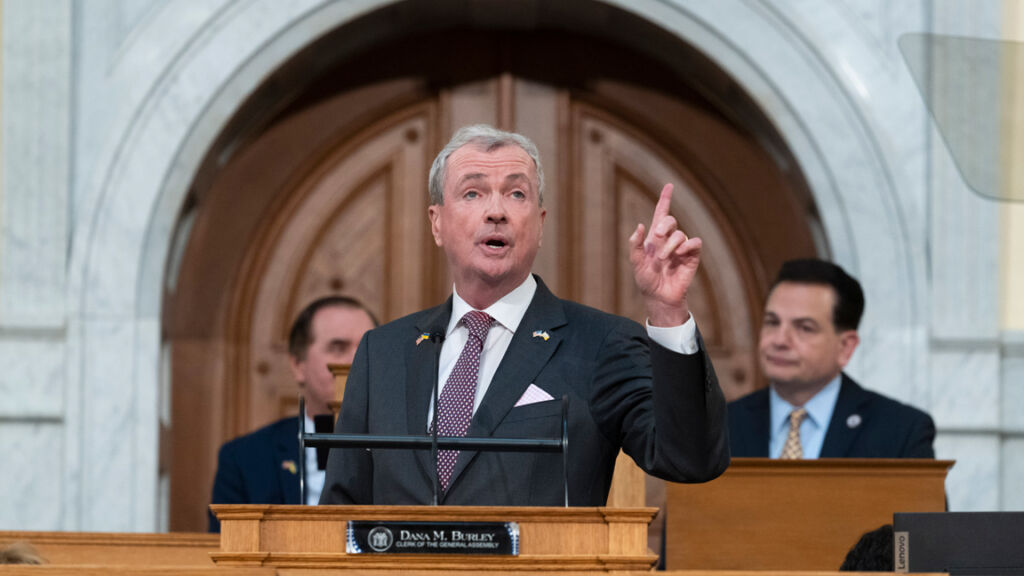
Gov. Phil Murphy proclaimed New Jersey is becoming a “state of opportunity,” where it’s easier to get a job and to benefit from big investments in infrastructure and public education, as he delivered an in-person State of the State address Tuesday.
Murphy, a second-term Democrat, highlighted a number of economic achievements, such as a long-running streak of private-sector job growth and several recent credit-rating upgrades, while portraying New Jersey as a state that is recovering well from the losses suffered during the worst years of the still-lingering COVID-19 pandemic.
Murphy also used his roughly 60-minute speech before a joint session of the Legislature inside the State House to unveil a handful of new policy goals and proposals.
Among them was a call to reform New Jersey’s outdated liquor license laws, something he said could create thousands of new jobs.
Murphy also said he will ask lawmakers when he proposes a new state budget next month to work with him to establish a new fund to reinvest in the boardwalks that play a key role in the state’s oceanfront tourism industry.
Among other topics, Murphy also detailed some advancements in health care and safety, including a recent reduction in the rate of car thefts, which has been an area of emphasis in recent months in response to a statewide uptick. He also highlighted preliminary figures that indicated a year-over-year reduction in drug-related deaths occurred last year and praised increasing access to naloxone, a lifesaving overdose treatment.
And on the issue of affordability, Murphy announced the extension of the deadline to apply for “Anchor” property-tax relief benefits, which will total as much as $1,500 for many homeowners when they go out later this year. Residents have until Feb. 28 to apply.
(More information about the Anchor program is available at https://nj.gov/ or by calling 1-888-238-1233.)
“This is money going right back into the pockets of roughly 2 million New Jersey middle-class and working homeowners, seniors and tenants — households in which well more than half of all of our residents live,” Murphy said.
GOP pushback
But not everyone who attended the ceremonial address shared Murphy’s generally sanguine version of the current state of affairs in New Jersey.
Among them were the leading Republicans in both the Assembly and Senate.
“We need to make New Jersey more affordable and, year after year, it’s become more expensive to live here,” said Assembly Minority leader John DiMaio (R-Warren).
Policy advocates for the state’s lowest-income residents also called for more aggressive action from the governor, including on prescription-drug prices, auto-insurance rates and other socioeconomic issues.
“We urge Gov. Murphy to reject tax cuts for corporations and return to championing the transformative reforms struggling New Jerseyans need to ensure economic security for their families and their communities,” said Dena Mottola Jaborska, executive director of New Jersey Citizen Action.
Meanwhile, despite the length of this year’s address, Murphy did not discuss, or fully address, several key issues and challenges that his administration is facing at the start of his sixth year in office.
Murphy also touted efforts to reduce firearm violence but failed to mention that a federal judge has just blocked much of the new state law designed to greatly limit where people can legally carry concealed guns.
For starters, COVID-19 — which is believed to have killed nearly 36,000 New Jersey residents since early 2020, according to state data — received just passing mention during Tuesday’s speech.
Murphy also highlighted efforts to improve maternal health outcomes in New Jersey — championed by his wife Tammy under the Nurture NJ campaign — as well as a need to better address mental health issues among students, but offered no other details on what would come next in these key areas.
He cheered the state’s work to become the East Coast leader in wind energy, with opportunities for thousands of jobs and cleaner power, once giant turbines are installed off Atlantic City.
But he did not discuss in detail other important climate-change initiatives under consideration, such as a proposal to phase out gasoline-powered vehicles and another to require building owners to eventually replace boilers that run on fossil fuels, an idea Republican lawmakers have labeled far too costly.
Murphy also touted efforts to reduce firearm violence — shootings were down 26% last year, he said — but failed to mention that a federal judge has just blocked much of the new state law designed to greatly limit where people can legally carry concealed guns.
And Murphy was completely silent on plans to replace the 110-year-old Edna Mahan Women’s Correctional Facility in Hunterdon County, plagued for decades by sexual abuse, assaults and, more recently, physical abuse of inmates by corrections officials. The governor pledged to close the facility, now under a federal monitor, some 19 months ago, but made no mention Tuesday of the facility or any potential for additional progress being made.
National politics
This year’s speech marked a return to normal of sorts after the last several had to be pre-recorded due to concerns about the pandemic.
It was also delivered against a backdrop of potential national ambitions as Murphy and many other Democratic politicians are waiting to see whether 80-year-old President Joe Biden decides to run for reelection. And adding to the political undertones were the upcoming legislative elections, which will see all 120 seats in the Legislature up for grabs in November.
 Credit: (Edwin J. Torres/NJ Governorâs Office
By focusing on things like boardwalks, liquor licenses and property-tax relief, Murphy signaled he is still very much engaged in state-level policy issues.
Yet he also repeatedly held New Jersey up as a national model in a number of key areas, including jobs and economic development. Moreover, he said tax breaks that are being offered to the entertainment industry are bearing fruit, and he suggested a focus on offshore wind development is delivering on both economic and environmental policy goals.
“It’s cool to be from New Jersey again,” Murphy said as the speech concluded. “It’s cool because we are once again leading in all the right things.”
‘We do believe the administration can — and should — be doing more to address affordability for New Jersey small businesses.’ — Michele Siekerka, New Jersey Business & Industry Association
For their part, state business groups credited Murphy for emphasizing a need to adapt economic-development incentives to a changing landscape that includes many companies employing workers who are no longer commuting to an office on a regular basis. And they also liked Murphy’s talk about infrastructure, including investments that will benefit rail commuters and “Main Street” business districts.
Still, the same groups called for even more emphasis on tax relief, noting businesses do not qualify for any of the $2 billion in funding that was set aside for the “Anchor” property-tax relief program in the latest fiscal year budget.
“We do believe the administration can — and should — be doing more to address affordability for New Jersey small businesses,” said Michele Siekerka, president and chief executive officer of the New Jersey Business & Industry Association.
Among other concerns, the Republicans leaders also called for the adoption of more affordability measures, including a call to link the state’s income-tax brackets to inflation. Meanwhile, they also faulted increased spending, including on legislative pet projects.
“The state of the state is not good,” said Senate Minority Leader Steve Oroho (R-Sussex).

