
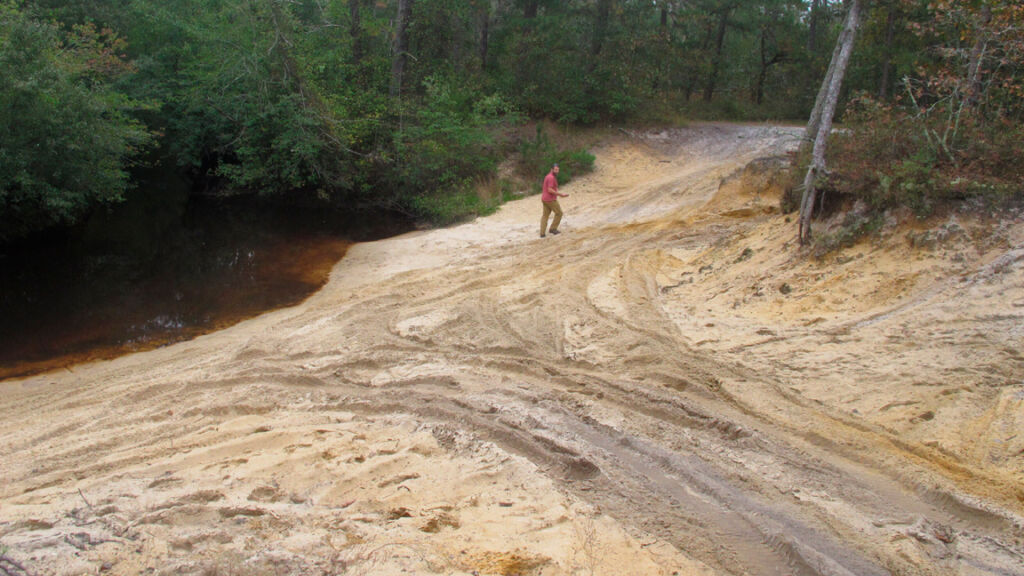
Officials are making their latest attempt to control the use of off-road vehicles on state property in the Pinelands with a view to resolving a long-running confrontation between drivers and nonmotorized users of the South Jersey forests.
The Department of Environmental Protection says it now plans to issue a public-access survey in coming weeks, and to follow that with public meetings this summer in an attempt to balance access to the region for both groups.
 Credit: (AP Photo/Wayne Parry)
The DEP said it has already begun discussions with stakeholders including the Pinelands Commission over how to manage off-road vehicles, which naturalists say continue to ignore existing restrictions and damage sensitive areas.
Talks will focus initially on Wharton State Forest, a 122,000-acre tract that attracts off-roaders from all over the mid-Atlantic states. Any agreement would become a template for other state lands in the region such as Brendan T. Byrne State Forest, another magnet for the drivers.
“It is critical that the state develop a plan to address off-road vehicle use and ensure the protection of sensitive forest ecosystems, while also holding accountable those responsible for damaging these resources,” DEP said in a statement last week. “Use of off-road vehicles is one of many pursuits people enjoy in the Pinelands, and can be done responsibly.”
Some drivers reject any restriction
Groups representing hikers, bird-watchers and other nonmotorized users have claimed for years that drivers of pickup trucks, all-terrain vehicles and dirt bikes go wherever they want in areas such as the Wharton tract, and have created a “wild west” culture that has no regard for other forest users.
Some drivers reject restrictions, and say they should be allowed to roam wherever they want on the public lands.
 Credit: (AP Photo/Wayne Parry)
Advocates for nature-based use of the forests have long accused the DEP of failing to state clearly where off-roaders can legally drive their vehicles, of ignoring damage to the region’s fragile ecology and of doing little to enforce current rules.
A recent report for the nonprofit Pinelands Preservation Alliance said off-roading is one of a number of threats to New Jersey’s park system as a whole, which it said is suffering from a 28% drop in funding since 2006.
Now, the DEP is making a new attempt to resolve the Pinelands problem, more than a year after Commissioner Shawn LaTourette promised in an interview with NJ Spotlight News to hold public meetings and seek a new agreement on use of state property in the Pinelands.
Permits for drivers?
The agency said it is considering issuing permits for drivers, modeled on a system used for anglers at Island Beach State Park. Permits would be issued for specific routes identified during the public meetings and in the public-access survey.
After it has collected public comments, DEP plans to publish a map that shows access to Wharton State Forest. The agency said it has already built physical barriers such as fences to protect sensitive habitat at sites in the forest including Carranza Road, Quaker Bridge Road, and White Horse Road.
In 2015, the agency released a “Motorized Access Plan” for Wharton State Forest but quickly withdrew it after a storm of protest by the off-road community.
Horner: ‘It is still the wild west. Sensitive areas are constantly being destroyed. They keep promising but they have not delivered anything since stating they would…’
In an attempt to enforce access rules, the Attorney General’s Office in 2021 increased fines for violators. First offenders driving their vehicles in off-limits areas now must pay $500, up from $250, rising to $1,000 for a second offense. If a violation results in damage or destruction of natural resources, an additional fine of five times the cost of repair can be imposed, the agency said.
The DEP didn’t say how many tickets have been issued under the new penalty system but added that park police and conservation police have conducted “sting” operations in popular off-roading areas.
Criticism of DEP
Advocates for restraints on off-roading in the Pinelands have long accused the DEP of failing to crack down on environmental destruction that results from monster trucks being driven through woods, creating deep ruts, and eroding sensitive areas like vernal ponds which have been badly damaged by spinning tires — a practice known as “mudding.” Despite the agency’s assurance last year that it was working on the problem, there has been no improvement on the ground, said Al Horner, a Pinelands photographer and longtime foe of off-roaders.
 Credit: (Jon Hurdle)
“It is still the wild west. Sensitive areas are constantly being destroyed. They keep promising but they have not delivered anything since stating they would, which is probably a year ago,” he said, referring to the DEP.
Horner said the closure of some wildlife management areas to prevent swimming in lakes is only effective until Sept. 6, and he predicted that the “wild men” who drive off-road vehicles will return to badly eroded areas like Cedar Lake in Williamstown as soon as the closure ends.
Recovery in some areas
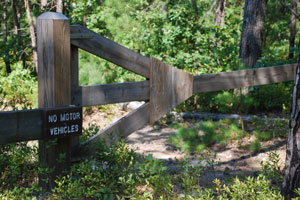
Still, some areas that were previously damaged by off-road drivers have been closed and are recovering. One is Jemima Mount, a hilltop in the Wharton tract that was deeply rutted by the vehicles but is now off-limits and blocked by gates built by off-road drivers. Many drivers in the off-road community deny that they damage the woods by driving. They have worked to protect areas such as Jemima Mount that were previously damaged by the vehicles.
 Credit: (Jon Hurdle)
DEP’s new efforts include working with the Pinelands Commission, a state agency that in 2017 published a map identifying legal and illegal off-road areas in Wharton State Forest. Commission spokesman Paul Leakan said the map was intended as a “baseline for future consultation” with the DEP. “We are actively coordinating with the NJDEP to address the problem and identify solutions,” he said.
Jason Howell, stewardship coordinator with the Pinelands Preservation Alliance, argued that enforcement of access rules has declined in recent years because of what he said was a hands-off policy by park police. And he accused DEP Commissioner LaTourette of failing to follow through on his promise of reform more than a year ago.
Howell said continuing damage to the Pinelands by off-road vehicles is part of a deterioration in the whole park system, and reflects a failure by state leaders.
“The people have made it clear that we need more accessible walking trails, more scenic viewing areas, more biking trails, and more swimming areas,” he said. “We want to prevent destructive uses like illegal dumping and illegal off-road vehicles that are causing vast harm to the park system and the people who use it.”
