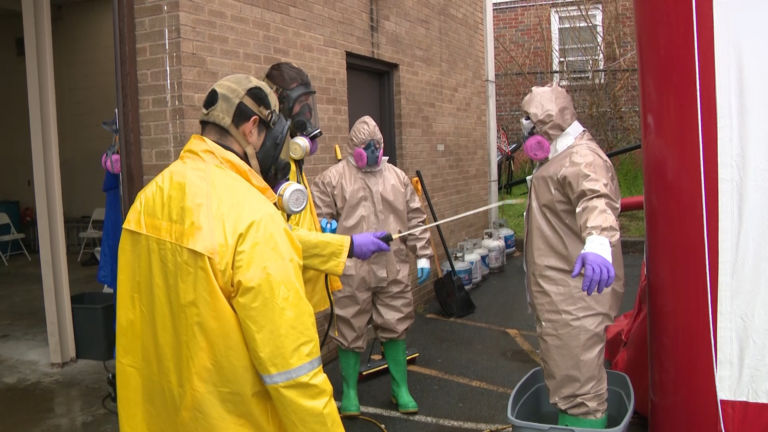
Credit: (AP Photo/Mel Evans)
When emergency responders transport a Medicaid member to a hospital or nursing home, they collect $58 for the ambulance run plus $1.50 a mile in New Jersey, regardless of the patient’s level of need or the cost of medications and other supplies used to stabilize them or keep them safe.
At this reimbursement rate — set by the state nearly three decades ago and now among the lowest nationwide — ambulance squads lose money on as many as half their daily outings, first responders said.
That could change under a proposal to boost the Medicaid payment to $200 for certain emergency ambulance runs, which advanced Monday in the Senate Health, Human Services and Senior Citizens Committee. Sponsors of the measure said the goal is to help emergency squads keep pace with rising costs and rebuild their workforce, which has been reduced through the COVID-19 pandemic.
“We are in crisis mode,” Jamie Wood, chief of the Lumberton Emergency Squad and a volunteer in Tuckerton, told lawmakers Monday. The cost of gas is nearly four times what it was in 1994 when the Medicaid rate was established and a stretcher is five times as much, she said. A new ambulance is nearly $300,000, almost double the cost then, she said.
“We are seeing an increase in critical patients requiring multiple interventions, increasing the demand for training on our staff (and) the cost of patient care. All the costs of goods have gone up,” Wood said. Other emergency responders would have traveled to Trenton to testify, she added, but there was no one to cover their shifts.
Basic life support
New Jersey’s Medicaid program covers some 2.1 million low-income residents and children at an annual cost of $16.4 billion in state and federal dollars. Last year the program spent $46.1 million on more than 295,000 emergency ambulance trips for nearly 139,000 members, according to the state Department of Human Services, which oversees Medicaid.
The $58 Medicaid reimbursement in place in New Jersey is for basic life support, or BLS, runs, which — depending on the community — are largely handled by municipal fire departments, hospital networks, private companies or hybrid paid and volunteer squads. Charges for advanced life support, or ALS, transport, which involves more advanced care and is overseen by hospitals in New Jersey, are billed as part of the provider’s overall tab for services, state officials said
The legislation, introduced in June by Burlington County senators Troy Singleton, a Democrat, and Jean Stanfield, a Republican, seeks to bring New Jersey’s Medicaid reimbursement rate closer in line with what’s paid in neighboring states. Rates range from range from $65.23 in Delaware to $293.90 in Connecticut, according to the bill, while Pennsylvania lawmakers are considering boosting the payment there to $325. Arizona’s Medicaid program pays the most, responders said, at $399 plus $9.50 per mile.
‘Agencies that provide service in large urban areas with higher volumes of Medicaid patients have to make up for the shortfall in revenue somehow.’ — Anthony Maneri, ambulance company president
The New Jersey bill (S-2946) calls for ambulance providers to collect $200 for basic life support transport of Medicaid patients with “unplanned urgent or life-threatening health conditions.” It would not alter the ALS transport or the current $1.50 per mile payment. An Assembly version with bipartisan backing was introduced in September and awaits a first hearing.
In their testimony Monday, emergency responders repeatedly stressed how the current Medicaid rate is inadequate. The average cost for a basic life support run today is nearly eight times the reimbursement, according to Greg Scott, an ambulance company owner and president of the Medical Transportation Association of New Jersey, which represents dozens of BLS squads.
Medicare pays much more
Scott said that Medicaid runs could make up anywhere from 5% to 50% of a squad’s business, depending on the community. Some patients are uninsured, meaning the crew has no one to bill, he said, and others have private insurance, which can pay hundreds of dollars for a basic run. Medicare, the federally funded insurance plan for elderly Americans, pays $450 for the same service, Scott said.
‘How can we help ensure that ambulances respond? Funding. Money can solve a lot of problems.’ — Toms River Council President Kevin Geoghegan, who owns an ambulance service
“We move everybody who needs to be moved, regardless of their ability to pay,” Scott said Monday. “And that’s why it’s critical to our industry, when there is a payer, it has to be a fair and reasonable payment to offset that,” he said.
Low reimbursement rates also cost communities, the responders told lawmakers, particularly poorer areas with high numbers of Medicaid members. Anthony Maneri, president of a South Jersey-based ambulance company, said struggling squads are less likely to carry costly medications or equipment that is not mandatory. They may have older ambulances than groups with more revenue, he said, and lower salaries for their emergency medical technicians, resulting in teams with less training and experience.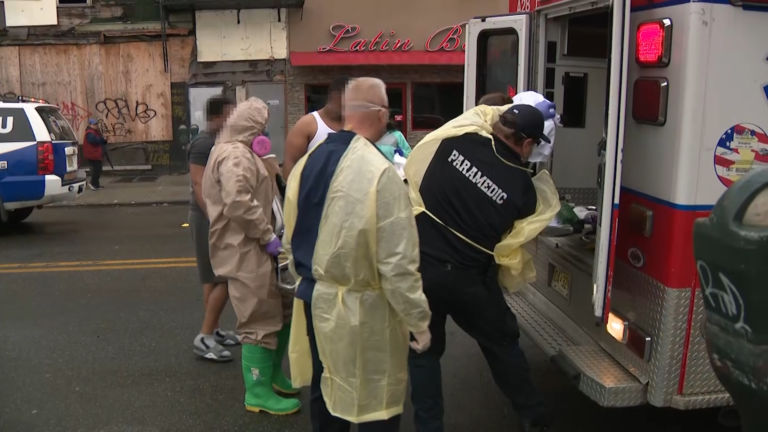
“Agencies that provide service in large urban areas with higher volumes of Medicaid patients have to make up for the shortfall in revenue somehow,” Maneri said, which often leads to heavier taxes. “This is negatively affecting communities with the greatest level of poverty,” he said.
Business groups and insurance companies often raise concerns about proposals to increase reimbursements for select medical services — particularly through state-established rates — since these increases are generally passed on to employers, workers and others through higher insurance premiums. But on Monday no organizations opposed the legislation to boost ambulance rates.
Need for upgrades
First responders also underscored how additional funding could help them restore some capacity, which has declined since the start of the pandemic. All-volunteer squads are becoming rare, they said, and paid staff are needed to keep communities safe. Ambulance services that aren’t township-run may not receive public funding, they added, leaving them more dependent on insurance reimbursements.
“No community is immune from a lack of volunteers for any community organization across the state and country, especially in your local first aid squad or EMS agency,” said Toms River Council President Kevin Geoghegan, who also owns an ambulance service and has worked as a longtime volunteer. “Some EMS agencies have simply closed, shifting that burden even more to neighboring towns and agencies,” he said.
For smaller squads, pay can be low and benefits almost nonexistent, Geoghegan said. “How can we help ensure that ambulances respond? Funding. Money can solve a lot of problems,” he said.