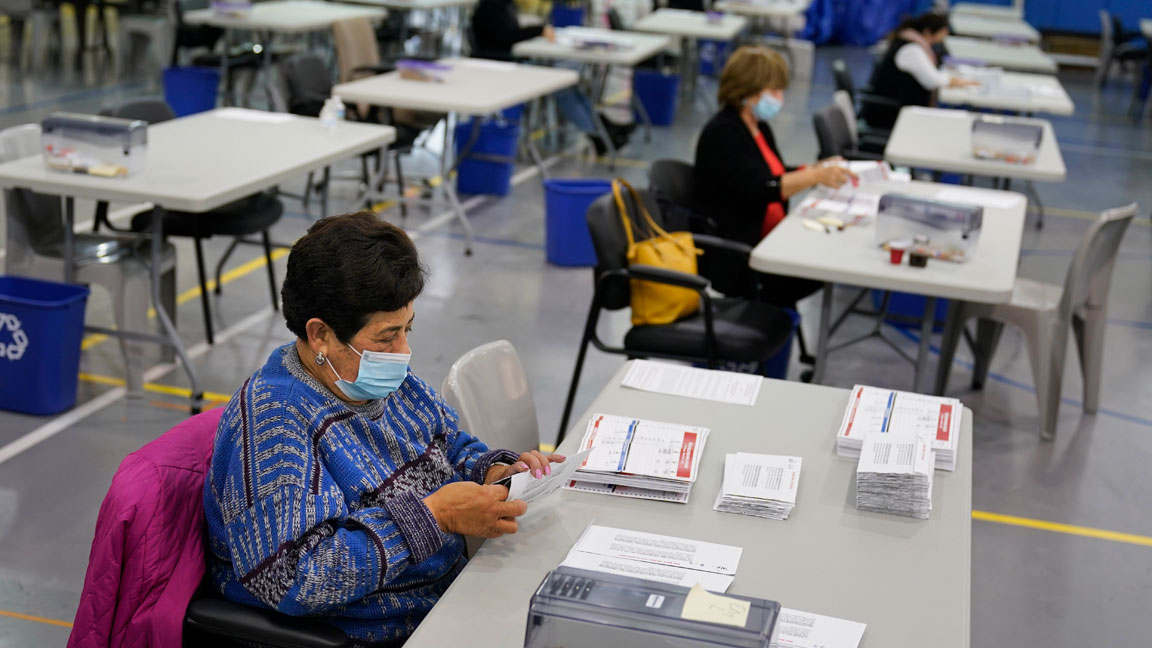
 Credit: (AP Photo/Seth Wenig)
For decades, news outlets have tried to call races as quickly as possible and the public got used to watching TV or, more recently, checking the internet to find out who won within hours after polls closed. But the popularity of mail-in balloting has made that impossible in some races.
It is likely that the winners in a number of close congressional contests, as well as county, municipal and school board races, will not be known on election night, and possibly not until several days later. Only those seats where there is a clear numerical winner may be considered decided hours after the polls close at 8 p.m. on Nov. 8.
In New Jersey, mail-in ballots will be counted if they are received up to six days after Election Day, provided they were postmarked by then. And the process allowing for a person to fix a problem with a ballot stretches through Nov. 19. Counties have sent close to 970,000 ballots to people so far. More than 411,000 of those have already been returned, but not all of those may be tallied by election night and thousands more may arrive later.
County officials still have leeway to determine when they count the ballots and how they report the results, not only of the overall tallies but of the different types of votes cast — mail, machine or early in-person. A law signed three months ago allows, but does not require, election officials to begin opening and processing mail-in ballots five days before Election Day. But they are not allowed to tally or disclose the votes; if they do, it’s a crime.
A survey of county clerks and election officials by NJ Spotlight News found that a number of counties have chosen not to process the mail-in ballots early and plan to wait until the polls open on Election Day to begin doing so.
Calls for standard processes
People have called for reforms to standardize the counting and reporting of results to provide greater consistency and transparency, as well as to dispel any doubts about the outcome. Lawmakers have not acted on those calls. As initially drafted, the law providing for the early counting of mail-in ballots would have required county clerks to update their websites in real time after polls closed with the number of ballots received and counted, as well as any remaining ballots. Lawmakers struck that provision on the hectic last day before their summer break.
“It was something that was clearly the intention, one of the big priorities for that voting package, but at the last minute it was taken out,” Henal Patel of the New Jersey Institute for Social Justice said of the reporting requirement. “I don’t know what happened. As I understand it, it is still a priority, something the Legislature still wants to do, but no, for this election, that’s not a requirement.”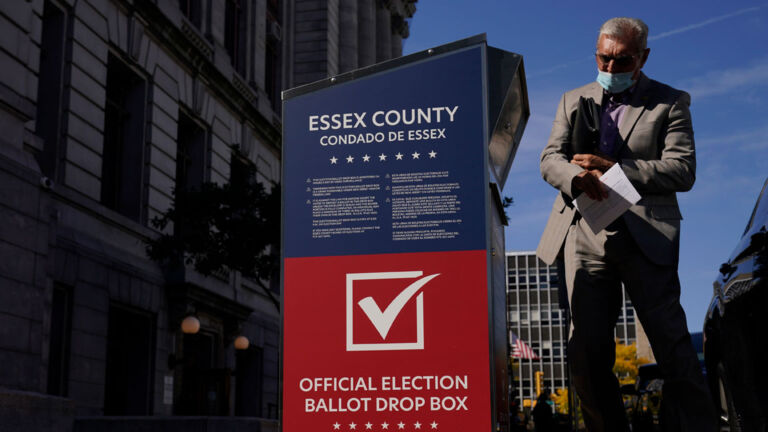
This means that in some counties it will be impossible for the public to easily tell how many, and what kinds of votes, have been reported and how many remain uncounted. That kind of uncertainty over the last two elections allowed some to contend the election results were illegitimate.
“It’s important that we have some consistency in reporting,” Patel said. “Counties don’t actually need a law to require them to do this. They could work with the secretary of state’s office to do this themselves. They do report results every election night. The issue is that they don’t do it consistently. Some counties do post all the early vote at one time. Some don’t. They do have the ability to do it.”
‘The new law allows boards of election to count votes five days prior to election day so we will likely have much more accurate numbers to report on election night.’ — Paula Sollami-Covello, Mercer County Clerk
On election night last year, for instance, Republican Jack Ciattarelli was leading Gov. Phil Murphy. Many people went to bed thinking Ciattarelli had won. But early returns from some counties, notably the state’s largest county, Bergen, did not include early mail-in votes. More Democrats vote by mail than Republicans, so when those votes were added to the tallies, Murphy retook the lead and he wound up winning by about 3% of the vote. People then spread conspiracy theories on social media, questioning the legitimacy of the election.
Getting results quickly … or right
While county officials are aware of the public’s desire to know as quickly as possible who won, they are more focused on doing a thorough count and certifying official results, which does not need to be done until Nov. 21.
Another factor complicating how results are reported is that clerks don’t count the results they make public. Boards of elections tally votes. A clerk’s office can’t report results until it gets them from the board.
‘We are not counting early … because we don’t need to. We can comfortably process 25,000 without opening early.’ — Nicole DiRado, Union County elections administrator
The Bergen County Clerk’s office said it plans to report as many results as it gets — from the board of elections — as the night progresses, including a full tally from all machines used on Election Day and the early in-person voting, which ends at 6 p.m. Sunday. Sabrina Taranto, elections supervisor for the clerk’s office, said the results, which will be posted on the clerk’s website, will also include whatever mail-in ballot tallies it receives.
But Bergen’s board of elections does not plan to count mail-in ballots early, only to begin opening the ballots and getting them ready to be counted on Election Day. With more than 33,000 ballots to process so far for Bergen County — and some 50,000 more that could come in — officials may not finish tallying them all by close of polls or even by midnight on election night.
‘I hope to have the early voting results and much of the vote-by-mail results uploaded even before the machine votes from Election Day come in.’ — Christine Hanlon, Monmouth County Clerk
Nicole DiRado, elections administrator in Union County, said that while Union also does not plan to do any early tallying of mail-in ballots, it will be able to count all the votes received by Election Day.
“We are not counting early … because we don’t need to,” she said. “We can comfortably process 25,000 without opening early. If we start opening the day before, then we can absolutely run anything we receive up until Election Day.”
As early as possible
Mercer County, on the other hand, plans to take full advantage of the new law and to post all results as early as possible.
“Because of the law change, we will be able to post the vote by mail votes that are counted from five days prior to the election,” said Paula Sollami-Covello, the county clerk. “The new law allows boards of election to count votes five days prior to election day so we will likely have much more accurate numbers to report on election night. We won’t have all VBM (vote-by-mail) ballots counted because of course, we will still have to count those received on Election Day, and after … But we will have a much larger number of VBM ballots counted this year on election night and, hopefully, a much better idea of who won their races.”
Similarly, Monmouth County will be taking advantage of the ability to start processing early.
“I hope to have the early voting results and much of the vote-by-mail results uploaded even before the machine votes from Election Day come in,” said Clerk Christine Hanlon. “Hopefully there will be no issues that interfere with this plan.”
Hanlon is one of the clerks who provides a detailed accounting atop the county’s online results page, noting which types of ballots are included in the tally and which types remain outstanding. Many other clerks now report similar vote breakdowns as well, but not all.
‘I do think the election officials have a really challenging job in increasingly difficult times. We are dealing with threats and scrutiny.’ — Henal Patel, New Jersey Institute for Social Justice
It’s not as important to count early in smaller counties, such as Hunterdon. Officials there plan to prepare the mail-in ballots but not start feeding them into the counters until polls open on Election Day. Still, all the mail-in ballots received by Election Day, early in-person votes and day-of machine tallies should be available by 10 p.m., Clerk Mary Melfi said. However, the clerk’s office then does not intend to release any more results until all outstanding ballots — those in drop boxes on Election Day, those that arrive after Nov. 8 that are eligible to be counted, those with signature problems that voters cure, or fix, and all the paper provisional ballots cast by those not allowed to vote on a machine for any of a number of issues — are in on Nov. 17. She said that’s because providing interim results could expose an individual’s vote if ballots are tallied one by one and because the county has to pay a service fee to its vendor every time it does machine tallies. Still, she said the county will be keeping track of how many and what types of ballots are outstanding in the interim.
Patel said it would be better if the counties all reported results consistently and that a law to order them to do so might be needed.
“Then you don’t have confusion,” she said. “I do think the election officials have a really challenging job in increasingly difficult times. We are dealing with threats and scrutiny … But there are also ways to limit some of this, to make things as streamlined as possible if we coordinate.”