
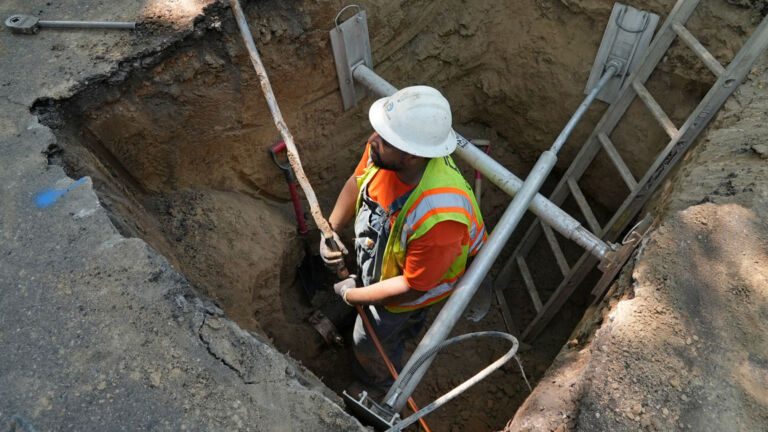
 Credit: (AP Photo/Seth Wenig)
The new state budget aims to spend potentially hundreds of millions of dollars in federal money to significantly reduce the toxic effects of lead — either from paint in New Jersey homes or in the water people drink.
In the budget signed into law Thursday, $170 million is targeted to removing lead paint from homes and apartments and at least some portion of another $300 million to reduce lead in residents’ water by replacing lead service lines.
The spending, made possible by the state’s allocation from the American Rescue Plan Act, would virtually eliminate the hazards posed by lead paint in a least 250,000 housing units occupied by children that have unsafe levels of lead paint, according to community advocates.
Kids being poisoned every day
“More than a dozen children are still being poisoned by lead every day in New Jersey, and according to the Department of Health, dust from lead-based paint is responsible for at least 75% of these cases, said Ben Haygood, policy director of Isles Inc., a community development and environmental organization based in Trenton. “This new funding provides a significant down payment in fulfilling the promise of ending childhood lead poisoning in New Jersey’s kids forever.’’
But even with more federal money, a big funding gap remains, advocates say
“We know making these homes safe reduces health care costs, improves educational performance and helps our kids and family succeed. This is an investment that will pay off for our families — and our state,’’ said Sean Jackson, CEO of Isles.
Elyse Pivnick, Isles’ senior director of environmental health, said there is no such thing as a safe level of lead.
Lead and juvenile crime
“Children with even low levels of lead are six times more likely to enter the juvenile justice system, 30% more likely to fail 3rd grade reading and math and seven times more likely to drop out of school,’’ she said.
The costs associated with lead are immense — more than $62 million annually, according to Isles. Lead poisoning drives higher special education costs, higher rates of unemployment and a variety of health problems that lead to early retirement, enrollment in Medicaid and even death.
Lead-Free New Jersey also lauded the budget allocation, calling it a demonstration of the Murphy administration’s and Legislature’s commitment to removing the danger of lead paint from New Jersey homes once and for all.
At this point, it is unclear how much of the $300 million allocated to water infrastructure will be spent on replacing lead service lines in New Jersey, an undertaking the state Department of Environmental Protection originally projected would cost about $2.3 billion. The DEP did not respond to questions about how much of the money will be targeted for that purpose.
Investment in upgrading New Jersey’s drinking water infrastructure is a priority of the Murphy administration, according to Larry Hajna, a DEP spokesman. The department will evaluate how to leverage the additional allocation to maximize available funds in achieving public health priorities. This is an important step in meeting New Jersey’s water infrastructure needs, and it will provide much-needed relief for many residents, including those in underserved communities, he said.
“We certainly hope a large chunk of that ($300 million) will go to replace lead service lines,’’ said Mo Kinberg, community outreach manager for New Jersey Future, an organization that has been pressing for aid to local communities to help address the problem.
The state still has not spent approximately $1.4 billion of its American Rescue Plan allocation, according to Kinberg. New Jersey Future and the partners would like to see an additional $700 million targeted to replace lead service lines and other water infrastructure projects, she said.
But the state has no shortage of projects awaiting funding, including eliminating combined sewer-overflow systems that spew raw sewage into waterways during heavy rainfall; cleaning up newfound contaminants in drinking water supplies; and fixing aging stormwater management systems.
— Editor’s note: This story has been updated to clarify how New Jersey Future would like additional funding to be targeted.
