
 Credit: (AP Photo/Patrick Semansky)
Each New Jersey congressional district has about 773,600 people living in it. But in almost all cases, fewer than 80,000 — roughly 10% — are deciding who gets to represent them.
As exemplified by last week’s primary election, where fewer than 15% of the electorate voted for congressional candidates statewide, low voter turnout has become a fact of life in New Jersey politics.
Some is the product of voter malaise — and some arguably by design to protect party favorites. But as the state moves to the general election in November, the victors in a half-dozen districts are already decided by the primary where barely one in eight voted.
Consider the 8th District based in Hudson County. It’s been more than six decades since a Hudson County Republican has been elected to the U.S. House of Representatives. In his eight elections, retiring Democratic Rep. Albio Sires never got less than 74% of the vote. More than 54% of all registered voters in the district are Democrats and only 11% are Republicans.
Pre-picking the winners?
Suffice it to say that whoever wins the Democratic nomination in this district wins the general election.
This year, that will be Rob Menendez, the son of the U.S. senator who held this seat when the district was known as the 13th. A political novice, Rob Menendez received 25,627 votes in the primary in which 30,835 Democrats voted. Those numbers will rise slightly as the final mail-in and provisional ballots are tallied, but still are not likely to reach 5% of the population of the district.
Patrick Murray, director of the Monmouth University Polling Institute, said New Jersey county parties’ use of the ballot “party line” — putting all candidates endorsed by the party in the same row or column on the ballot — discourages more candidates from running and discourages more voters from turning out.
Patel: ‘We absolutely must increase our turnout in primary elections so that our candidate choices reflect the will of a larger part of the population.’
“It’s by design, that’s what that line does,” he said. “What does that say about New Jersey? We’re the only state that does this.”
The same kinds of statistics are repeated in at least the five other districts in the state that lean heavily Democratic and two that heavily favor Republicans. But even races in competitive districts are decided by a relatively small portion of the people represented.
About 91,000 total votes have been tallied so far for last week’s primaries in the 7th District, which stretches across the state from Hunterdon and Warren counties to Union. That appears to be the district that drew out the most voters. Close to 54,000 ballots were cast by Republicans, who comprise a third of the district’s 612,000 registered voters, the largest voter pool in the state. Still the total number of votes cast represents less than 12% of the district’s population, or 15% of all registered voters.
Low turnout
“We absolutely must increase our turnout in primary elections so that our candidate choices reflect the will of a larger part of the population,” said Henal Patel of the New Jersey Institute for Social Justice. “Low turnout reflects that people don’t feel they have a stake in — or a say in — the outcome of these races, and that couldn’t be further from the truth. We need to change that perception, as well as increase voter education about when and how to vote.
The problem of low voter turnout is a nagging one that really diminishes only during presidential election years.
Turnout has been dropping for decades, with occasional blips, such as for the 2020 presidential election, when 72% of registered New Jersey voters cast ballots.
While the total turnout for this year’s primary won’t be available until sometime next week at the earliest, an NJ Spotlight News analysis of turnout and ballots counted so far found that at least 707,000 people voted, representing about 11% of all those registered, or 18% of registered partisans. Comparing those who turned out against the number of Democrats and Republicans is in many ways the fairest measure because New Jersey has a closed primary system, meaning that a partisan can only vote for candidates of his party. People who are unaffiliated must join a party in order to participate, and few do.
If the 2018 midterm election was any indication, New Jersey could see some 55% of voters casting ballots in the fall. But in at least seven other congressional districts in addition to the 8th, one party or the other dominates so the primary election determines the winner. A similar portion of state legislative districts have been gerrymandered to give one of the parties all but certain victory in the general election. Yet primaries always have much lower turnouts.
Quashing voter interest
Like Murray, Patel blamed the party line for suppressing voters’ interest.
“We need to abolish the line,” she said. “Voters recognize when there are no competitive primaries and we cannot have real competition while maintaining the line. The line also disincentivizes others from running — so there were many races that had only one candidate.”
Hale: ‘If people don’t feel like they have a choice or if their choice doesn’t matter, they are less likely to vote.’
A lawsuit filed in federal court by several former candidates and the New Jersey Working Families Party seeks to end the use of the line, but it’s unclear when that might be decided.
That change could make a difference, voting advocates say, as could the adoption of ranked-choice voting. Under that system, people choose more than one candidate and rank them by order of preference. The rankings come into play if no single candidate wins at least 50% of the vote.
A bill currently pending in the Legislature would bring ranked-choice voting, a process used in Alaska, Maine and some two dozen cities around the country including New York. Matt Hale, a political science professor at Seton Hall University, said this system has been shown to increase turnout in some places.
“More people vote when elections are competitive,” Hale said. “If people don’t feel like they have a choice or if their choice doesn’t matter, they are less likely to vote.”
Reforming the system
Philip Hensley of the League of Women Voters of New Jersey, said some of the reforms New Jersey has undertaken to improve turnout can work, but they need more time.
“Election system reforms like early voting are shown to increase voter turnout over the medium- and long-terms as voters become familiar with all their voting options, and we anticipate that will be the case in New Jersey,” Hensley said. “More must be done to educate voters about their options, and the convenience of early in-person voting.”
So far, New Jersey’s first two experiences with early in-person voting have been underwhelming. In its rollout for last year’s gubernatorial election, nine days of early machine voting drew about 208,000 people, or 8% of all those who voted that year. Close to three times that number used mail-in ballots. This year, only 20,230 people voted during three days of early in-person voting, roughly 3% of turnout as counted so far. By comparison, the number using mail-in ballots was more than 13 times higher, or about 275,000.Balmir: ‘It’s about voters really starting to lose faith in our governmental process, in terms of it being a vehicle to create positive change in their lives.’
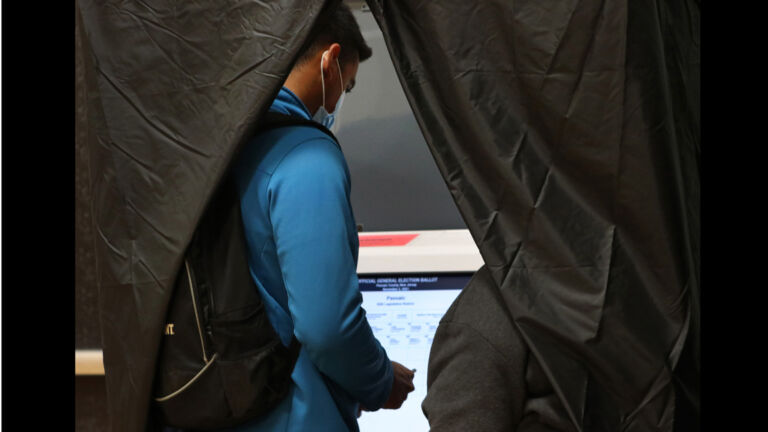
Expanded early voting and expanded mail-in balloting, including the automatic mailing of ballots to some voters, were billed as ways to increase turnout, although Murray said it’s still unclear whether they have drawn in any sizable number of new voters or simply changed the way existing voters cast ballots.
Don’t blame apathy
Others say there are much more difficult issues to overcome to get more people to vote.
T. Missy Balmir, a Democratic campaign strategist and a visiting associate at Rutgers University’s Eagleton Institute of Politics, said that while many talk about voter apathy, that’s not necessarily the right word to use.
“It’s not a question of apathy, particularly for BIPOC (Black, Indigenous, people of color) voters,” she said during last Wednesday’s Morning After panel discussion on the election sponsored by Eagleton. “I think very often folks have entertained the thought that people don’t care, they’re apathetic or they’re too concerned with their day-to-day activities to vote. I would challenge that. They’re so concerned with their day-to-day activities and they’re frustrated with what they feel government is not doing on either side that they just don’t see the need to vote … It’s about voters really starting to lose faith in our governmental process, in terms of it being a vehicle to create positive change in their lives.”
“I think people are just burnt out and frustrated by everything that has to do with politics,” agreed Hale. “There is a perception that everything is going down the tubes and voting won’t help.”
Balmir said it’s crucial that party activists and voting advocates do all they can to get more people to the polls — and not just those who traditionally turn out.
“We’re going to have to start to do that more to actually engage voters about what’s important to them,” she said. “It’s going to be really important that we figure out a way to get people out.”

