
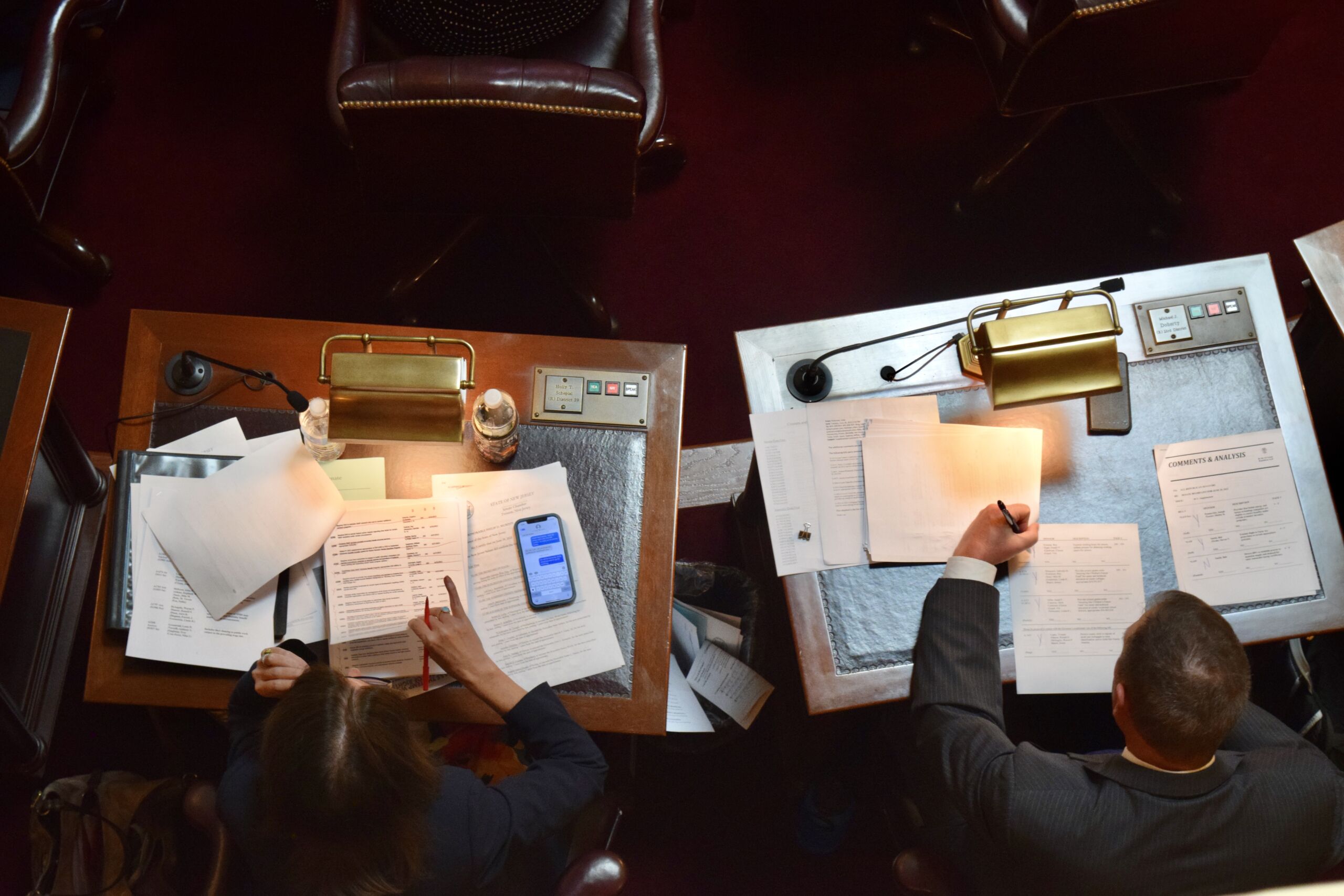
Stronger gun safety measures, protections for New Jersey abortion providers and a raft of election reform bills were among the dozens of measures passed by New Jersey lawmakers on Wednesday before taking the summer off.
Both the Senate and Assembly waived their rules to allow votes on at least twice as many bills as normally allowed. In total, close to 220 bills were on their agendas. Not all passed and those that didn’t likely have to wait until lawmakers return in September.
On an especially busy day in the State House when both houses also approved a new state budget and several bills meant to provide some temporary financial relief to individuals next year, the Senate met for more than seven hours, while the Assembly held a voting session that ran for more than four hours. Other bills that advanced included measures designed to reduce food insecurity, improve mental health care and license police officers.
Most, though not all, of the bills cleared both houses and now await action by Gov. Phil Murphy.
Gun safety
Murphy had pushed a number of gun safety bills that had stalled in the Democratic-controlled Legislature. But a week after the U.S. Supreme Court invalidated a New York bill that limited the concealed carrying of a firearm, lawmakers acted. Still, not all of the measures made it to Murphy’s desk.

Greater election night transparency and early processing of mail-in ballots could soon be in place
Both houses passed bills that would prohibit .50 caliber rifles (S-2905), require the tracking of the sale of ammunition and mandate buyers provide a photo identification card when making a purchase (A-1302), require people who move into New Jersey to get an ID card and register handguns required out of state (S-1204). They also cleared bills that would crack down on ghost guns by upgrading the crime of manufacturing firearms to a second-degree offense (S-2846), mandate training prior to the issuance of a firearms purchaser ID card (S-2906) and require firearms retailers to sell guns with microstamping to enable better tracing of bullets when this technology is available (A-4368). A final measure (A-1765) would give the state attorney general the ability to sue gun manufacturers in some instances.
The Assembly, in a 50-28 vote, passed A-509, which would raise the minimum age to buy a rifle or shotgun to 21 from 18. Assemblyman Roy Freiman (D-Somerset), one of the bill’s sponsors, said the bill “is about preventing gun violence.” Those under age 21 could still possess a gun under limited circumstances, including under the supervision of a parent, for military drills, target practice or for hunting during season.
Only the Senate passed S-2847, which would strictly regulate the use of body armor.
Elections
A seven-bill package of election reform package received final approval. If signed by Murphy, at least some of these could be in place in time for the November general election.
The most significant measure, A-3822/S-2865, would let counties start processing mail-in ballots five days early provided no tallies be released prior to Election Day.
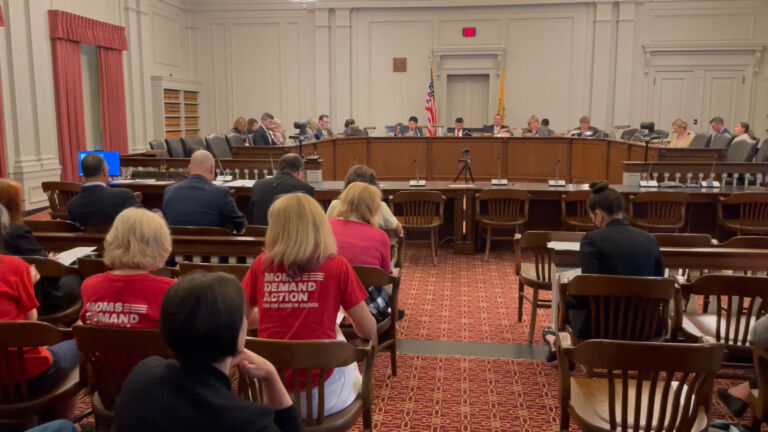
Other bills would allow minors to work the polls on Election Day, give college credit to higher education students who serve as poll workers and stop automatically sending primary mail-in ballots to unaffiliated voters. The bills also tell election officials to use death records to clean voter rolls, establish criteria for the removal of a person from the permanent vote-by-mail list and change where a ballot is sent and allow some New Jerseyans living overseas to vote in state elections.
The Senate passed a measure, S-2912, which would allow police officers to be present at schools and senior citizens centers used as polling places. Last year, the state enacted a law keeping police officers at a distance from all polling locations. The measure faces an uncertain fate in the Assembly.
Food insecurity
Both houses passed a nine-bill package of bills meant to tackle food insecurity. Assembly Speaker Craig Coughlin (D-Middlesex) has made reducing hunger one of his priorities. A number of the bills are meant to improve the Supplemental Nutrition Assistance Program or SNAP, formerly known as food stamps, that helps lower-income residents pay for food. These improvements would include streamlining the application process (A-2359), creating an $18 million SNAP minimum benefit program (A-2366) and requiring the state Department of Human Services to increase its outreach efforts (A-2361).
Other measures seek to increase the number of students receiving free or reduced-price meals at school, including by requiring schools to better educate parents about school meal programs (A-2365) and expand free school breakfasts and lunches to students from working class and middle-income families, with incomes just below twice the federal poverty level (A-2368). The latter bill, deemed the Working Class Families’ Anti-Hunger Act, would cost the state at least $19.4 million a year, with the state picking up the cost .
Abortion
The Assembly passed two bills prompted by the U.S. Supreme Court’s overturning the Roe v Wade decision that had given American women the right to an abortion for a half-century. A-3974 and A-3975, designed to protect New Jersey medical professionals who provide abortions to women from out of state that might be in violation of any other state’s laws and prohibit other states from extraditing any providers. Both bills passed the Assembly mostly along party lines, 47-16-13.
Mental health
Three measures meant to help improve mental health services received final legislative passage and were sent to Murphy.
S-311 would require the Department of Human Services to create a statewide system of care for behavioral health services, including the integration of the new 988 suicide prevention crisis hotline and rollout of mobile crisis response teams for people experiencing a mental health crisis. Sponsored by Sen. Joseph F. Vitale (D-Middlesex) and Sen. Vin Gopal (D-Monmouth), the legislation comes amid a nationwide implementation of the same hotline number for crisis and suicide prevention. In the new budget, the Murphy administration allocated $16 million to the 988 mental health crisis and suicide prevention hotline.
Another bill, S-722, seeks to establish a crisis response report program in the Department of Health (DOH) that would pair a mental health professional with a police officer when responding to someone experiencing a mental health crisis. The bill would give DOH $2 million to put the program in place.
Other legislation
Both houses passed S-2742, which would have New Jersey join 44 other states in licensing police officers. The three major police unions all supported the measure, which was touted as a way to improve officers’ training and allow for a uniform way to suspend the licenses of those who fail to meet state standards.

Lawmakers line up $250M for improvements. Conservationists agree park needs cash influx but still fear large-scale privatization
Lawmakers sent Murphy S-2807, which would create a task force to chart a new future for Liberty State Park, located on the Jersey City waterfront across from the Statue of Liberty. Supporters say this would improve the 1,200-acre park that is mostly undeveloped today, while some opponents fear it could lead to a loss of wildlife habitat and to commercialization of the park.
The Senate gave final passage to A-3149, which transfers the responsibility for the New Jersey School of Conservation to a nonprofit organization. Bill sponsors hope this will ensure the future of the school, once threatened with closure due to a lack of funding.
The Senate also passed S-460, which would prevent the state from disclosing the personal information of New Jersey driver’s license holders to other states seeking to issue red-light camera or speed camera citations by mail, thus protecting them from being fined.
— Bobby Brier, Katie Crist and Tanisha Bhat contributed to this story.
