
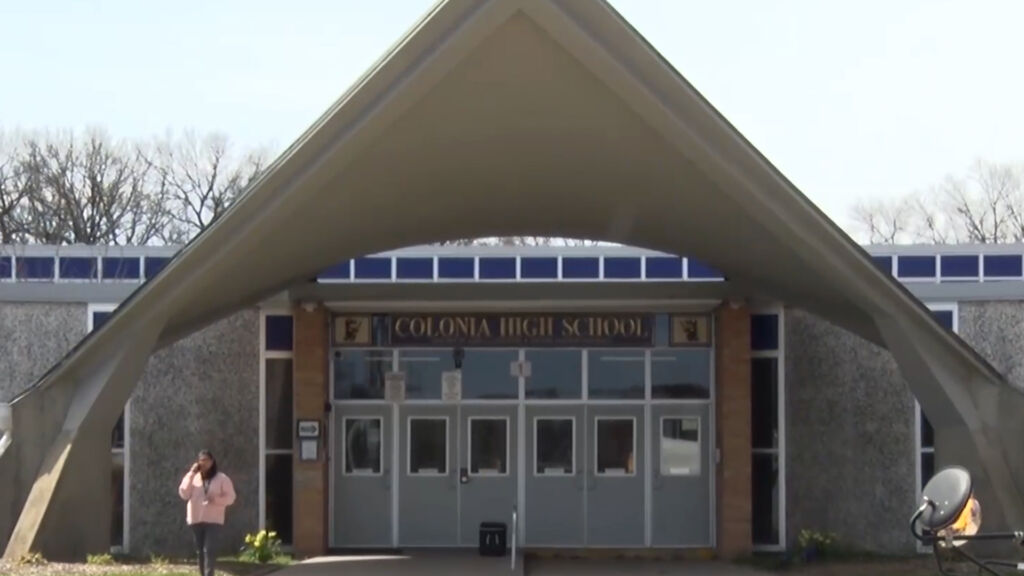
Radiation levels at Colonia High School in Woodbridge are within normal levels, and there’s no evidence of any contamination that might have caused brain cancer among former students and staff, state and local officials said Thursday.
For several weeks, tests were performed in and around the school after a graduate posted on social media a list of more than 100 school attendees who have been diagnosed with different kinds of brain cancer, some of them fatal.
The tests showed that both radiation and radon at the school were within state guidelines, and other possible causes including nearby hazardous waste sites were also ruled out, according to officials from the Department of Environmental Protection and the Department of Health who made the results public at a news conference in Woodbridge.
Brain cancers are more common than people realize, the officials said, even if most of those cancers are not malignant. And they warned people against thinking that the social media list contained an unusually high number of cancer incidents.
Persichilli: ‘No radiological hazards have been identified that warrant further investigation.’
Department of Health Commissioner Judith Persichilli said that 98 to 105 students who attended the school between 1968 and 2021 could statistically be expected to get brain cancer — similar to the number that was published on the social media list.
“No radiological hazards have been identified that warrant further investigation,” Persichilli said. “These findings represent good news that we hope will reassure current and former Colonia High School students.”
Persichilli dismissed concerns that a radioactive rock found in the school in 1997 had caused high levels of radiation that might have been linked with brain cancer among students and staff.
Health department officials, working with experts from the federal Agency for Toxic Substances and Disease Registry, examined a report on radiological data prompted by discovery of the rock in 1997, and concluded there was no contamination of the school’s environment, Persichilli said.
‘No harmful health impacts’
“No harmful health impacts are expected from the external exposure to ionizing radiation from the rock found in that classroom,” she said.
Shawn LaTourette, commissioner of the DEP, said his department’s testing had found no sign of abnormal radiation levels, and there was no reason for further testing.
LaTourette said agency officials worked with contractors to ensure there was a “thorough” investigation of radiological issues in and around the school.
“We want to help this community feel safe,” he said. “I’m a parent, and I would be concerned if there were issues of radioactivity even alleged.”
In a letter to Woodbridge Mayor John McCormac, DEP said there’s no need for further testing.
‘DEP concurs with the conclusion of the report that all survey results are consistent with normal background radiation found in New Jersey…’
The letter said the department reviewed the report prepared for the township, and agreed with its conclusion that no abnormal levels of radiation were found at or around the school.
“DEP concurs with the conclusion of the report that all survey results are consistent with normal background radiation found in New Jersey, which varies widely from location to location based on underlying geology, ground cover, building materials, and cosmic radiation,” the letter said.
A technician certified by DEP also measured radon by distributing 83 measuring devices around the school, and found that none exceeded a state guidance level of 4 picocuries per liter. All but one device showed radon levels at below 2 pCi/L, in line with the prevailing level throughout Middlesex County, the letter said.
Wider radiation investigation
Since radiation is the most likely environmental factor linked with primary brain tumors, DEP also — out of an “abundance of caution” — investigated possible nearby sources including naturally occurring radioactive deposits, historic land use, and hazardous site contamination records within a one-mile radius of the high school.
But it found no cause for alarm in the wider probe either. “DEP did not identify any likely sources of environmental exposures at or impacting the high school. Based on available information, no further testing of environmental media at the high school grounds is required,” it said.
McCormac commended Al Lupiano, a former Colonia student who has a benign type of brain tumor, for collecting and publishing the list of cancer diagnoses on Facebook. But, McCormac said, the list was not an official or verified source of cancer patients who have a background at Colonia. “It’s not validated or verified,” he said.
Lupiano did not respond to requests for comment on the investigation.
Dr. Rob Laumbach, a professor of environmental health at Rutgers University, said the testing on the basis of available evidence should put to rest public fears about any link between a suspected “cancer cluster” at Colonia and any elevated radiation level.
“They are ruling out that there was undue or unusual ionizing radiation exposure at the school,” Laumbach said.
The number of primary brain cancer cases that would be statistically expected in the student population between 1968 and 2021 is in line with those reported on Lupiano’s list, and so should not be seen as any kind of outbreak of the illness.
“At this point, there’s no evidence to go on with further evaluation,” he said.
