

New Jersey’s public-worker pension fund is launching a new investment initiative and will set aside $250 million to purchase stakes in smaller and newly established investment funds, including those run by diverse fund managers.
The idea behind the initiative is to get in on the ground floor with so-called emerging fund managers and those with more diverse backgrounds than the pension fund has traditionally invested in, officials said Wednesday during a public meeting of the New Jersey State Investment Council.
The effort is being launched as the $94.7 billion pension fund itself is contending with a period of market volatility that resulted in sagging returns following last year’s record-setting investment performance.
It also comes as Gov. Phil Murphy’s administration is moving ahead with a similarly oriented investment initiative by the state Economic Development Authority. In that effort, up to $500 million will go to encourage more investment in New Jersey-based startup businesses. The money comes through the sale of state tax credits that will then be paired with matching dollars provided by private-sector venture-capital firms, according to administration officials.
New Jersey’s public-worker pension fund backs the retirements of roughly 800,000 current and retired government workers. The fund is financed with contributions made regularly by workers and their taxpayer-funded government employers, including the state, as well as dedicated revenues from the New Jersey Lottery.
Fund assets are managed by the Department of Treasury’s Division of Investment under policies set in law and by the investment council.
While much of the fund is invested in traditional asset classes like stocks and bonds, a significant share of the portfolio has also been devoted to so-called alternative investments, like hedge funds and private equity, as part of a long-standing diversification strategy aimed at easing the impact of market volatility and economic downturns.
Broader investment strategy
The new alternative-investment initiative that will focus on emerging managers will kick off with the Division of Investment making an initial investment of up to $250 million in an investment vehicle that will be separately managed by Barings, a North Carolina-based investment-management firm.
The goal of the initiative is to broaden the pension fund’s diversification strategy, while also targeting investments with smaller and more diverse fund managers that have the potential to generate stronger returns than larger firms, Treasury officials said.
Barings was selected, in part, because it has a record of working with organizations that are focused on improving the representation of women and diverse managers in the asset-management industry, the officials said.
The move drew strong praise from several investment council members as it was outlined by Division of Investment officials during Wednesday’s meeting.
“I think for us to be able to cast our net wider (and) broader, to more diverse managers — and it’s very encouraging the performance of these managers is also better — I think it is really a terrific initiative,” said Deepak Raj, who chairs the investment council.
The pension fund would be taking a “necessary step in the direction of democratizing access to capital to managers who may not have otherwise had an opportunity,” said council member Vaughn Crowe.
“We’re taking a good step, hopefully it’s the beginning of something larger,” Crowe said.
Big push in the fall
And while the push to invest in emerging and more diverse fund managers won’t prioritize New Jersey-based investment businesses, the state is planning to do significant outreach to the financial industry this fall and expects to generate strong interest from local fund managers, Treasury officials said.
“There should be tremendous opportunity for businesses and managers in New Jersey to make themselves known to us,” Assistant Treasurer Michael Kanef told members of the investment council.
Overall pension fund returns for the first nine months of the current fiscal year, according to preliminary figures reviewed by the investment council on Wednesday, were just under 1%.
While still unaudited and subject to change due to the delayed reporting of some key returns, the latest estimates mark a big turnaround following the nearly 30% gains realized during the 2021 fiscal year, which ended on June 30, 2021.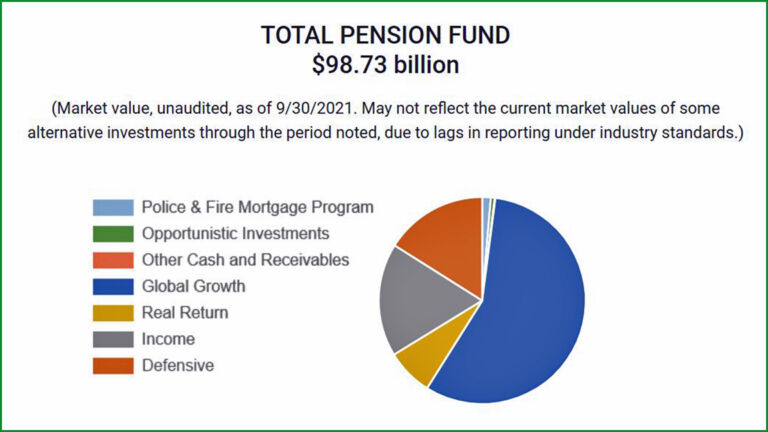
The latest returns for the current fiscal year also suggest the pension fund is likely to fall well short of its 7.3% assumed rate of return by the time the fiscal year closes on June 30.
Shoaib Khan, acting director of the Division of Investment, listed volatile financial markets and ongoing geopolitical turmoil as the key concerns as he detailed the latest returns during Wednesday’s meeting.
“The reality is that clearly performance is not as robust — far from that, in fact — this year,” Khan told investment council members. “Markets are extremely challenging as we continue to go through the fiscal year, as well as the calendar year.”
“I just want to make sure that we are somewhat managing expectations as we get closer to the fiscal year-end date,” he said.
