
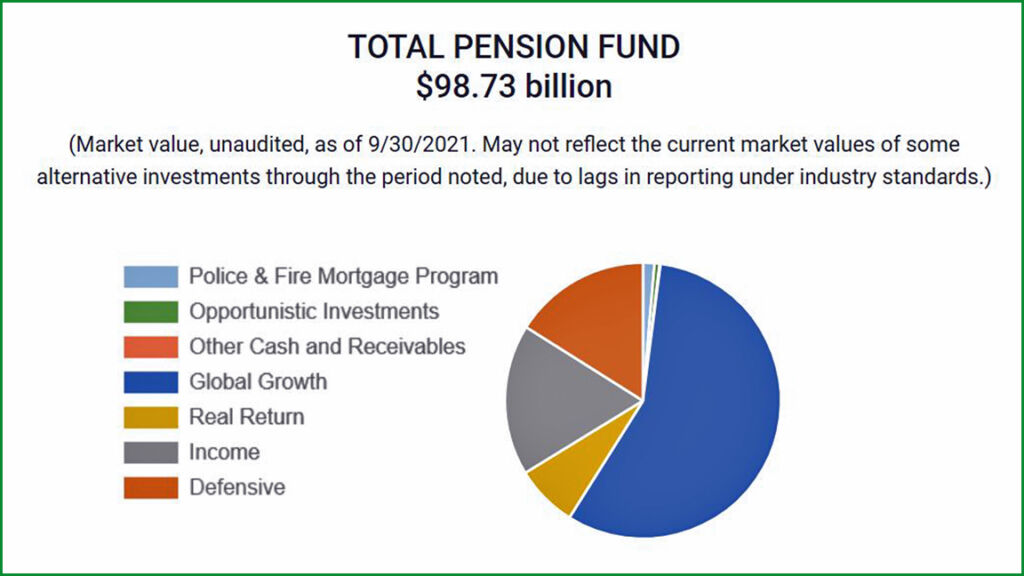
Thanks to booming investment returns and increased state contributions, the value of New Jersey’s pension fund has soared to its highest total in at least two decades.
The latest figures are preliminary estimates and subject to revision, but they show the pension fund’s market value is up to nearly $100 billion, according to the state Division of Investment.
The fund’s improving bottom line has given state pension officials something to celebrate after many years of having to deal with the consequences of chronic underfunding by the state — a practice that was only recently halted.
“It’s great teamwork all around,” said Shoaib Khan, acting director of the Division of Investment, as he discussed the latest figures during a recent meeting of the New Jersey State Investment Council.
And while the pension fund hasn’t quite hit the $100 billion market-value threshold just yet, Khan said “we’re keeping our fingers crossed and hoping that we are getting there rather soon.”
“We’re certainly very close to it,” he told members of the investment council last week.
A long way from a clean bill of health
However, despite the promising outlook, New Jersey’s pension fund still has a long way to go to get a clean bill of health. Significant payments by the state into the pension fund are expected to be needed for several decades to undo the years of short or altogether skipped employer contributions that left New Jersey’s public-worker retirement plan ranked among the nation’s worst-funded.
In all, the state pension fund covers the retirements of roughly 800,000 government workers and retirees in New Jersey.
It is financed with contributions from workers, along with taxpayer-funded payments made by their respective state and local government employers. Dedicated revenue also flows into the pension fund monthly from the New Jersey Lottery.
After a pandemic-fueled sell-off, investment returns sagged and the fund’s value dropped to $74 billion at the end of April 2020.
But the state’s latest official figures, although still unaudited and considered preliminary by the Department of Treasury, indicated the value of the pension fund had risen to $98.7 billion as of the end of September 2021.
Treasury officials highlighted significant investment returns recorded over the last year and the state’s first full employer contribution in more than two decades — including a hefty lump-sum payment earlier this year — as significant factors.
Best results since 2000
“This is the highest market value of assets since at least 2000,” Treasury spokeswoman Melinda Caliendo said in an emailed statement.
For years, governors and lawmakers from both parties put the state pension system in a deep hole by shorting the annual employer pension contribution or, in some years, making no contribution at all.
But among other pension-funding policy changes enacted over the last decade, former Gov. Chris Christie launched a pension-payment ramp-up plan to put the state on a course to reach full funding, a goal Gov. Phil Murphy, who took office in early 2018, is planning to hit during the current fiscal year.
Bolstered by booming tax receipts, the Murphy administration earmarked a record-high $5.8 billion lump-sum payment for the pension system earlier this year. Another roughly $1 billion in pension contributions is also expected from the Lottery throughout the 2022 fiscal year, which began on July 1.
Lottery revenues over the first four months of the current fiscal year were up by more than 10% year-over-year, according to the latest tax-collection data from Treasury. Overall state revenues were up by nearly 25% over the same period, according to the tax data.
Way better than assumed rate of return
Meanwhile, unaudited final figures for the 2021 fiscal year reviewed several weeks ago by the investment council indicated annual investment returns for the pension fund soared to an estimated 28.63% over the 12-month period that closed on June 30.
That was easily the highest annual return recorded by the Division of Investment over the past two decades, according to Treasury’s records.
Moreover, the 2021 fiscal year returns more than tripled the pension fund’s long-term assumption for annual investment gains, which is 7.3%. They also marked a major reversal from the prior fiscal year, when annual returns barely topped 1%.
“It’s nice to see that the fund was well-positioned to benefit from a constructive market environment,” Khan said at the time.
However, recent projections of required annual pension funding indicate New Jersey will have to continue making significant employer pension contributions well into the 2040s to offset the many years of underfunding state payments.
According to state bond documents made public earlier this year, the pension system was only about 50% funded as of June 30, 2020, and hefty pension contributions of between $5 billion and $7 billion will be required through the 2050 fiscal year to restore the fund to good health.
