
 Credit: (NJ Spotlight News)
For over a decade, Trenton has ignored their pleas to stop taking money meant to maintain and improve the 911 emergency call system.
Now county officials are asking Congress to penalize New Jersey and four other states for using those fees paid by telephone customers on other programs.
By law, everyone in New Jersey who owns a cellphone or landline pays a 90-cents fee each month to the 911 System and Emergency Response Trust Fund. A family of four where everyone has a cellphone and there’s a landline in the home pays $54 a year into this fund.
New Jersey expects to collect almost $126 million in those 911 fees in the coming fiscal year. But in his proposed budget, Gov. Phil Murphy wants most of that money to go to the State Police. Only 14%, or about $17 million, would go to maintaining the emergency call system and the office that oversees it.
The state began collecting the fees in mid-2004. Five years later it started diverting them to plug budget gaps. None of the fees paid by consumers have gone to pay for local system maintenance or upgrades since 2009, county officials say.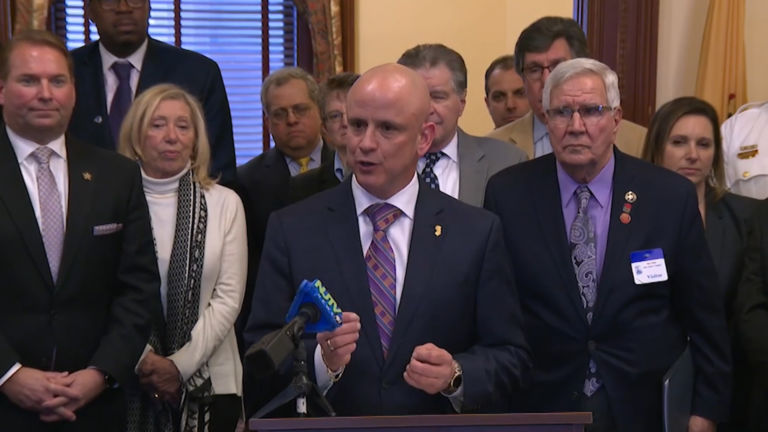
The 911 fund is just one of a number of special funds — including those for clean energy and affordable housing — the state taps to cover expenses not related to those dedicated accounts.
County officials have been spending millions of dollars in property taxes to maintain and upgrade their emergency response and dispatch systems. The Federal Communications Commission calls New Jersey one of only five states that diverts 911 fees meant to modernize the system, they note. And, the fact that local taxpayers are footing the bill for improvements on top of paying the fee amounts to double taxation, they maintain.
Strong words from critics
John Lanza, director of the Hunterdon County Commissioners, went further during a news conference Tuesday held at the Hunterdon County 911 Center.
“If lawyers do it, it’s misappropriation. If you do it at the bank, it’s called robbery. But if the state does it, it’s diversion. Whatever, we all pay this tax on our phone bills,” Lanza said.
Sen. Michael Testa (R-Cumberland) asked state Treasurer Elizabeth Muoio about the diversion during a budget hearing Tuesday. The state has collected more than $1.3 billion in 911 fees and “yet here we stand, we haven’t upgraded the 911 infrastructure statewide,” Testa said.
Muoio disputed calling the practice a “diversion.”
“It’s not a diversion. It’s a legally allowed expenditure of the funds,” she said.
It is legal because when New Jersey adopted its law for collecting fees, it gave the state permission to use the money for other purposes, including emergency-response training, capital and operating expenses arising from emergency response and the Office of Emergency Management.
But according to the FCC, the fees are supposed to be used “for the support or implementation of 911 or E911 (enhanced) services.” The commission’s most recent annual report on how states are using the 911 fees said New Jersey is one of just five identified “as diverting or transferring 911/E911 fees for purposes other than 911/E911 in 2020.”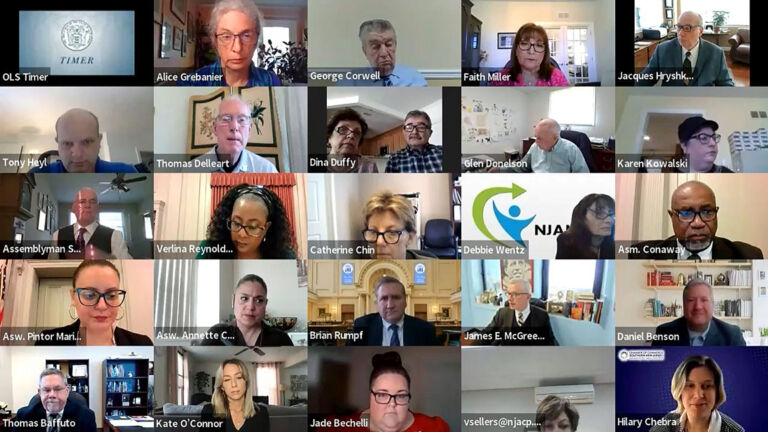
New Jersey diverted the most money of any state in 2020 — 82.1% of the fees collected, roughly twice that of New York, the second largest diverter. New Jersey was also one of the few states with no specific data on the number of landline and cellphone calls to 911 that year — the state simply estimated 9.5 million total calls — nor any estimate of the total cost of providing 911 service to residents.
In a filing with the FCC, the state’s chief technology officer, Christopher Rein, wrote that the state does not distribute funds directly to the 263 public-safety answering points that handle 911 calls and cited a 1989 state law that makes local governments operating them responsible for their funding.
“New Jersey is the only state in the nation that does not share the 911 monies as intended under the law,” said Teri O’Connor, the Monmouth County administrator and president of the New Jersey Association of Counties.
Expensive system to operate and maintain
Maintaining a 911 call center and keeping it updated is costly, several officials said.
“Those who are involved in emergency response know that there’s a constant need and requirement for technological upgrades to the 911 infrastructure to best serve the public in times of need,” Lanza said.
Hunterdon County has spent more than $4 million on its network over the last eight years and its Department of Public Safety is seeking $4.2 million this year, in part for a major upgrade needed for the computer-aided dispatch system.
“Right now, those costs fall entirely upon the property taxpayer because the state has diverted this tax,” Lanza added. “It was supposed to be dedicated to fund these specific projects.”
Jonathan Young, a Camden County commissioner, said county governments have spent about $175 million in recent years on capital improvements, facility upgrades, telephone systems, computer-aided dispatch, location mapping technology and next-generation 911 enhancements.
“Counties also spend an estimated $125 million each year on general operating expenses for salaries, staff training, system maintenance, network security, IT consultant services, and much, much more,” Young said.
Other counties have not kept pace. Young said it is going to cost Cumberland County $40 million to bring its system up to current standards. That would still fall short of what Congress urged in passing a 2008 law that calls for states to “rapidly deploy” an enhanced 911 system that will be faster, better able to manage call overloads and allow for voice, photos, videos and text messages to the emergency network.
The National 911 Project says New Jersey lags behind the majority of states in implementing this next-generation 911 system.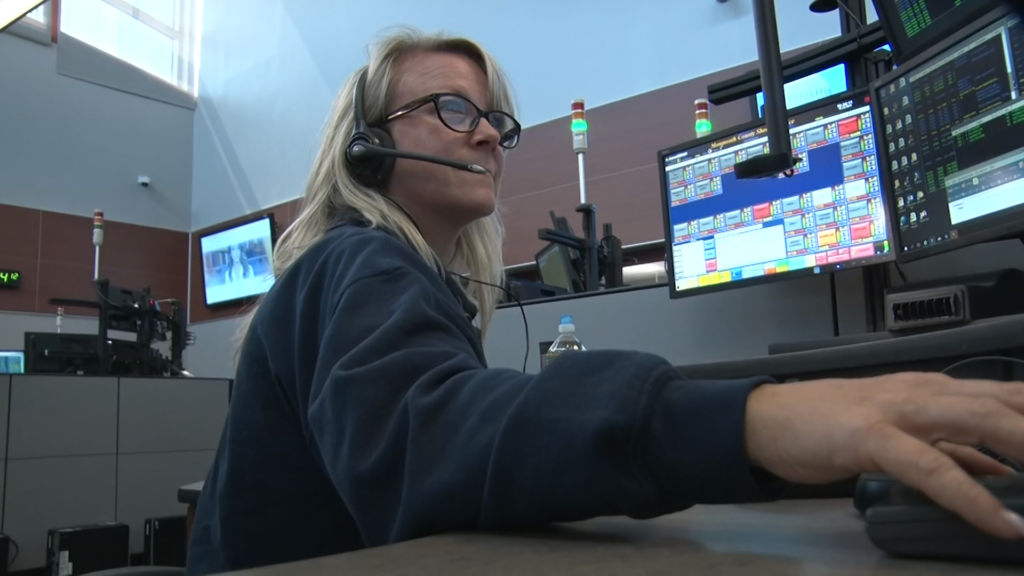
“We’re only a natural disaster away from the whole thing failing,” Young said of the current system.
The statewide 911 system still manages calls using 9600-baud modems that are hard to replace or find parts for when they break down, officials said. And when a disaster strikes, such as Tropical Storm Ida that last year killed 30 people and caused more than $100 million in damage, these modems have trouble keeping up with calls. They also cannot accept texts, photos or video.
Long-standing complaints
County officials have been complaining for years about the problem but have found no relief. This year they are urging Congress, and New Jersey’s representatives in particular, to adopt the recommendations of the 911 Strike Force created by the FCC, to look into ways to stop the diversions. Specifically, they urge that New Jersey and other states diverting fees be fined and be ineligible for 911 federal grant funding. The states should also be barred from renewing, modifying or getting new public safety spectrum FCC licenses until the commission approves of a fee remediation plan.
There may also be legislative help coming.
Assemblyman William Spearman (D-Camden) promised to at least hold hearings on his legislation (A-587) that would prioritize the distribution of 911 fees to counties and municipalities for maintaining their emergency call systems.
Other lawmakers expressed their unhappiness this week when Muoio appeared before the Assembly and Senate budget committees.
“I think it’s very important, since we just came out of a pandemic, how important that 911 system is,” said Assemblywoman Annette Chaparro (D-Hudson). “My concern is that diverting the fund and not putting it directly into the 911 system is a strain on our counties and locally.”
When Muoio told Testa that the state was legally using the fees for other purposes, he responded, “I know that it’s legal. I just don’t know that it’s right.”
