
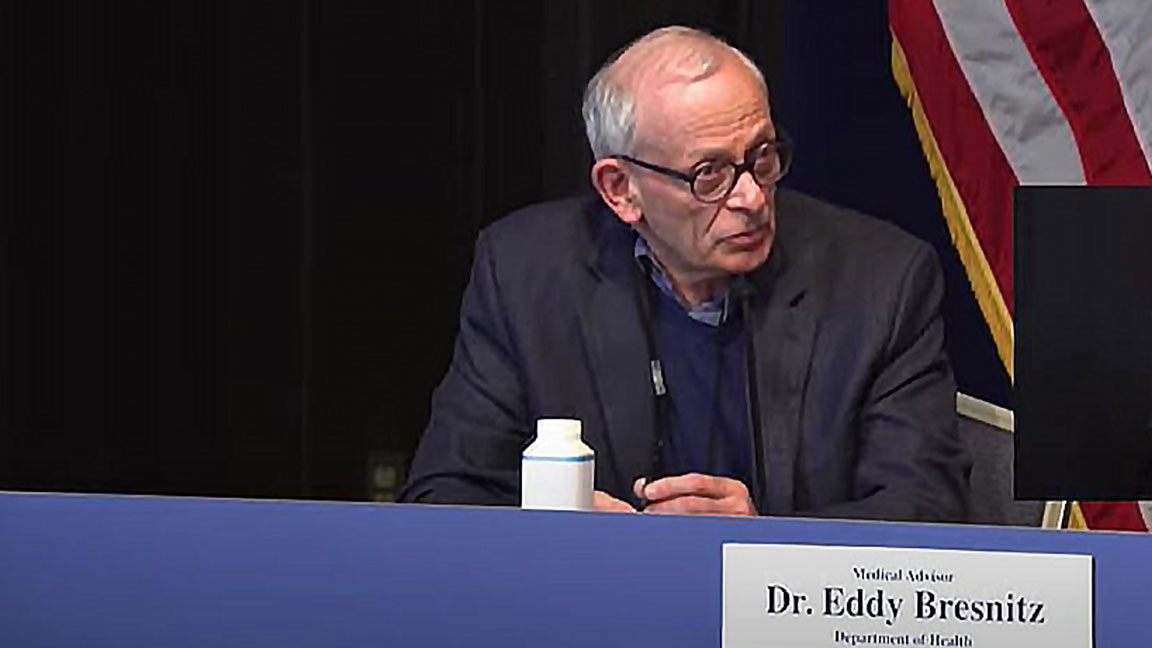
 Credit: (YouTube.com)
 There’s a growing awareness that COVID-19 isn’t going away, even if we the pandemic is no longer at its height. NJ Spotlight News recently convened a panel of experts in a virtual roundtable to discuss what that means for New Jerseyans and how they can safely navigate the new landscape.
Participants in the interactive event submitted questions in advance and during the 75-minute conversation to ask panelists about school safety, workplace protocols and travel restrictions.
Today Dr. Eddy Bresnitz, the former medical adviser to the New Jersey Department of Health’s COVID-19 response, answers questions about a topic of particular importance to participants: vaccines and booster shots.
Responses to other questions were published Tuesday.
Q: When can we expect a vaccine for the under-5 population?
Both Pfizer/BioNTech and Moderna have been studying the use of their respective mRNA vaccines in children under age 5. Because of an inadequate immunologic response to a two-dose series in that age group (each dose 1/10 of the approved adult dose), Pfizer/BioNTech expanded its study to a three-dose series, with results expected this month.
Moderna recently announced results of its two-dose series in children under age 6 (each dose 1/4 of the adult dose) which showed an immunologic response similar to that seen in adults ages 18-25. The vaccines prevented symptomatic infection in 37.5% of the children ages 2 to 6 years and in 43.7% of the children ages 6 months to 2 years. Moderna is expecting to submit these data to the Food and Drug Administration for emergency use authorization in the next few weeks.
The limited data from both studies are only available through press releases and have not yet been published in peer-reviewed journals or posted online. Once all the data are submitted by the manufacturers, the FDA and its advisory committee will review the data and if the agency authorizes the vaccines, the Centers for Disease Control and Prevention and its advisory group will issue recommendations on the use of the vaccines. The whole process is likely to take several months, and optimistically one or both vaccines would be available for the targeted age groups by late spring or early summer.
Q: What is the latest information available on vaccine and booster efficacy?
The answer to this question is complicated and informed by many studies of all authorized or licensed COVID-19 vaccines in many countries, assessing both immunogenicity and vaccine efficacy, or how well it works to prevent infection, symptomatic disease and serious illness (hospitalization, ICU admission) and death.
The emergence of variants of concern, including delta and omicron, has impacted the response to the current vaccines. Immunologic studies have demonstrated a decline in neutralizing antibody levels within months after completion of a primary series of shots and also after a booster dose in all eligible age groups.
The decline in vaccine efficiency after a primary series led to the recommendation of a booster dose last year (see below), and limited data on the decline in vaccine efficiency after an initial booster dose contributed to the recent authorization by the FDA of a second booster dose at least four months after the first for certain higher-risk individuals.
A current CDC review of studies shows that individuals who are up-to-date on their COVID-19 vaccinations continue to be relatively well-protected against serious illness, even months after their last dose. However, the risk of infection, both symptomatic and asymptomatic, increases with time after vaccination.
Q; Will boosters be needed once a year going forward or every six months?
In late March, following the FDA authorization for a second booster, the CDC updated its recommendations to allow for a second booster of both mRNA vaccines, at least four months after the first booster, for people age 50 years and older and for younger people with significant immunodeficiencies.
This is considered a permissive recommendation and implies that an eligible individual should make a shared clinical decision with a health care provider about whether or not it is the right time to get the second booster based on their individual circumstances.
Those individuals who received a dose of the J&J/Janssen vaccine for their primary vaccination and a subsequent booster dose at least two months after the initial dose may now receive a second booster dose with an mRNA COVID-19 vaccine.
It is unknown whether or when additional booster doses, either with the current vaccine formulation or a new formulation that is specific to new variants, will be recommended in the future. The FDA’s vaccine advisory committee discussed this issue on April 6 to provide input on how best to proceed.
The presentations of data informing the discussion are available here.
Q: What do you think about traveling overseas? Do you think testing to return to the U.S. will be required in the near and distant future?
The decision to travel internationally is informed by several factors including personal risk, risk at the destination and personal risk tolerance. Personal risk factors include age, underlying medical conditions, vaccination status and willingness to wear a mask in specific situations. The risk at the destination(s) depends on the status of current infection in the local communities you plan to visit, level of vaccination in the local population and local utilization of other non-pharmaceutical protective measures. Finally, your personal tolerance for risk of disease (as well as those of your travel companions) will have a significant bearing on your decision to travel.
It is important to consult current recommendations/requirements of all the countries and locales you are planning to visit in advance of booking your trip to ensure that you can meet those conditions to enter and travel in the country/ies.
A good source for initial information is this CDC website.
Another good source is the U.S. Department of State, which has COVID-19 country-specific information.
At this point, there is a requirement for proof of a negative COVID-19 test or documentation of recovery from COVID-19 before travel to the U.S. by air. The current requirements are summarized on this CDC site.
As long as the world is considered to be in a COVID-19 pandemic phase, it is unlikely that the U.S. will change these requirements. Before the U.S. would drop this requirement, the World Health Organization would have to declare the pandemic had shifted to an endemic phase with both the CDC and U.S. State Department concurring in that assessment.
Q: Are we now in a stage, just like the flu or common cold, where we will be living with COVID-19 indefinitely?
That is a hard question to answer but the trajectory of the pandemic globally to date suggests that this is the case. Over more than two years, the SARS CoV-2 virus has shown a remarkable ability to mutate to facilitate its transmission to individuals who are unvaccinated, partially or fully vaccinated, with or without a booster dose and those who have previously been infected.
As the majority of people in the world are either unvaccinated or partially vaccinated, the virus has many hosts susceptible to infection and illness. With each new variant, there is the risk that the virus is more transmissible, more resistant to current vaccines and/or therapeutics, and more difficult to contain.
All this underscores the need for people to be up-to-date in their COVID-19 vaccinations; be vigilant about the ever-changing epidemiology in their community; be cognizant of their own personal risk of disease and those in their home; and practice a layered approach to prevention when appropriate — masking, physical distancing, etc.