
 Credit: (AP Photo/Julio Cortez; AP Photo/Seth Wenig)
The newly adopted New Jersey legislative district map will give voters new representatives in many parts of the state and could wind up sending more Republicans to the State House. And it is also proof that Republicans and Democrats can compromise on a major political undertaking when the circumstances are right.
But good-government advocates say it’s still not a perfect process.
“Our process was designed for bipartisan consensus. For the first time, it worked out exactly as designed,” said Henal Patel of the New Jersey Institute of Social Justice. However, she added, “Bipartisan is not nonpartisan.”
On Friday, the New Jersey Legislative Apportionment Commission voted 9-2 to adopt a consensus map to be used in elections from 2024 to 2031. That final map was different from what the Democratic members and the Republican members proposed earlier this month as the so-called Turnpike and Parkway maps, respectively. The chosen map does appear to make a number of GOP districts more Republican, while making a couple of districts more difficult for Democrats to retain. Still, a majority of members of both parties’ delegations to the commission approved the map, a first since this process began in 1970.
In the past, a map has been chosen by the commission only when the 11th member cast a tie-breaking vote between competing Democratic and Republican proposals.
Something for both parties
Some Democrats groused about the final map’s pitting two incumbent senators against one another in the new 33rd District in Hudson County and the redrawn 27th in Essex. The map also makes the currently Democratic 4th District in South Jersey and 16th in Central Jersey more competitive. But others in the party said it’s a map they can live with.
“The map adopted today preserves every Democratic district and allows opportunities to expand our majority,” said Assembly Speaker Craig Coughlin (D-Middlesex). “It also allows for much-needed increase in representation for people of color. I look forward to working to earn Democratic majorities in both Houses of the Legislature under these new districts.”
Republicans were happier. Even though some sitting lawmakers were moved into different districts, they are not being forced into primary fights and their new districts remain GOP-leaning. And the party will have a better chance to pick up more seats in the 2023 election.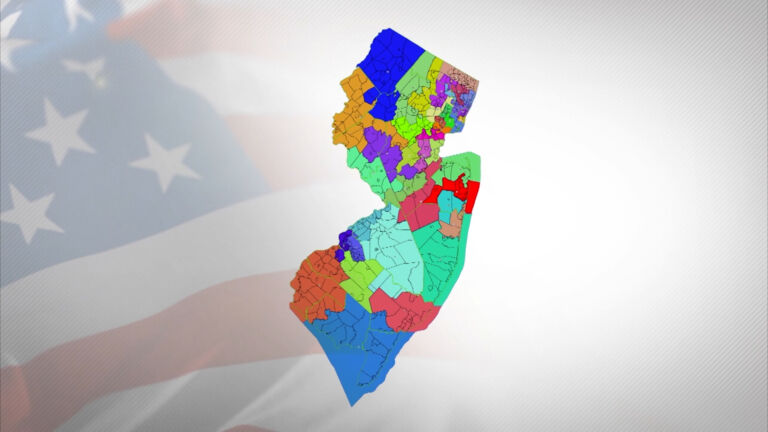
Bob Hugin, chair of the New Jersey Republican Party, said the new map “solidifies and strengthens the positions of our Republican representatives in battleground districts, but just as importantly, delivers a number of highly competitive, offensive pickup opportunities.”
He also said it gives the party a chance to take control of the Legislature if it fights hard and runs good candidates.
But Micah Rasmussen, director of the Rebovich Institute for New Jersey Politics at Rider University, said that’s likely an overstatement. Other than the 4th District, which truly becomes competitive, the changes to the map should be seen as “adjustments” that don’t really shift the underlying statewide dynamics.
“Yes, there are additional potential opportunities for Republicans to make further in-roads, but anyone who is being candid will concede that it will take a wave election to see wholesale changes,” he said. “In that respect, the new map is a series of adjustments to the last map.”
Changes for many voters
While it may not change the political party representing many districts, the new map will give hundreds of thousands of New Jerseyans new representation because of the number of municipalities it shifted from one district to another. In particular, some boundary lines in north Jersey were redrawn significantly, especially Morris County’s 25th and 26th districts and those in Essex, Hudson and southern Bergen counties, where Newark, Jersey City and some other communities are home to some of the largest population growth between the 2010 and 2020 censuses.
Once a decade, districts are redrawn to rebalance the size of districts and, in theory, reflect the demographic changes of the population.
For advocates, some who helped stop a Democratic-led effort to change the rules and give an edge to the party that gets the most votes in elections, the legislative commission did a much better job of listening to the public, including by releasing the parties’ early map proposals.
“Publicly releasing the maps was historic and crucial,” said Patel, who was a member of the Fair Districts Coalition that had proposed its own map. “Now it’s a matter of whether this can become a permanent part of the process.”
A ‘fundamentally redefined’ role
Rasmussen said Philip Carchman — a retired appellate judge who served as the 11th member of the commission, otherwise divided equally between the two parties — “fundamentally redefined the role,” which used to be known as a tiebreaker.
“Rather than cast the deciding vote, Carchman brokered a bipartisan compromise map,” Rasmussen said. “In an age of polarization, I do find that important for public confidence. He was determined not to let the final map be labeled as the Democrats’ or the Republicans’. And it worked. If you use the metric of both sides getting some of what they wanted but neither side getting everything they wanted, it was mission accomplished.”
Patrick Murray, director of the Monmouth University Polling Institute, credited Carchman with the way the process worked and said there could have been a different outcome had former Senate President Steve Sweeney remained on the panel. Sweeney, a Democrat, was highly critical of the consensus map and likely would have “fought much harder to have Carchman retain the tiebreaker role,” Murray said.
Murray said he hopes Carchman will write about this year’s process and how he was able to get the sides to agree. He said he thinks much of the reason was “the power of his own personality,” referring to Carchman. But this success does not preclude the need for further reform.
“Carchman is the exception who proves the need for reform in that you can’t replicate Carchman in every redistricting process,” Murray said.
Recalling a reform proposal he put forth with others, Murray said the redistricting commission should have three independent members, not just one, and should require a supermajority vote to adopt a map. That should result in the parties having to compromise, something Carchman was able to achieve but that is not guaranteed to occur in the future.
Stark contrast with congressional process
The legislative commission’s operation and vote was much different from that of the bipartisan body that redrew congressional district boundaries shortly before Christmas. The New Jersey Congressional Redistricting Commission held 10 public hearings, but did not release any maps prior to its party-line vote, which saw its 13th member breaking a tie and siding with Democrats. The Republican members challenged the map in state court but lost.
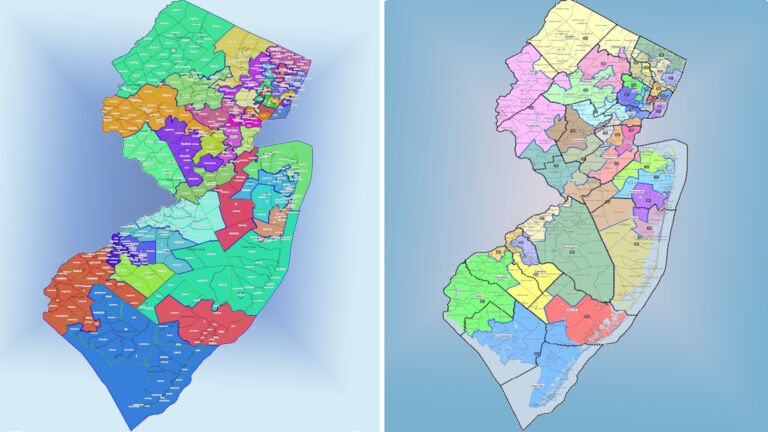
Especially troubling, Patel maintained, is the “packing” of Black and Latino voters in the 28th District in Essex County and 33rd in Hudson. Concentrating large numbers of people of any given group in a district dilutes that group’s ability to influence in neighboring districts. According to data from the commission, the 28th District is 67% non-Hispanic Black and 13% Hispanic and the 33rd is about 68% Hispanic with another 14% Black, Asian, multiracial or of some other race.
So while some saw this year’s legislative redistricting process as better than past incarnations, it is still not as unbiased as what happens in some other states.
“We absolutely should be considering other options,” Patel said. “Political considerations take priority in partisan processes like ours. That’s how you end up with packed districts and cracked communities. We need a more independent, transparent redistricting process that centers public participation and racial equity.”
