

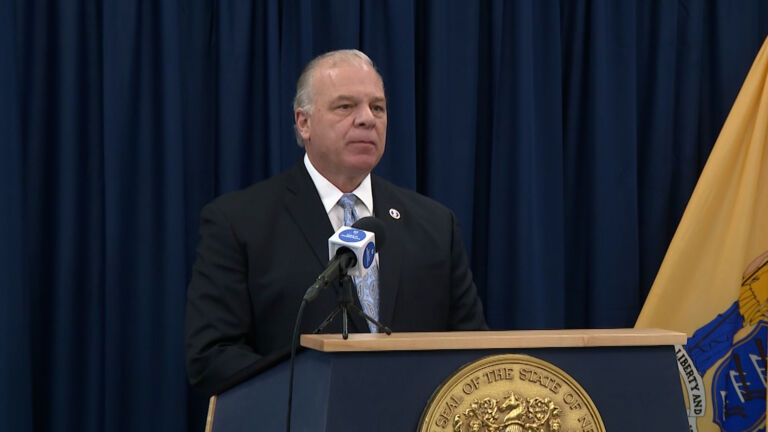
Just days away from leaving office after a shocking loss at the polls, Senate President Steve Sweeney is striking a bipartisan tone as he prepares to step aside following two decades in the State House.
During a lengthy interview with NJ Spotlight News, Sweeney (D-Gloucester) showed no bitterness and urged incoming lawmakers to “build relationships with the other party, whether you’re a Republican or Democrat.”
“My advice would be, don’t worry about the letter next to your name,” said Sweeney, who was known as a bipartisan dealmaker while serving for more than a decade as Senate president.
“I always fought and took on the big issues that aren’t always good for you, politically,” Sweeney said later during the interview. “I always looked at it as, when you’re in a leadership role, you have to lead. You know what I mean? I do believe we have good people here and I wish for their success.”
But preparing to leave the Senate and looking to start up what he calls a bipartisan think tank, was not how he was supposed to be spending the first part of the new year.

The Senate president hadn’t lost an election in 20 years
However, Sweeney’s stunning loss to Republican newcomer Edward Durr in November shook up New Jersey’s political universe, as well as the power dynamic in Trenton.
In a November concession, Sweeney cited a “red wave” that swamped him and his Assembly running mates John Burzichelli and Adam Taliaferro. Gov. Phil Murphy, a fellow Democrat, also only narrowly held off GOP challenger Jack Ciattarelli in a state where Democrats hold a wide majority over Republicans.
During Monday’s interview, Sweeney was more circumspect, noting his district is not one of those in the state where a majority of the registered voters are Democrats.
“I didn’t lose in a Democrat district. I lost in a Republican district where the governor lost by 15 points, and I lost by 3. You know?” Sweeney said.
In all, 16 new lawmakers are due to take the oath of office next week when the Legislature formally reorganizes in the wake of the results of the November elections. But Democrats are still holding onto majorities in both houses, and veteran Sen. Nicholas Scutari (D-Union) is expected to become the next Senate president
However, Sweeney’s loss means a South Jersey lawmaker will no longer control the agenda in the Senate. It also means the region’s clout will undoubtedly take a hit after years of either Sweeney or former Assembly Speaker Joe Roberts (D-Camden) holding one of the top positions on State Street.
“I tell people, ‘Forget about me for a second, we just gave away the Senate presidency.’ It’s going to hurt South Jersey. Without question it’s going to hurt South Jersey. But elections have consequences,” Sweeney said.
As for what’s next, in addition to confirming plans to launch a think tank, Sweeney did not rule out a future run for governor, which is something many have already begun to pencil in as a strong likelihood for 2025. Under constitutional term limits, Murphy cannot seek a third term and Sweeney is not declaring his candidacy, something that would trigger formal campaign-finance laws.
“What do I do next? The think tank is for sure first. (But) I’m not done, and I’m going to make it very clear to my colleagues in the Senate, I don’t want farewell speeches from anyone because I’m not going away,” he said.
In terms of regrets, Sweeney said his biggest one is not voting in favor of same-sex marriage in 2010 when the issue first went before the Senate.
“The marriage-equality vote, nothing more upset me than that because, look, I was the incoming Senate president, you see the district I’m in, and I cast a vote thinking about politics instead of policy,” he said.
“I had never done that in my life. I’ve always taken hard stands and stood for the things I believe in. I was disgusted with myself — immediately,” Sweeney said.
But he believes the mistake has been addressed to some degree after a recent vote that sent a new bill seeking to codify subsequent court rulings on marriage equality. The Sweeney-led Senate passed the same-sex marriage legislation last month with support from many Republicans in a 35-4 vote. Meanwhile, the Assembly also voted in favor of the measure, by a 53-10 margin.
“What made me really feel quite proud is we had 35 members vote ‘yes.’ When you think about it from a decade ago, where it was a brawl to get a vote . . . and now to get 35 votes, like I said, I’m very proud of it,” he said.
Sweeney said he intends to continue efforts to promote shared services and regionalization once the think tank is up and running.
During the interview, he also looked back on efforts to address New Jersey’s significant pension-funding challenges, including by seeking full funding of the employer obligation by the state. That’s a hurdle New Jersey is finally overcoming during the current fiscal year, after more than two decades of repeated underfunding.
Meanwhile, Sweeney in 2011 also worked with former Republican Gov. Chris Christie on several other changes to public-worker benefits, including upping worker contribution rates and pushing back the retirement age for many workers. Those efforts put him at odds with the state’s powerful public-worker unions.
Yet he still wants to see more work done in this area, citing the many years of significant payments the state will need to make over the next several decades to fully climb out of its deep pension-funding hole.
With New Jersey now devoting more than 15% of annual revenues to the employer pension contribution, Sweeney said he will also be holding Murphy to a commitment the governor made to enact policy changes once the state lived up to its own promises to workers on pension funding. And workers are also itching to get back cost-of-living adjustments that were suspended a decade ago as another cost-saving measure.
“We’re by no means out of the woods,” Sweeney said.
“This is not attacking the workforce either. It’s sitting down with the unions and coming up with a solution,” he went on to say.

The Senate president is leaving office knowing he’s succeeded in moving district regionalization ahead, if not across the finish line
Sweeney also praised Murphy for sticking to efforts to reform school funding, even if it has meant some districts have seen their state aid reduced in recent years. But finding a dedicated source of revenue for New Jersey Transit also remains a key policy goal, albeit one that Sweeney will no longer get to push for as a lawmaker.
As for the importance of addressing top issues on a bipartisan basis, in an increasingly partisan environment, Sweeney said: “Anything meaningful, anything that’s really going to be challenging, needs to be done in a bipartisan way.”
“You’ve got to be for something, but to be for something means you have to work for something to get it done,” he added.
“Hopefully we get to a point where people start focusing on the people of New Jersey,” he said. “That’s what I prided myself on. I didn’t care about Republican or Democrat, who got credit, as long as we were moving the ball down the field, and we were making it better for people, that’s what mattered the most.”
