
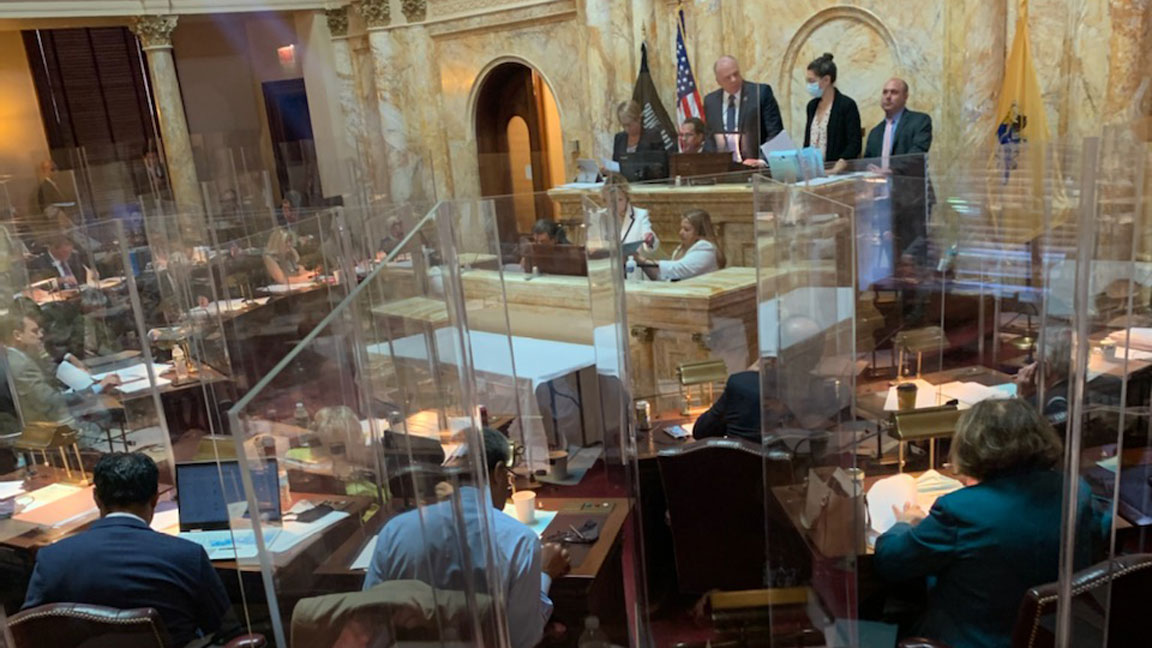
 Credit: (NJ Spotlight News)
Lawmakers went down to the wire on Monday, using the final full day of a two-year legislative session to send Gov. Phil Murphy dozens of bills addressing everything from abortion rights to pollution concerns.
The end of a lame-duck portion of their calendar that followed last November’s elections also served as a swan song for more than a dozen lawmakers, including longtime Senate President Steve Sweeney (D-Gloucester) who is out after last year’s shocking reelection loss.
On Tuesday, the Legislature will reorganize based on those election results. In all, 16 new members of the Legislature will be sworn into office. Murphy, a Democrat, who won a second, four-year term in November, is also due to deliver the annual State of the State address on Tuesday.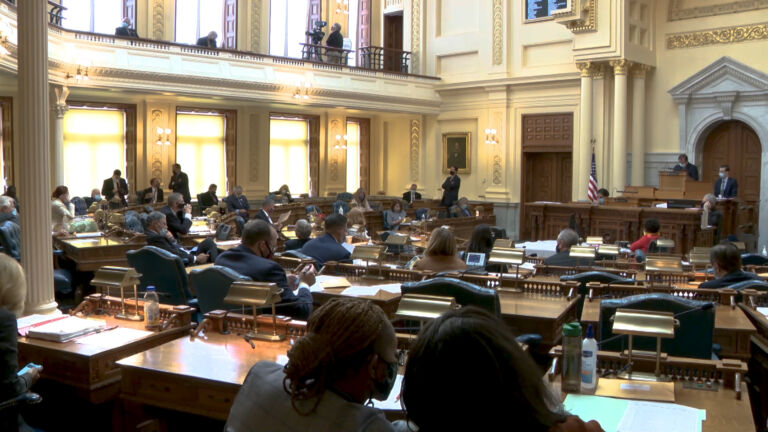
Here’s a closer look at some of the bills that made it to the legislative finish line on Monday, as well as some that did not.
Bills that were sent to the governor’s desk
Abortion rights/reproductive choice (S-49) – A bill that calls for codifying the freedom of reproductive choice, including the right to access contraception, to terminate a pregnancy, and to carry a pregnancy to term as a constitutional right previously recognized by the New Jersey Supreme Court. The bill also called for guaranteeing the “fundamental right of reproductive autonomy” to all individuals present in New Jersey, including nonresidents. It would also enable all qualified health care professionals to provide pregnancy termination services.
Nursing home regulations (S-2759/A-4478) – A bill that would provide the Department of Health more power and discretion in regulating nursing homes, which were extremely hard-hit by COVID-19 during the first year of the pandemic. The bill — one of many passed based on a consultant’s report that found long-standing problems in the industry — allows DOH to assess larger fines and require additional facility reforms; forces nursing homes to post IRS990s or certified financial statements on their websites; requires greater tracking and reporting on infections and resources; and creates a nursing home advisory council within DOH.
Electronic medical records (A-4253/S-3233) – A bill that would require certain labs, hospitals and other entities maintaining electronic medical records to also collect, maintain and share with state regulators data on gender, race and ethnicity. Introduced in late 2020, the measure was proposed to help identify — and eventually address — racial disparities in health that were broadly exposed by the pandemic.
Harm reduction (S-3009) – A bill seeking to expand access to clean-needle programs for opioid users — and reduce blood-borne infections like HIV/AIDS — including by giving the state, and not local government, more control over where to locate such programs.
Retired teachers (S-3685) – A bill that would allow retired teachers to return to the classroom without losing their pension benefits. The bill was backed by education groups whose schools have been grappling with severe — and daily — shortages in teachers, substitute teachers and other staff in the face of the pandemic. Under the bill, the retirees would be able to return to work full-time in areas that must be determined to be of “critical need.”
Plastics recycling (A-4676/S-2515) – A bill that would require plastic manufacturers to use a certain amount of recycled plastics in their products. The legislation aims to reduce plastic pollution in the state’s waste stream. Advocates say that this top priority of the environmental community will also help revive the recycling market, which has collapsed in recent years.
Pesticide classification (A-2070/S-1016) – In a bid to help avert the die-off of bee populations, the bill directs the state Department of Environmental Protection to classify neonicotinoid pesticides as restricted-use pesticides. Environmentalists claim these insecticides are harmful to public health but can destroy bee populations that are critical to the ecosystem and food supply. A report published by the DEP in 2020 found neonicotinoid pesticides, or neonics, in half of more than 250 surface water and groundwater samples taken around the state.
Paint recycling (S-2679) – The bill would establish a program to make paint manufacturers set up a collection program to recycle and reuse the half-empty paint cans that sit in basements and garages of homes. The legislation has kicked around Trenton for years. This time around, the measure has strong support from paint manufacturers and environmentalists.
Police at polling places/drop boxes (A-4655/S-3595) – Initially proposed by sponsors to address voter intimidation in New Jersey, this bill would limit police presence at polling sites and ballot drop boxes, and also prohibit electioneering within 100 feet of a ballot drop box.
Police body cam footage (A-5864) – A bill that grants law enforcement officers permission to review body-worn camera recordings before writing their initial report. Current law prohibits officers from viewing body camera recordings prior to creating a report regarding a recorded event. The bill would allow law enforcement to review footage in certain instances, excluding encounters of police violence, weapon use, or bias and discrimination. The bill was previously conditionally vetoed by Murphy.
Film and digital-media production tax breaks (S-4094) – This bill would raise the cap on the value of digital-media production tax credits that can be awarded annually in New Jersey. It would also hike an existing limit on how much can be paid to an individual actor, director, writer or other film production employee while still qualifying for a state tax break.
Library grants (A-6148) – This bill appropriates $37 million in state funding for grants to county and local library branches. The funding is for library upgrades, including construction, reconstruction, development, extension, improvement, and furnishing. The funding comes from a $125 million bond issue that won widespread approval from New Jersey voters in 2017. This is the second round of grants to be funded with the bond proceeds, using a competitive grant process established in law.
Police crisis-intervention training (S-2801/A-4366) – A bill that would require every municipal and county police officer in New Jersey to complete the Crisis Intervention Team model as part of the officer’s in-service training, within five years of the bill’s effective date or by a date determined by the attorney general.
Municipal prosecutor domestic-violence training (A-1763/S-386) – This bill would establish mandatory domestic violence training for municipal prosecutors in New Jersey. It would also require the attorney general to develop a curriculum for training programs specific to domestic violence regarding the impacts it can have on children, the impact of trauma on survivors, offender’s accountability, and safety planning and services for survivors. It would also ensure that all new municipal prosecutors attend domestic violence training within 90 days of their appointment.

Notable bills that failed to clear the Legislature
Reparations task force (A-711/S-322) – This bill called for the creation of a group of interdisciplinary experts — historians, advocates and others — to quantify and qualify the generational impact of slavery on Black residents in New Jersey. The group would propose policy changes and investments in Black communities to serve as “reparations.” Sponsors said it would go beyond the work of a wealth disparity task force impaneled by Murphy by specifically focusing on the legacy of slavery.
Police chokehold measure (A-4284/S-2617) – A bill that would make it a crime for police officers to use chokeholds. Currently, police can only use chokeholds if a life is at risk, under updated guidelines issued by former Attorney General Gurbir Grewal in June 2020. Criminal justice advocates have been outspoken about the bill’s failure to move forward.
Qualified immunity (S-3730) – The bill seeks to end qualified immunity, a legal precedent which protects government workers in civil suits often used in cases against police officers accused of misconduct. Activists say the legal immunity could protect police who have physically harmed individuals.
Racism as a public health crisis (A-R175/SR-127) – This resolution would declare racism a public health crisis in New Jersey. It cleared the Senate but stalled in the Assembly.
Teacher residency requirement (S-4203) – This bill would end the New Jersey residency requirement for public school teachers and staff, first imposed a decade ago by then-Gov. Chris Christie. Introduced last month, the bill is meant to free up teacher candidates to work in the state’s public schools at a time of significant staff shortages. The residency requirement — which has applied to all state and local employees — had especially impacted school districts near the New York and Pennsylvania borders. The loosening of the restriction for teachers would be in effect for three years, after which the state Department of Education would issue a report on its impact. The bill cleared the Senate, but a companion bill in the Assembly was not filed.
Building electrification (S-4133) – A bill that would have served as the first significant rebuke to the Murphy administration’ clean-energy agenda, it called for undermining one of the governor’s top priorities — electrifying buildings to replace natural gas, which is used by 75% of homeowners to heat their homes. The legislation would have prohibited any mandates to replace those systems with electric and water heating systems.
Revenue-forecasting reform (S-1530) – A bill that would have overhauled the way New Jersey forecasts annual tax collections, including by enlisting outside experts to improve accuracy. The bill also called for enhancing monthly financial-reporting requirements; mandating multiyear spending projections; and requiring annual “stress testing” of the budget to improve recession preparedness.
— Tom Johnson, Taylor Jung, John Mooney, Colleen O’Dea, Lilo H. Stainton and Michael Sol Warren contributed to this story.

