
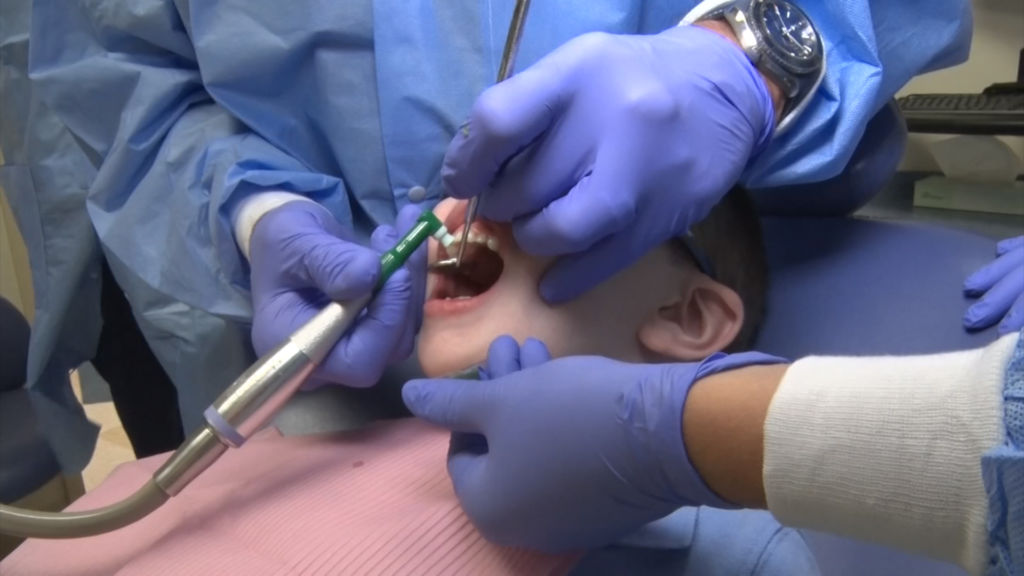
The COVID-19 pandemic changed how patients think about even routine health care appointments, forcing them to weigh the risks of potential infection against the urgency of their medical needs. Consider dental treatments, where even a regular cleaning involves close physical contact — for provider and patient — and a high likelihood of contact with blood and saliva.
Dentists have a long history of infection-control practices and industry studies show their offices were not COVID-19 transmission sites, even before vaccines were available. Dental providers were among the first group eligible for immunization late last year and nine out of 10 dentists are now vaccinated, according to the American Dental Association, along with nearly three-quarters of the hygienist staff.
But for most dentists in New Jersey and nationwide, COVID-19 vaccination is optional. Private dental practices — along with private doctors’ offices — are not covered by the state or federal vaccine mandates for health care workers.
That may come as a surprise to some. It certainly did for one elderly couple from central Jersey, who were appalled to learn the hygienist that was about to perform a cleaning did not believe in the COVID-19 vaccine. They walked out. The seniors who detailed their story for NJ Spotlight News did not want their names used publicly as they are still searching for a dentist that will assure them practice staff is fully immunized.
“When the public hears health care workers must be vaccinated, they don’t realize that does not trickle down to nurses or staff at a private (medical) practice. It doesn’t trickle down to dentists in private practice,” said Steven Adler, a leading labor and employment attorney with the Roseland law firm Mandelbaum Salsburg.
Adler said the federal vaccine mandates have essentially focused on two groups, large employers and high-risk settings like hospitals, nursing homes and facilities that accept Medicare and Medicaid payments, which could eventually be used as enforcement leverage. At least 10 states have challenged the health care requirements and several elements remain in court.
New Jersey’s mandate — an executive order Gov. Phil Murphy issued in early August — targeted state-regulated entities like health care facilities, residential centers for individuals with disabilities and jails and prisons. But it does not include private practices, Adler noted, a decision that may reflect enforcement capacity and political considerations.
“I guess they decided we’re not going to push this all the way down to the private practices and the small doctors’ offices,” Adler said of the state order, which allows weekly COVID-19 testing as an option in locations where it does apply. While private practices may include providers who work in hospitals and are therefore subject to the mandate, small practices themselves are not included.
Record of safety
The impact of this gap is not clear, but dentists insist their work is safe.
“Dental offices have been very safe places throughout the coronavirus pandemic,” said Dr. Cecile Feldman, dean of Rutgers School of Dental Medicine. “Dentists in general are just really good with infection control. It’s central to who we are and what we do.”
Despite that track record, Feldman said dentists should embrace immunization to protect themselves, staff and patients.
“It’s not unreasonable for patients to want to go to dentists who have been vaccinated,” she said. “There’s no question that, by the nature of what we do, there’s higher risk.”
Most doctors — especially those involved with surgery or other invasive procedures — are likely to be associated with a facility and therefore would fall under the vaccine mandate, experts note. Even those in private practice have largely embraced immunization, according to Larry Downs, CEO of the Medical Society of New Jersey.
“The vast, vast majority of physician practices have been vaccinated, both their doctors and their staff,” he said.
Professional association opposes mandates
But dental care is more likely conducted in private practices. The American Dental Association has opposed the federal mandate, suggesting it should not apply to any dentists given their strong history of effective infection control. Techniques developed in the wake of the AIDS epidemic and further tuned during the SARS outbreak in 2004 have successfully kept patients and staff safe, the group points out. Practices have also deployed additional pandemic protections based on federal guidance.
Surveys show low COVID-19 infection rates among dentists and only a fraction of the provider cases that could be traced to a source linked to dental practices, according to a November 2020 report in JADA, the association’s clinical journal. No patient has reported contracting COVID-19 from a dental visit since the start of the pandemic, the ADA continues to assert.
“It is safe to go to the dentist. It was safe before there was a vaccine available and it is safe now,” said Dr. Luciano Ghisalberti, president of the New Jersey Dental Association with a Hudson County practice. “We do encourage people to be vaccinated, but we also follow the science. According to (federal data), there have been no identified clusters of COVID attributed to a dental office.”
The NJDA, which represents the state’s 6,500 practicing dentists, has supported the state and federal requirements as drafted and does not see a need for them to cover private practice as well. It is not clear how many of New Jersey’s dentists are covered by the existing mandates.
A ‘huge hole’
Feldman, at Rutgers, sees it slightly differently. She said she was “very disappointed” with the state and federal mandates that “left this huge hole” by not including private-practice providers. It also created confusion among patients and providers about who was covered, she said.
“I strongly believe that if you are a health care provider you have an obligation to do all you can to protect your patients,” Feldman said, while she regrets it requires a mandate to persuade clinicians to get immunized. More than 6 million New Jerseyans are considered fully vaccinated against COVID-19, although many remain eligible for a booster dose.
Staffers in Murphy’s office declined to explain how state officials drafted the COVID-19 vaccine mandate but note New Jersey’s order was more inclusive than those of several other states. Private employers also have the authority to require staff to be immunized, something a number have done. State employees also must get their shots or be tested weekly.
“Governor Murphy believes that vaccinations are a critical tool to ending the COVID-19 pandemic,” said Alexandra Altman, a spokesperson for the governor. “Governor Murphy and his team are constantly monitoring New Jersey’s statewide vaccination rates, as well as the vaccination rate among workers in covered settings. We continue to conduct outreach to increase vaccination rates across several areas and are exploring avenues to strengthen vaccination coverage among all health care workers in the state.”
