
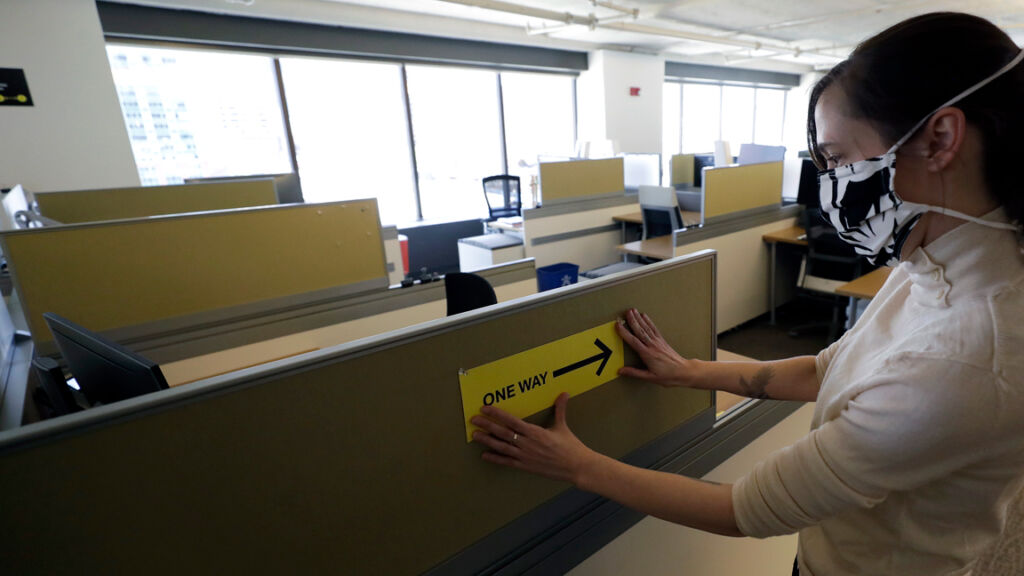
Monday was the deadline for some 200,000 employees in New Jersey’s schools and state government to be fully vaccinated against COVID-19 — or start submitting to weekly viral screenings — and the day state workers were slated to return to their offices in person.
Instead, Gov. Phil Murphy announced that New Jersey’s 64,000 state workers would return from remote work in phases, with the larger departments that engage most with the public reporting to their buildings first. Murphy could not say how many of these public employees — in state agencies or K-12 schools, which have been working in person since September — have already met the vaccination mandate he announced in August.
“We had used October 18 as a date that we wanted to get folks back in. I think we made the right decision to do that in a phased-in manner” to allow for a smoother rollout of the testing option, Murphy told reporters Monday at his regular pandemic media briefing. “We decided with some of the bigger agencies to focus on them first, especially some of the front-facing agencies,” he said. “Other agencies will get phased in over the coming weeks.”
Some state workers already back
Murphy said the departments that have returned to in-person duties as of Monday include his office; the Department of Children and Families, which reports some 6,600 staff on its website; the Motor Vehicle Commission, which had nearly 1,500 workers in 2019, according to its annual report that year; and the Department of Labor, with at least 3,000 workers, although the agency’s One-Stop Career Centers are open by appointment only. A labor department spokesperson did not respond to a request Monday for further detail.
Many staffers at the Department of Health have been working in their Trenton office every day since March 4, 2020, state health commissioner Judy Persichilli said Monday. She did not say how many of them were vaccinated.
About 70% of workers at the Department of Children and Families have been vaccinated, according to a department official. Monday was also the deadline for employees to file attestations confirming their vaccination status and state officials said they are still processing these forms.
Employees who decline to get inoculated against COVID-19 can opt to be tested at least once a month under the state policy, and screenings are available at more than 1,000 sites across New Jersey. The state also worked with local health departments to set up a testing protocol for school districts, officials said, and set aside $267 million in federal funds to help educators pay for the screening. But Murphy said Monday a “vendor issue” could delay the rollout of school-based testing in some districts for several weeks.
Statewide, nearly 6 million of New Jersey’s 9 million residents have been inoculated against COVID-19, which has been detected in nearly 1.2 million people here since March 2020, including the nearly 28,000 who have died. Murphy called for all health care workers to get immunized against COVID-19 in July, and the next month he added state government staff and public-school employees to New Jersey’s vaccination mandate list. The governor also signed an order in August requiring all students and staff to wear masks in schools.
Vaccination rates among school employees
The mandates have been the focus of public discussion for months and, in recent weeks, reporters have pressed the Murphy administration for more information on the vaccination rates among education personnel. But Murphy said he was unprepared for those questions when he briefed the media Monday. “I don’t know, at least off the top of my head, what percentage (of state workers) are vaccinated,” he said, before indicating staff members would get back to reporters with more information. “But it’s a very high percentage.”
Murphy said the vaccination mandate applies to all state workers, including those still working remotely, but the testing requirement is only required for those who are back in the office. He could not offer details “off the top of (his) head” on when other departments would return to in-person operations, but he indicated it would happen over the coming weeks. “The folks who work in those departments are aware of what their schedule is,” he said.
The phased return of state government was a surprise announcement Monday, but Murphy insisted it wasn’t a new development. “This is the way we’ve been thinking about it for some time,” he said, noting it was important to offer testing for those refusing the shot, but this option had made the return more complicated. If the process wasn’t made public before, “then it’s my bad,” Murphy said.
Alana Alfaro Post, Murphy’s press secretary, said late Monday that agencies or departments with more than 2,500 workers will be back in the office full-time on Nov. 8; these include Law and Public Safety, a division of the attorney general’s office, and the departments of Corrections, Environmental Protection, Transportation and Human Services. Many of these agencies include people in field positions who have been serving in their normal capacity for months.
Departments with between 500 and 2,500 staff members — including Community Affairs and Education — are slated to return on Nov. 15, as is the parole board, Alfaro Post said. Smaller government units — including the Department of Banking and Insurance, the Department of State and nearly three dozen agencies — must return before the end of November, she said.
New Jersey’s public-school system — with 1.3 million pupils and 130,000 teachers, plus administrators and support staff — returned to in-person education earlier this fall, with the mask mandate in place and the vaccination requirement pending for this week. Murphy and other state officials have said they are generally satisfied with how these measures are working to control the spread of the coronavirus. So far, a total of 96 school-based COVID-19 outbreaks have been reported, up from 69 at the start of the month.
But Murphy and Persichilli have also conceded they do not have a complete picture of the public health protections in place in thousands of school buildings across the state. In early October, they ordered school districts to provide weekly reports on infections among students and staff and vaccination rates for the workforce. COVID-19 vaccines have been approved for people age 12 and older, but Murphy’s immunization mandate applies to school staff, not students. Everyone age 5 and older must wear face coverings, however.
“It’s like all these other big steps that we’ve taken” to respond to the pandemic, Murphy added. While not everything is streamlined at first, “we will get there,” he said.
— This story has been updated to clarify that Department of Labor One-Stop Career Centers are open, and by appointment only.
