
To address this limitation, the state Department of Human Services has partnered with medical schools in Camden and Newark to train hundreds of additional healthcare professionals so they can receive the federal certification needed to provide MAT to patients. The classes, which began in February, are slated to continue into the fall; the DHS has committed $2 million in state and federal funds to support the initiative, which is open to doctors, advanced practice nurses, and physician assistants.
“We are continuously working to increase access to substance use disorder treatment, particularly medication-assisted treatment for opioid use disorder,” said Valerie Mielke, the department’s assistant commissioner for the Division of Mental Health and Addiction Services, or DMHAS, which oversees community-based treatment options in the state. “Treatment works, and we are delighted that more and more health care providers are getting ready to offer medication-assisted treatment,” she said.
 Credit: Wikimedia Commons
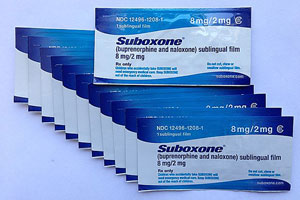
But federal regulators have placed additional requirements on healthcare professionals who prescribe buprenorphine; they must complete an eight-hour training module, obtain a specific waiver, and accept limits on the number of patients they can treat for opioid addiction at any one time. (They can treat 30 individuals with MAT the first year and 100 patients in future years.)
Prescribers’ concerns
These restrictions — in conjunction with personal concerns among providers about treating addicts with an opioid-based medication — have depressed participation in MAT programs, experts agree, resulting in a shortage of trained prescribers. This capacity gap was the top concern among participants at a roundtable discussion on opioid treatment hosted by NJ Spotlight in September.
The challenge is particularly acute for those facing the greatest risks, like individuals returning to their communities after time in prison, noted former Gov. Jim McGreevey, who now runs the New Jersey Reentry Corporation. While recently-incarcerated people are more than 40 times more likely to die of an opioid overdose than the general population, he said former inmates must deal with additional struggles — like obtaining a Medicaid card, scheduling doctor’s visits without easy access to a phone, and coordinating public transportation to various appointments.
“The clientele with the greatest vulnerability for overdose is getting the least attention,” McGreevey said. (NJRC did receive funding for several treatment-related efforts in the new state budget, including $500,000 for a MAT pilot project, and the state has sought to focus new attention on this population.)
New Jersey officials have sought to expand access to MAT in a variety of ways under Gov. Phil Murphy, who has pledged to invest $100 million annually in targeted, best practices to address the state’s opioid epidemic, which contributed to the death of more than 3,000 residents last year. This includes nearly $7.2 million in grants specifically for MAT programs that will be distributed through the DHS. The department has also reduced the barriers to this treatment for Medicaid members and required long-term programs funded by the state to accept MAT patients.
Clinical programs are also embracing the expansion of medication assisted treatment. Rutgers New Jersey Medical School now requires third-year students to obtain MAT training, and all emergency room staff at Cooper University Hospital in Camden have federal waivers. And in late June, the state Department of Health made New Jersey the first state in the nation to allow paramedics to carry and dispense buprenorphine to patients they have revived from an overdose.
Helping to ‘turn the tide’ on epidemic
The DHS training program — which has already engaged some 300 doctors, APNs and PAs — is another facet of the state’s effort to expand the use of MAT. The funding enables Cooper Medical School of Rowan University in Camden and Rutgers New Jersey Medical School in Newark to train dozens of providers at a time in the protocol. It also provides a $750 stipend to participants that complete the daylong course and receive federal approval to prescribe these medications. Sign-up for the program is handled through the schools.

Several professional organizations also praised the state’s training initiative, including the New Jersey State Nurses Association and the Medical Society of New Jersey. And leaders at DHS have welcomed this support as they look to grow treatment capacity around the Garden State.
“We are excited by the health care community’s response to our training sessions and their shared commitment to making opioid addiction treatment more readily available across our State,” said DHS commissioner Carole Johnson, who sat in on a training session at Rowan last week. “NJ Human Services is committed to making opioid addiction treatment as accessible as possible.”
