

“It’s a mixed bag,” David Hughes, professor of anthropology and vice president of the Rutgers American Association of University Professors-American Federation of Teachers faculty union said. “There are bright spots for which President [Robert] Barchi should take credit, but those are overwhelmed by his failures and his misunderstanding of public higher education.”
Barchi presented the report to the university’s Board of Governors last week, pointing to increases in endowed professorships, more than $2.5 billion in new construction, $42 million in strategic funding for the Rutgers Faculty Diversity Hiring Initiative, and the Rutgers Biomedical and Health Sciences and RWJBarnabas Health merger as examples of how much the university has achieved since it adopted its strategic plan in 2014.
“Through the efforts of our entire community, we have made tremendous progress at Rutgers in the past five years. The university is in an excellent position to meet the challenges and opportunities of the next decade and beyond,” Barchi said.
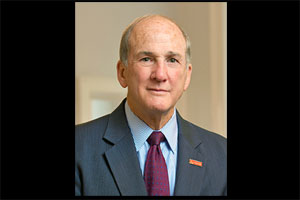 Credit: RU
‘Claiming credit’ where none is due?
“In some ways Rutgers is stronger than it was five years ago,” Hughes said. But he added that many of the accomplishments listed in the report occurred despite Barchi rather than because of him. “Twenty million of the $42 million for hiring of diverse faculty came in the teeth of a strike threat, more or less with the administration kicking and screaming and opposing it until the very last minute … he’s claiming credit for something we extracted.”
One of the plan’s foundational goals was to “raise Rutgers’ profile” in time for the university’s 250th anniversary in 2016. Indeed, Rutgers drew national attention when President Barack Obama delivered the commencement address in May of that year.
What’s more, since 2012, Barchi reported, Rutgers’ national rankings rose on U.S. News & World Report’s national research and regional institutions’ lists, and Rutgers was a top producer of Fulbright scholars 10 years in a row.
The state university has also taken a prominent place in the conversation on national issues, piloting a survey on campus sexual violence, advocating for student immigrants and Dreamers, and forming a First Amendment panel to advise on free speech issues.
The report lists several major accomplishments including:
The reality for faculty and students
But as Hughes pointed out, not all of Rutgers’ claimed successes are experienced by faculty and students on the ground.

“The system has taken so much staff and faculty time because of those bugs that it has really contributed to a great deal of dissatisfaction and some departures from the faculty.”
But the crux of Hughes’ issues with the report is its claims about keeping tuition increases to a minimum. Hughes argued Rutgers actually should be lowering tuition to serve the primary mission of any higher education institution — to expand knowledge for the economic and political enfranchisement of the widest possible swath of people.
“It’s like President Barchi is saying, ‘Well, the previous administrations hit you three times over the head with a two-by-four,’” which Hughes characterized as regular 3 percent tuition increases, “‘we’re only hitting you twice over the head with a two-by-four,’” by instituting two or 2.3 percent increases.
“The tuition issue is right at the core of the soul of this institution,” Hughes said. “There will be a lot of dissatisfaction among faculty, staff, and students with the report.”