
Candidates and committees spent more than $151 million on this year’s federal elections, according to an NJ Spotlight analysis of all data from the Center for Responsive Politics’ OpenSecrets website for all campaign reports filed with the Federal Election Commission through Monday. All of the major party candidates and some independents have filed required reports showing campaign activity through November 26.
In 2014, which also included 12 House seats and one in the Senate, the total spending was close to $53 million.
A few factors contributed to the spending increase, which far outpaced inflation.
For one, anti-Trump sentiment in several traditionally Republican districts brought excitement and cash into areas largely ignored by Democrats in the past. Two open House seats, due to Republican retirements in the southernmost 2nd district and north Jersey’s 11th, added to the fervor. Primary battles in half the districts brought additional spending. The result was unheard of spending of more than $10 million in three districts — the 3rd, 7th and 11th — and Democrats outspending Republicans in every House race, including the only one the party lost, the 4th.
The most expensive race
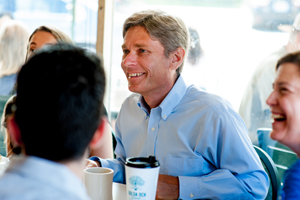
The most expensive race turned out to be the closest, in the 3rd district spanning Burlington and Ocean counties. A total of nearly $23 million was spent there, with more than half of that by so-called outside interest groups. This race was the last one called in New Jersey, after the counting of provisional ballots, and in the end, Democrat Andy Kim bested incumbent Rep. Tom MacArthur by fewer than 4,000 of almost 307,000 ballots cast.
MacArthur’s campaign spent less this year — $4.7 million, including $1.4 million from the candidate himself — than the $5 million he personally spent in 2014 to win the open seat. The most pro-Trump incumbent running in New Jersey, MacArthur sought to overturn the federal Affordable Care Act — he helped draft the legislation; that effort and his support for last year’s federal tax revisions hurt his re-election bid.
 Credit: Malinowski for Congress campaign
Democrat Mikie Sherrill, running in the 11th district, had the 16th largest war chest of any House candidate — almost $8.5 million — but may not have needed it. One of the most closely watched races in the state was predicted to be a close win for Sherrill, but she wound up trouncing Republican Jay Webber by almost 15 points. Between her campaign spending and that of outside groups, Sherrill spent more than six times what Webber spent. In total, the race cost $17.3 million.
Will Sherrill scare away competitors?
Brigid Harrison, a professor of political science and law at Montclair State University, said it’s difficult to say whether Sherrill or any of the other candidates had raised too much money.
“Optimally, a challenger would not spend excessively, but of course what’s excessive is impossible to know before the votes are counted,” she said. “In any case, Mikie’s expensive, resounding victory has the effect of potentially scaring away competitors in 2020, who would view both the enormous sums she raised and her enormous margin of victory as a formidable obstacle to unseating her.”
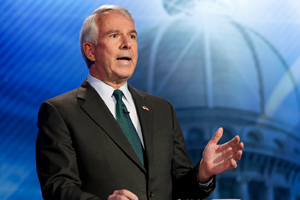
Another major reason for the large increase in spending for the midterms was the candidacy of Republican and former pharmaceuticals executive Bob Hugin, who attempted in vain to unseat Democratic Senate incumbent Bob Menendez in one of the nastiest campaigns in state history.
Hugin spent $36 million of his own money and his total war chest of $39.2 million — to which individuals, businesses and other political committees contributed — was the fifth largest for a Senate race this year. Hugin’s deep pockets and those of a pro-Hugin political action committee with ties to former Gov. Chris Christie attracted a large $7.6 million outlay by the Senate Majority PAC and millions more from other outside groups.
In total, almost $71.5 million was spent on the race, with half of that Hugin’s personal funds and 27 percent in outside spending ($19.4 million). The race was the ninth most expensive in the country on the Senate side this year.
Cash wasn’t enough for Hugin
 Credit: AP Photo/Julio Cortez, Pool
The expensive races in New Jersey are not surprising when put in a national context. OpenSecrets reported that the 2018 midterms broke several campaign finance records and were by far the most expensive midterms in history.
This year’s midterms also broke recent voting records in New Jersey, with 3.25 million people — 56 percent of all those registered — casting ballots.
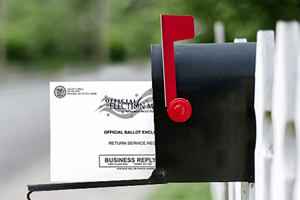
Last Friday, the state Division of Elections broke down those numbers further, showing that 12.3 percent of all the votes cast — or more than 400,000 — were cast by mail, a new record for any election. It even exceeded the 356,000 vote-by-mail ballots in the 2016 presidential election, which had a larger overall turnout of 68 percent. In the 2014 midterms, more than 143,000 people voted by mail.
Vote-by-mail, advantage Democrats
 Credit: Essex County Clerk's Office
“The Democrats have been trying to push this for a while because they are more successful with this,” Murray said. “Republicans tend to be higher propensity voters. The target for Democrats is to get those low propensity voters to vote more regularly.”
More than seven in 10 people who requested a mail-in ballot returned it, a higher percentage than the overall turnout for the elections.
