
 Credit: NJTV News
The Senate health committee held a “fact-finding” hearing Monday to determine what went wrong at the facility, the Wanaque Center for Nursing and Rehabilitation, where the virus has infected dozens of patients, and how the state can help reduce the danger in the future. The committee also discussed a bacterial outbreak at Newark’s University Hospital, which has been connected to the deaths of three severely premature infants.
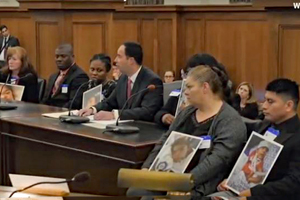
In addition to the state Health Commissioner Dr. Shereef Elnahal, the committee heard from labor leaders concerned about the impact of staffing levels at Wanaque and health policy experts on the challenge of protecting vulnerable patients from all types of infections. The panel also took testimony from families of Wanaque patients — including two who lost loved ones to the virus — and a medical malpractice attorney who is representing them.
 Credit: (NJ Spotlight News)
Missing from the hearing
Missing from the hearing were officials from Wanaque, University Hospital and the Voorhees Pediatric Facility, in Camden County, where eight children were infected with a less dangerous strain of adenovirus. “That troubles the committee and it troubles me as the chairman,” said Sen. Joe Vitale (D-Middlesex) who led the hearing.
Another committee member, Sen. Richard Codey (D-Essex), suggested the panel should seek subpoena power “to drag their butts in here.”
Vitale stressed that all three outbreaks are unrelated, and officials have said there is no danger to the public at large from the virus or bacterium. “Nevertheless, I’m sure a lesson can be learned from each of the facilities’ response, as well as the state’s response,” he said.
Elnahal said his department has already reviewed how it handles outbreak notifications and revised how these will happen in the future, so that he himself is alerted if the situation leads to a child’s death. He said he is also examining the need for new inspection and enforcement standards for pediatric long-term care facilities, like Wanaque and Voorhees.
Particularly important is ensuring that long-term care facilities have the physical capacity, staff and plan to effectively separate healthy patients from those who show symptoms of the disease or are diagnosed, Elnahal said. Wanaque was unable to do this until November 19 — when patient numbers had declined enough so there was physical space to move beds and equipment — but there have been no new diagnoses since then, he said.
Need for more care, more oversight
Sen. Gerald Cardinale (R-Bergen), who represents the district that includes Wanaque, has proposed legislation requiring pediatric facilities to be able to separate, or “cohort” patients, to prevent the spread of infection. “The children who died as a result of the outbreak at Wanaque were already at a high risk of infection. They needed more care and more oversight, not less,” Cardinale told the health committee Monday.
While Sen. Robert Singer (R-Monmouth) a health committee member, asked about other facilities that could accept and care for children with these needs, Elnahal said there are few available. (Attorney da Costa said some have waiting lists up to a year long.) The state is already in the process of authorizing 17 additional pediatric long-term care beds to existing facilities, and Elnahal said the DOH is exploring whether to allow for this number to be expanded.
 Credit: NJTV News
Vitale said the committee would weigh in further when those findings are available, but he might seek changes in how these facilities plan for outbreaks and how they notify the state when they occur. He is also considering revised family notification standards and additional infection-control training for staff. “We need to wait for the investigatory report by the Commissioner of Health to fully determine the root causes at all the facilities so we may develop the reforms, improvements and remedies, but today’s hearing helped identify potential areas for improvement,” Vitale said.
Zeroing in on infection control
The situation at Wanaque dates to September 26, when the first young patients —many of whom depend on medical equipment to breathe and eat and move about — were identified with adenovirus symptoms. The DOH was alerted to the outbreak on the evening of October 9, by which time 20 patients had been infected and two had died.
In response, the department, supported by the federal Centers for Disease Control and Prevention and local health officials, called for new attention to infection-control practices and, later that month, installed a state expert at Wanaque to serve as a daily monitor. Elnahal also initiated a wider infection-control campaign aimed at all four New Jersey pediatric long-term care facilities.
But by mid-November the virus — adenovirus type #7, which officials said can cause mild respiratory symptoms in healthy patients but is often deadly to those with compromised immune systems — had infected 34 individuals at Wanaque, 11 of whom have since died. The facility, owned by a for-profit operator, is licensed to care for 92 pediatric patients but had less than half that number by late last month, the DOH said.
