
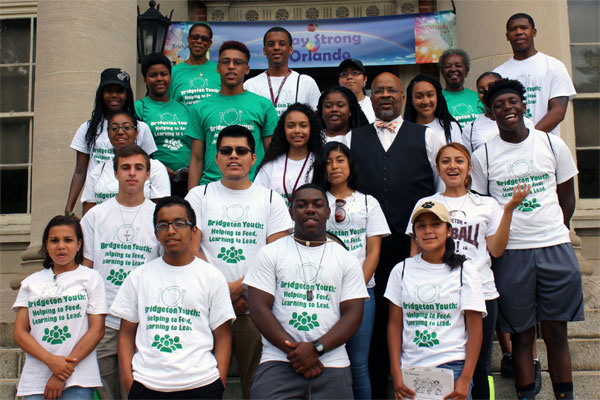
The project — fueled in part by $50,000 from the Robert Wood Johnson Foundation and the passion of local leaders like Bridgeton Mayor Albert B. Kelly — also served as a model for a larger grant program announced Tuesday that will provide $2 million for 10 organizations to coordinate youth teams to conduct other local public-health projects over the next three years.
Building teams
Atkins said each group will recruit a dozen or so youngsters, ages 14-21, who will meet with community members and civic leaders to identify local health concerns; the team members will then be paid to design and implement a project to help address these needs.
He envisions efforts to reduce lead exposure, improve preschool enrollment or plant trees — but the ideas must be community driven and beneficial to everyone involved. The grant cycle allows for each group to work with two separate teams.
“We do not want youth picking up trash. We do not want them filing (papers),” Atkins said. “We also don’t want them doing something way beyond their skill set.”
Improving healthcare
Each year RWJF, the nation’s largest healthcare philanthropy, provides millions of dollars to diverse community-based organizations to improve local health care, particularly in underserved communities like Trenton and Camden. It has also helped pay to scale up some of the programs developed in these cities for use in other areas nationwide. (The foundation also supports NJ Spotlight.)
The plan for this year involved a coordinated focus on youth development, Atkins said, which resulted in the NJHI: Next Generation Community Leaders initiative, complete with a hashtag: #NJLeaders2030. In some vulnerable cities, like Bridgeton and Newark, as much as 40 percent of the population is under 18, making it important to engage these youngsters in community development, he added.
“We’re not shooting for the honor roll students,” Atkins continued, stressing the importance of having a diverse group of participants. “A lot of those students are going to move away from Camden or Bridgeton. We need those kids who are going to stay. And they can still be leaders.”
Dan Hart, a psychologist with Rutgers Institute for Effective Education, who helped design the Bridgeton program and served as a sort of coach to get it going, said it is also important that others in the community understand the contributions these kids can make. “They don’t have to be problems,” Hart said in a video about the project posted on YouTube, which reflects the participants’ excitement for the project and their community. “They are part of the solution.”
Life lessons
Bridgeton Mayor Kelly said the program, which was also supported by the New Jersey Health Care Quality Institute’s Mayor’s Wellness Campaign, made a positive difference in his city. At a population health summit in June, he recounted how it provided valuable life lessons for the kids involved and enrolled hundreds of families in a free federal food program, among other gains.
Bridgeton will have a chance to build on this work, or invest in another youth-driven project, in the coming years. The city’s Tri-County Community Action Agency, known locally as the Gateway Community Action Partnership and led by Kelly, is one of the 10 agencies that will receive a $200,000 grant to develop local health projects. Other grants will go to groups based in Elizabeth, Perth Amboy, Atlantic City, Newark, Trenton, and municipalities around the state. (A full list of awards is below.)
Atkins said the funding should provide jobs — with minimum wage pay or better — for at least 200 youngsters over time. The organizations will also hire several team coordinators, or coaches, to help guide the work. RWJF has committed an additional $600,000 for oversight and to bring all the participants together several times a year for face-to-face meetings, he said, and the first is scheduled for September.
“Youth are an underutilized asset, and we can’t build healthier communities without them,” Atkins added. “While we can’t predict how many future mayors, school board members, little league presidents, or chamber of commerce presidents will emerge from this group, I look forward to seeing the solutions they design, and also watching them mature as community leaders.”
The following organizations have been awarded grants under the NJHI: Next Generation Community Leaders initiative:
