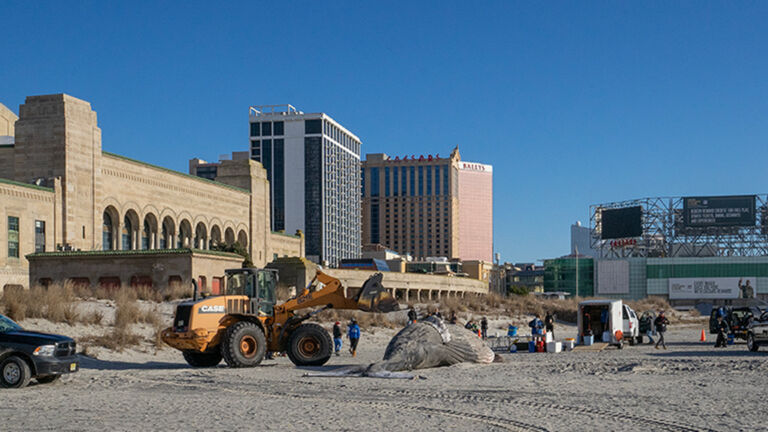
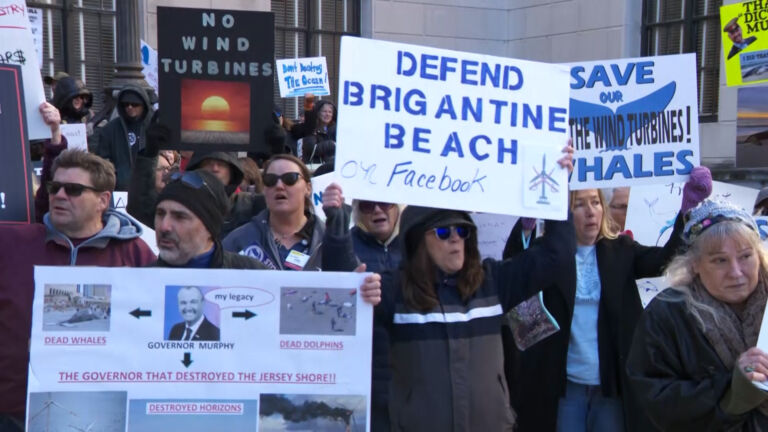
“We are obviously very distressed over the increase in large marine mammals washing ashore,” said Assemblyman Christopher Tully (D-Bergen). A panel of Trenton lawmakers Thursday looked for answers to why nine whales and 28 dolphins have been stranded in New Jersey since Dec. 1. It’s a scientific inquiry — but also a hot political question — caught up in opposition to the Murphy administration’s offshore wind development, which some have blamed for the mortality spike. It prompted pointed exchanges.
Assemblyman Antwan McClellan (R-Cape May) asked, “Do you think there’s an opportunity that we need to take a step back — 60, 90, 120 days — and try to figure out what’s affecting them? If you can’t answer that question for certain?”
“The idea that we don’t know — we do know! We do know!,” replied New Jersey Department of Environmental Protection Commissioner Shawn LaTourette. “The changes to the environment in which these mammals exist is what is causing them.” LaTourette cited analysis showing a shifting underwater menu for whales. Driven by warming ocean currents, food fish called menhaden gather in large schools closer to shore. Whales follow to feed — but that puts them in the path of increasing port traffic — and big ships. “And we are seeing mortality of whales in many instances because of ship strikes,” he said.
But Republicans on the Assembly Science, Innovation and Technology Committee wanted to know whether underwater seismic surveys by offshore wind developers played a role in whale deaths. And they questioned the scientific basis for LaTourette’s explanation. “It’s a little hard for us to just assume that that affirmation is real,” said Assemblyman Christian Barranco (R-Essex). “So I hope at some point, Mr. Chairman, that we have a scientist who can confirm your affirmation. Because if we just accept your affirmation as fact — then this debate is over.” What was very clear — is that this debate is far from over.