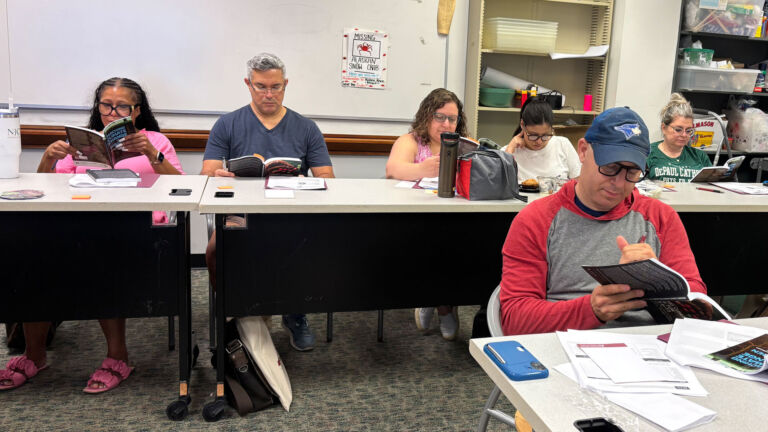
Stockton University brought a group of K-12 teachers to Great Bay in South Jersey last week to catch and measure marine life — putting the teachers on the front line of climate research, even those who are not specifically science teachers.
A $600,000 grant awarded by the state Department of Education funded two free days of climate change instruction for the teachers.
“I feel that when you go and actually do the things and learn the things, and see the climate change and how it’s changing, and see how you can impact the kids, that’s the way that you can teach it best,” said Elizabeth Podolski, a first-grade teacher in Mays Landing.
Britne Field, a biology and oceanography teacher at Egg Harbor Township High School, said, “These kids see this water all the time and they don’t know what’s at the bottom.” For that reason, she said, “getting to bring those little things back” was a benefit of the two-day program for educators.
The program is two years old, but Stockton University researchers have been monitoring marine life in Great Bay for decades.
“When you sample multiple sites over a nice time window, you can really start to see patterns emerging,” said Mark Sullivan, a professor of marine science at Stockton. “Species that are maybe moving into New Jersey waters from the south. And then you also get an idea of species that might be expanding their range north.”
In 2020, New Jersey became the first state to enact climate change education standards throughout its schools.