Editor’s note: On Thursday evening, after this story was published, the International Longshoremen’s Association announced they reached a tentative agreement with United States Maritime Alliance. The strike has been suspended until Jan. 15, 2025. Under the tentative agreement, the union will go back to work, and both sides will continue to negotiate other issues.
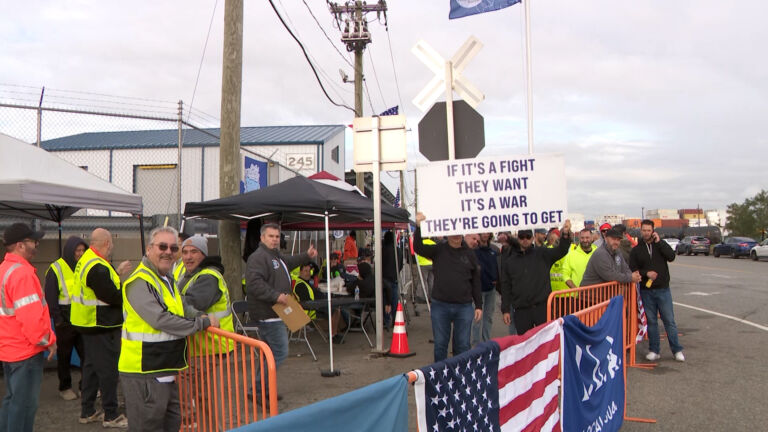
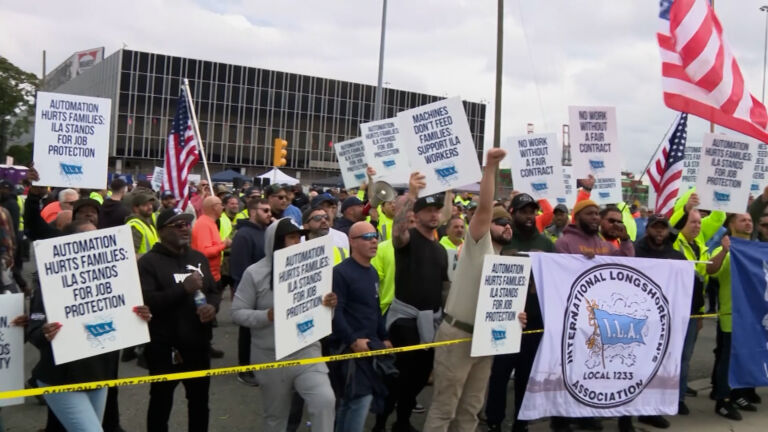
Longshoremen walked the picket lines around Port Newark with spirits high on Day 3 of the International Longshoremen’s Association strike, while the job action has sent panicked shoppers to clear shelves of toilet paper and other goods for fear of coming shortages.
The union threatened to “cripple” the supply chain unless port operators not only raise wages, but also promise job protection against wholesale automation.
“We’ll accept technology that allows jobs to be safer and more efficient,” ILA vice president Dennis Daggett told picketers on the strike line on Thursday. “But we’re never ever going to support automation that displaces our workforce. Robots over people, hell, no! We’re never going to accept that.”
The ILA blames foreign corporations that comprise the U.S. Maritime Alliance for pushing fully automated terminals for profit, at Americans’ expense.
“Automation will not pay taxes. It won’t put food on your baby’s table. Automation is your enemy,” said David Gonzales, the International Longshore and Warehouse Union’s vice president.
Port Liberty in Bayonne already uses partially-automated cranes to handle shipping containers, something permitted in the ILA’s current contract, with union permission. But the union stopped negotiating a new contract in June, after Maersk in Port Mobile installed automatic gate processing for trucks. And the union has been dead-set against the new, fully automated cranes now operating worldwide.
The New York/New Jersey import market is booming, said shipping expert Jean-Paul Rodrigue, but it’s constrained by a tight footprint that limits expansion by adding terminals. So how else to stay competitive in a global marketplace where automation is common and ships keep getting bigger?
“I have to improve the productivity of it. And therefore I start to consider and implement automation plans,” Rodrigue says.
“It also creates pressure on the employers to be like, ‘OK, well, if we want this technology, do we have to actually pay the workers more to use it?” said Rutgers labor historian Will Brucher, “And that’s what the ILA is essentially doing: protect our jobs and pay us what we’re worth.”
Brucher noted the move towards automation started with shipping containers, an idea launched by SeaLand in Newark. Moving standardized containers instead of individual packages increased efficiency but cost longshoremen thousands of jobs. The union struck in 1977 and settled only after shippers agreed to compensate workers for jobs lost to automation.
He said high-tech innovation has led to job actions in industries across the country, including the Hollywood writers strike over the use of artificial intelligence.
The U.S. Maritime Alliance on Thursday stated that it wants to ratify “a new Master contract that addresses all of the critical issues…We cannot agree to preconditions to return to bargaining, but we remain committed to bargaining in good faith.”