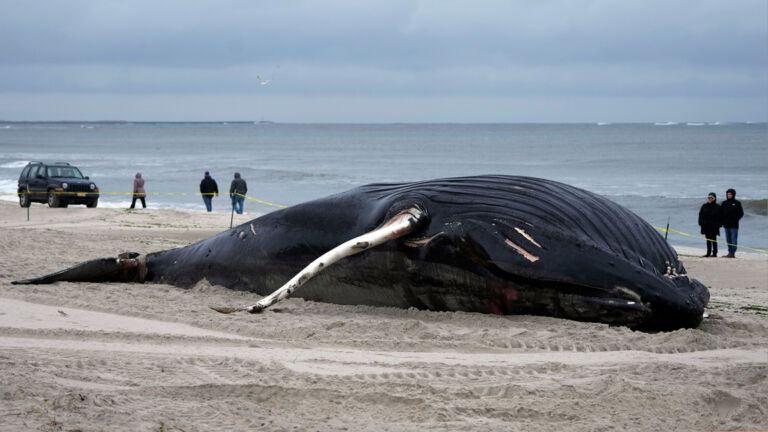
U.S. Rep. Frank Pallone and wildlife advocates called on Thursday for stricter federal enforcement of speed limits for cargo ships that they say are killing whales off New Jersey’s coast.
“Boats are speeding and whales are dying — it’s just that simple,” says John Weber, senior field representative for the advocacy group Oceana, at a press event in Long Branch. His group studied whale strikes in shipping lanes and determined North Atlantic right whales swimming in busy shipping lanes too often end up as hit-and-run victims.
Some 86% of big cargo vessels using the ports of New York and New Jersey exceed an 11 mph mandatory speed limit in the “go slow” zones established by the National Oceanic and Atmospheric Administration, according to Oceana’s study.
NOAA disputes the Oceana findings. An agency spokesperson said in a statement to NJ Spotlight News that compliance with vessel speed rules along the East Coast was up to about 80% during last year’s North Atlantic right whale migration season.
“Even one human-caused death is too many for this [whale] population to sustain,” said Weber. “If NOAA wants to save this species from extinction, ships must slow down when these whales are present. And speeding boats must be held accountable.”
Anjuli Ramos, director of the New Jersey Sierra Club, said: “We see marine mammals washing ashore along the East Coast — and even the entire country — most of them with clear evidence of propeller marks and injuries of severe skull damage and internal bleeding. We must actually do the work to crack down and enforce the vessel speed rule.”
“The idea that they just issue the rule and don’t enforce it is totally unacceptable to me,” said Pallone, the Democratic congressman from the 6th district. Pallone said the U.S. Coast Guard has told him they need more resources to enforce the whale safety speed limit. NOAA reports it’s pursued just 56 civil cases, worth about $1 million in fines over the past two years.
Katie Wagner, the NOAA spokesperson, added that the agency has also sent approximately 1,000 compliance letters to vessel owners along the Atlantic coast since 2018, plus more than 250 alerts to vessels that were detected by satellite to be operating in close proximity to right whales.
Pallone said he has sent a letter to both agencies, demanding they “aggressively expand existing enforcement efforts to ensure compliance with the rule and deter future violators.” Pallone noted that NOAA received $82 million in federal infrastructure funding this past summer, and he urged the agency and the U.S. Coast Guard to spend more on speed enforcement.
“As you know — if you have a rule and you find that out that nobody’s enforcing it — it doesn’t have any deterrent effect,” Pallone said.
Animal welfare advocate Greg Reilly said both agencies need to take stronger action. “I know first-hand that even small amounts of enforcement — even small tickets — cause changes in behavior,” said Reilly, who used to work for the U.S. Coast Guard.
Ship-whale collisions have increased as climate change draws marine mammals following their food closer to shore. Since 2017, more than 120 whales have died, most of them after ship strikes and entanglements, according to experts. Only 340 North Atlantic right whales remain, including just 70 breeding females.
“When those mother-calf pairs are in the water, they are especially susceptible to vessel strikes,” Reilly said. “They spend a lot of time at or near the surface and that’s exactly when the strikes happen.”