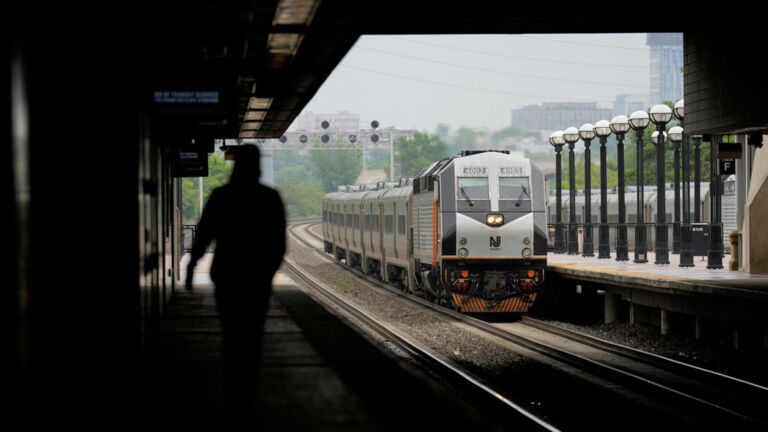
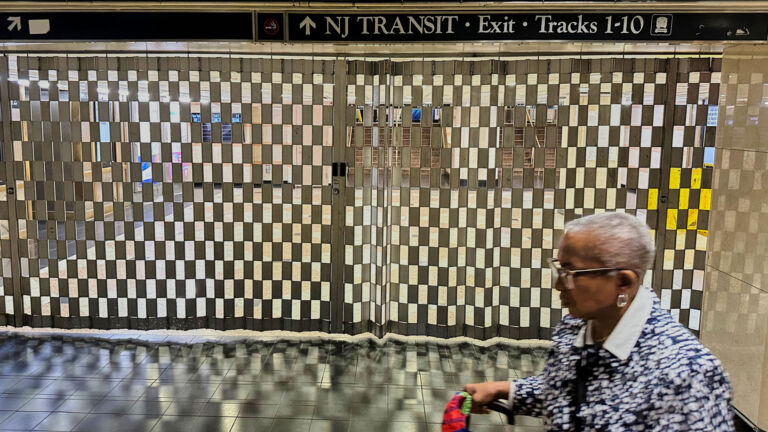
Commuters welcomed the news: New Jersey’s rail strike is over and NJ Transit train service will be back on track Tuesday, after four days of customer frustration to find alternate rides.
“Oh, thank god!” exclaimed Leah Dukes, who took a bus from Berlin in Burlington County on Monday. “I have to get from Hamilton up to Newark every day, so I need these trains!”
“The sound that you probably hear is the sound of our state’s commuters breathing a collective sigh of relief,” said Gov. Phil Murphy on Sunday night.
Murphy and NJ Transit CEO Kris Kolluri called the deal “a very good outcome,” hammered out late Sunday afternoon in a meeting with the Brotherhood of Locomotive Engineers and Trainmen and a federal mediator.
“They have poured hour after countless hour into reaching an agreement that is both fair to NJ Transit’s employees, while also being affordable for our state’s commuters and taxpayers,” Murphy said.
“I think we learned some important lessons on what the membership wanted, and I think the union this time did a really good job of clarifying, if you will, their positions,” Kolluri added.
On Monday, union general chairman Tom Haas said he’s exhausted but pleased.
“Engineers are getting back to work — we’re starting to get trains moving again — getting everything set up for full service tomorrow,” he said.
The union has worked without a contract since 2019. Members rejected a tentative deal in April that they complained lagged 20% behind New York engineers doing the same job. This deal would ultimately put them just 3-5% behind comparable railroads, Haas said — that is, if it’s approved.
“I mean, it’s not over,” Haas said. “The members still have to vote on it. But I’m reasonably certain that they are very satisfied with what we came out with … This time NJ Transit really stepped up and addressed what we saw as the main issue, which was our wages … It’s more than the last offer, but it’s not more expense to NJ Transit.”
According to union sources, the contract gives engineers higher wages in exchange for concessions on work rules and health benefit contributions. NJ Transit insisted on structuring the deal to also manage demands for equity from the agency’s other unions, under the so-called “me too” clause.
Murphy said the contract’s cost would be affordable for the state. “Something we could manage our way through that was single-digit millions or maybe double-digit millions of an impact, versus a nine-figure impact,” Murphy said Sunday.
For the many small shops that depend on rail riders, even four days with no trains took a bite out of their bottom line. Hearing the strike had ended thrilled staff at Zaro’s Family Bakers.
“Woo-hoo! That’s about all I can say. People come back, it’s more business. That’s what we need,” said retailer Janina LaTorre.
“We immediately think about the riders, but we forget about everybody along the rail lines and particularly the small businesses,” said Michele Siekerka, president of the New Jersey Business & Industry Association.
Those shops take a hit, she noted, explaining that New Jersey’s business community had urged a contract settlement that doesn’t require hiking fares or increasing the state’s corporate transit fee. Now businesses and lawmakers are waiting to see the new contract details.
“So, we are banking on the fact that we were told that this is a reasonable settlement, reasonable meaning that it is fair to the workers, that it’s fair to the riders, and that it’s fair to the taxpayers,” Siekerka said.
Both sides said they hope the deal — at least for now — keeps the fiscally-challenged commuter railroad on track. Meanwhile, Haas said both rails and equipment required safety inspections before train service could resume under federal regulations. Engines parked for the strike were redeployed along their routes, and engineers got their new shift schedules.
Trains will start rolling at midnight tonight. The union’s rank-and-file members will vote on this offer electronically. NJ Transit’s board is scheduled to vote June 11.