With New Jersey residents facing steep hikes in electric bills, some lawmakers are taking aim at a growing industry that has been singled out for driving up costs: artificial intelligence data centers.
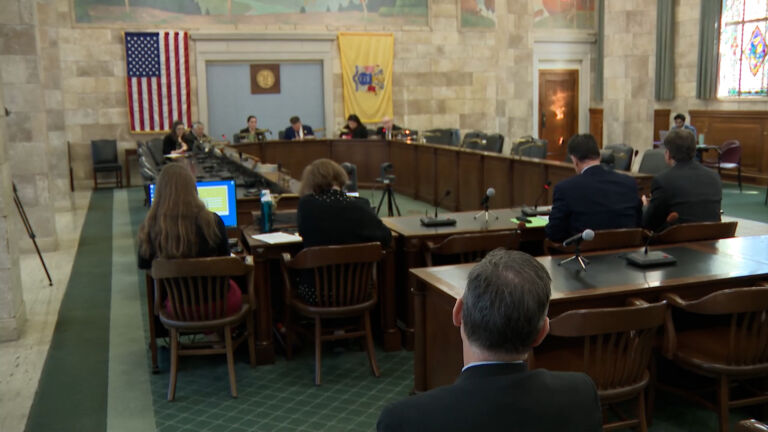
Assemblyman Dave Bailey (D-Salem), has sponsored a bill to create a rate structure, known as a tariff, for any new data centers built in the state.
“We’ve got to strategize. We have to think, what are the positive impacts of this type of technology, what are the potential negative impacts, especially on the ratepayer and the increased use of energy that will come about because of the use of the data centers,” Bailey said.
New Jersey and the 12 other states served by the PJM regional grid are dealing with spiking electric costs as demand for power is outpacing supply. State leaders in New Jersey have spent months blaming PJM Interconnection for moving too slowly to connect new power sources to the grid.
Bailey’s bill highlights the strain on energy supplies that the fast-growing AI industry is creating.
Data centers can use huge amounts of electricity. The Dutch company Nebius Group announced earlier this year plans to build a new data center in Vineland that will have the capacity to use up to 300 megawatts of power. That’s roughly a quarter of the power produced by PSEG’s Hope Creek nuclear plant in Salem County.
Other states have adopted measures similar to Bailey’s bill, according to Abraham Silverman, an assistant research scholar at Johns Hopkins University’s Ralph O’Connor Sustainable Energy Institute.
“Nobody knows right now how much electricity these data centers are going to use. So what we need to do, as a good regulator should do, is make sure consumers are protected regardless of how much electricity the data centers end up using,” said Silverman, who previously served as general counsel for the New Jersey Board of Public Utilities.
Republicans lawmakers are skeptical. Assemblyman Christian Barranco (R-Morris) said this bill looks good on paper, but doesn’t have much practical impact, because data centers are already dependent on their own power sources, a practice called co-locating. He argues the state would be better served by focusing on bringing new power sources online.
Business and industry lobbying groups opposes Bailey’s bill, saying it unfairly scapegoats AI and will deter investment in the growing sector.
“Data centers are large energy users, but so are large manufacturers. So are large hospitals. What we need to do as a society if we’re going to have economic growth, we need to make sure that we build the energy supply that we need,” said Ray Cantor, the deputy chief government affairs officer for the New Jersey Business & Industry Association. “More nuclear power plants [and] we believe that natural gas is a very clean and efficient source of energy. It also can be put online quick if we do it right.”
This report is made possible in part by the Corporation for Public Broadcasting, a private corporation funded by the American people.