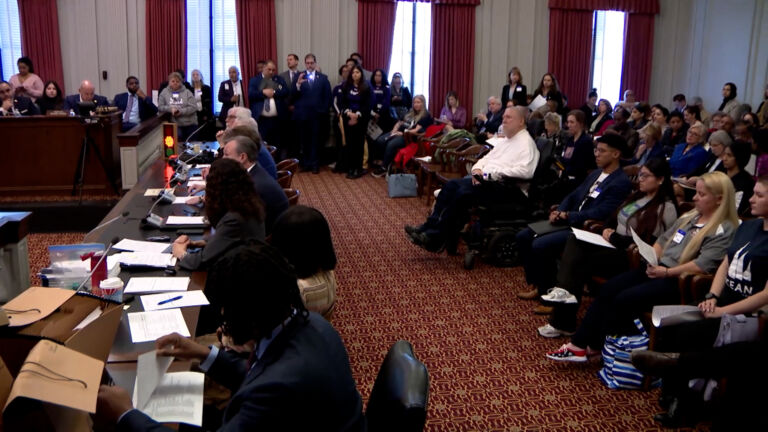
At a hearing of the Senate budget committee on Tuesday, forecasts from the nonpartisan Office of Legislative Services urged caution, warning that Gov. Phil Murphy’s $58 billion budget proposal spends about $1 billion more than New Jersey will raise in projected revenues.
At current spending levels, New Jersey would burn through its current $6 billion surplus by 2028, according to OLS estimates. And while both OLS and Treasurer Elizabeth Maher Muoio generally agree on projected revenue estimates, the economic outlook remains highly volatile.
“Both the executive and OLS are optimistic about fiscal 25 revenue. Fiscal 26 however is more complicated … volatility in the capital markets, shifting consumer behavior and potential policy shifts could adversely impact revenue collections,” OLS revenue and policy analyst Oscar Mendez told the committee.
Senate Budget Committee chairman Paul Sarlo (D-Bergen) pointed to headlines of sagging profits on Wall Street — an important revenue source for New Jersey. “Our revenues are driven by gross income tax … predominantly by folks in northern part of the state — Wall Street bonuses, Wall Street income,” said Sarlo.
Senators also raised red flags about potentially deep cuts in federal funding. And Muoio noted the Trump administration has already frozen hundreds of millions of dollars in funds the state spent and expected to be reimbursed.
“The potential hit to our budget and our programs could be drastic. So that is a major, major concern for all of us as we navigate this budget,” she said.
Muoio said the governor’s budget plan raises $1 billion in new taxes and fees on alcohol, tobacco, online casino and sports betting, and more — revenue-raisers that would help fill the projected budget gap. But Sarlo signaled there’s little support in the Legislature for tax hikes.
“I’m quite confident I will not be supporting them and they will not be part of a final budget document,” he said.
The biggest uncertainty remains the extent of federal revenue cuts. In the worst-case scenario, Sarlo warned, lawmakers might have to pass a budget by June 30 and return to rebalance it if necessary.
This report is made possible in part by the Corporation for Public Broadcasting, a private corporation funded by the American people.