An exultant Sen. Chuck Schumer (D-NY) announced construction of the Gateway train tunnel under the Hudson River began in earnest Friday, fueled by the Biden administration’s promise to kick in another $3.8 billion in funding. It boosts the federal share to more than 70% of Gateway’s $16 billion price tag.
“It brings the federal total to over $11 billion dollars,” Schumer said at a news conference in Manhattan on Friday. “With these new dollars, Gateway’s future is assured. All systems go. There is no turning back.”
“This represents the largest infusion of federal funds for any mass transit project in the country in modern history,” said Chris Kolluri, CEO of the Gateway Development Commission. New York and New Jersey are each obligated to pick up a quarter share of Gateway’s costs. The extra federal Infrastructure Act funding means “Jersey’s contribution could be as low as $300 million,” Kolluri said.
The extra federal infusion is “a huge, huge deal,” said Gov. Phil Murphy, that “meaningfully lessens the burden on New Jersey.”
Construction equipment framed the announcement at the Hudson Yards complex in Manhattan. Deep underneath, workers will start building a 550-foot-long reinforced concrete box to protect the Gateway tunnel’s right of way from Penn Station to the Hudson River.
Gateway advocates feel the need for speed. First, public transit demand is rising. A new study from the Regional Plan Association predicts that as commuters reconfigure their post-COVID work-from-home schedules, trans-Hudson transit ridership could exceed its pre-pandemic peak by the time the new tunnel is complete in 2035.
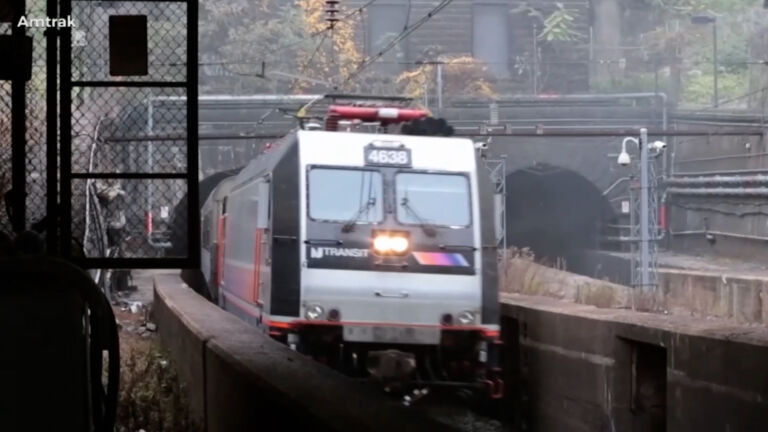
Meanwhile, the old tunnel keeps deteriorating; its two tracks, damaged by Superstorm Sandy, are corroding faster than Amtrak can repair them. And every year of delay adds another $1 billion to Gateway’s price tag, warns RPA President Tom Wright.
“Time is not on our side. Costs go up exponentially, the longer it takes to do these projects, the more expensive it’s going be,” he said.
Wright said that if one track fails, it would slash rail service by 75%, sending economic shockwaves across the nation.
Next up, on the New Jersey side, a big portion of Tonnelle Avenue in North Bergen needs to be elevated to make way for two massive boring machines which will start grinding their way beneath the river starting in 2025.