In the first year where neither major political party is using the “party line” on election ballots, some changes are already evident, says Julia Sass Rubin, the Rutgers University professor whose research helped fuel the court challenge to the line.
Both Democrats and Republicans in almost every county in the state used the party line to group their preferred candidates in one column on the ballot.
“I would say the two most notable impacts so far are that so many Democrats and Republican candidates, including pretty legitimate candidates with a shot at winning, [are] choosing not to go for an endorsement. That would have been unheard of before,” said Rubin, an associate dean at Rutgers University’s Edward J. Bloustein School of Planning and Public Policy.
“And the other impact is just the number of people running for the Legislature, so we have twice the number of people running as we did two years ago.”
Nuzhat Chowdhury of the New Jersey Institute for Social Justice says the new ballot design, absent the party line, is easier to follow. “The way that the races will be organized will be that the office will be clearly marked,” Chowdhury said. “The name of the candidates who are running for that office will be listed directly underneath that particular office or beside that particular office.”
And candidates’ names are now randomly selected for ballot placement. So a candidate could have the party’s endorsement and be the last name on the list — and vice versa. The party line guaranteed the top spot on the ballot and that’s a big advantage to lose. But the new rules also allow slogans, and the county party’s slogan can say “endorsed by the county party.”
“The county organizations aren’t worth nothing, just because their line has gone away. They still have the expertise, the know-how, the tools, and they’re still going to use them. They still know how to win in their neighborhoods and in their towns,” said Micah Rasmussen, director of the Rebovich Institute for New Jersey Politics at Rider University.
The absence of the party line makes surprises more possible, Rubin says.
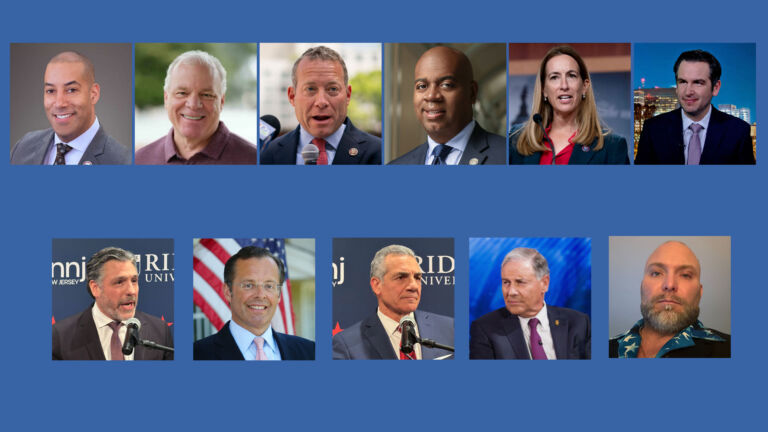
“A, we have candidates running who are very viable who are not on the line. B, if one of them actually wins, that would be quite dramatic. For example, if Fulop won or Baraka won, they don’t have the line in any counties,” said Rubin, referring to candidates in the Democratic gubernatorial primary, which takes places June 10.
“Even if Gottheimer or Sweeney [won], they don’t have the line in very many counties, so they would also be quite dramatic.”
Rubin said the other thing she’s watching for is the power of the county organizations without the line.