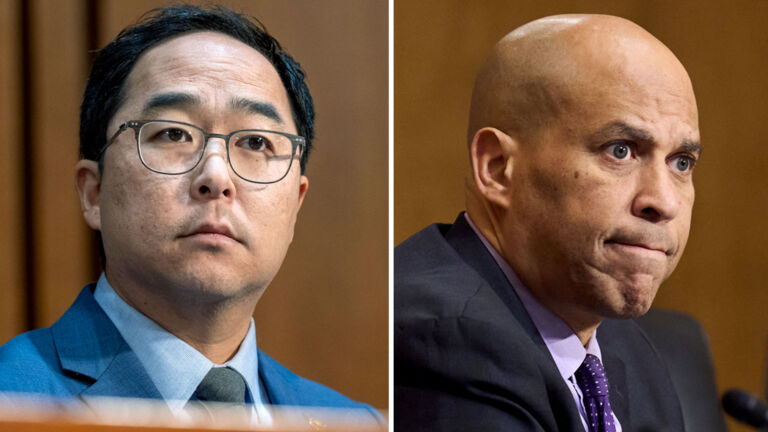
New Jersey’s two U.S. senators have made news with their split votes on the sale of weapons to Israel and the ongoing war in Gaza. Cory Booker has voted to approve; Andy Kim has voted to block them.
Ben Hulac, NJ Spotlight News’ Washington D.C. correspondent, discusses the policy and the politics of the two men’s votes. It has been excerpted and lightly edited.
Briana Vannozzi, Anchor: Let’s just start with the vote itself. What exactly did Booker approve and how important are these weapons in the context of this war in Gaza?
Ben Hulac: This is an interesting comparison between the two men, senators Booker and Kim. So last week, the Senate voted on actually two resolutions that would have blocked two separate batches of weapons. One was largely assault rifles, 20,000 assault rifles that would go to Israeli police. And then the second vote would have blocked a variety of bombs — a couple of types of bombs, 1,000-pound bombs going to the region, going to Israel itself … These fit a pattern. In my reporting that ran today, that we published today, I looked at seven separate votes that the Congress has taken to block these weapons sales since the war in Gaza and the broader region began about two years ago. So it [is] just a sort of interesting book-ended comparison between the two men.
BV: As you reported, Booker has defended this vote [and] other votes, saying that blocking these sales would essentially limit U.S. options for bringing the war to an end. Is it sort of, as he sees it, this broader humanitarian diplomatic strategy? Is that a fair argument to be made?
BH: I would defer to the foreign policy experts on that. But just from my perch on Capitol Hill, that is the argument that Senator Booker will make and many Democrats will make, which is this is Israel as a steadfast ally, has been for decades. And we need to use all the leverage that we can.
I had an interesting conversation with Senator Kim last week after these votes. And he’s taken a lot of criticism for voting to block these weapons sales. But his point was we’ve tried so much. . . In Israel earlier this year, he met with Netanyahu face to face and has tried to convey to the Israeli leader there that this humanitarian crisis has to come to an end.
Senator Kim, I should point out, is still in the minority, even of his own party in voting to block these weapons sales, which also would have had to gone through the House to ultimately block these deals. But it’s an interesting study in contrast, as I said.
BV: Would Kim go so far as to say that a genocide is happening, which few but other members of Congress have claimed?
BH: I asked him that direct question and he said no. But it was sort of an equivocating no. Basically, he hasn’t done the research to bear that out. He does come from an academic background. He worked at the State Department during the Obama administration and actually has written and studied and examined mass atrocities and genocide. His answer to me was that’s really a legal determination.
But I did ask him a follow-up, which is, what about war crimes? And he said almost certainly highly likely, I think were his words, are war crimes being committed in Gaza. And I asked about starvation, which is a war crime under international law. And his point was there are food trucks waiting to go into Gaza. We can see them. . . It’s war crimes, in his eyes, almost certainly happening.