
 Credit: (Edwin J. Torres/Governor's Office)
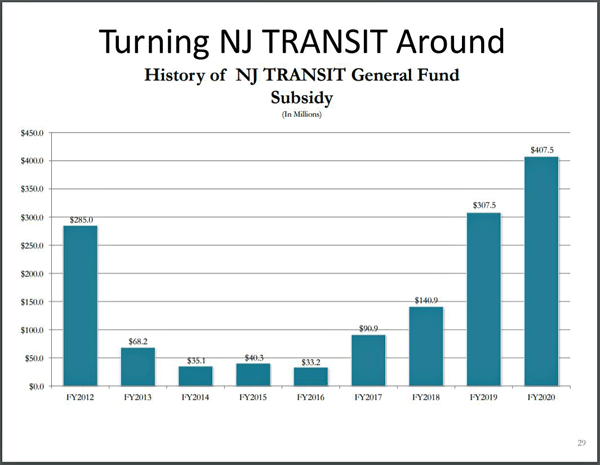
The combination of new tax revenue and money freed up through savings proposals — that include departmental belt tightening and changes to public-employee health coverage — would allow the state to cover several notable spending increases that Murphy is recommending for fiscal 2020. These include $206 million in new direct aid for K-12 education and $25 million in new funding for New Jersey Transit.
The first-term Democrat is also calling for a record state payment into the public-worker pension system of nearly $4 billion and is seeking to increase the state’s rainy-day surplus to over $1 billion for the first time in roughly a decade.
“We are building a stronger fiscal house for New Jersey,” Murphy said during a nearly hourlong budget address at the State House. “We are replacing gimmicks with stability.”

$600M for public-worker pension system
Compared to Murphy’s first budget enacted last July, spending would increase by a little over a $1 billion based on the spending plan he put forward yesterday. Much of the increase, nearly $600 million, would go into the pension system, pushing the contribution from this year’s $3.2 billion payment up to $3.8 billion in fiscal 2020.
The governor’s budget allocates another $2.7 billion for public-worker healthcare coverage, but that figure represents a decrease of about $500 million compared to what the state is spending this year on worker health benefits. Total savings from the healthcare initiatives — which include auditing plan enrollees and shifting retirees into less costly Medicare plans — would amount to nearly $900 million, according to Murphy. The state would save another $212 million through departmental savings initiatives.
“You heard that number right,” Murphy said to lawmakers yesterday. “Over $1.1 billion in real and sustainable savings.”
On the revenue side of the ledger, Murphy’s budget calls for boosting income-tax collections with nearly $450 million in new revenue from a proposed 10.75 percent top-end marginal rate that would be applied to earnings over $1 million. The millionaire’s tax proposal was a core element of Murphy’s 2017 campaign platform, and it mimics something he tried to get lawmakers to agree to last year as part of his FY 2019 budget. In the end, the higher rate was only established for earnings over $5 million, with the rate of 8.97 percent remaining in place for all earnings between $500,000 and $5 million.
Millionaire’s tax, round two
In making the case for the millionaire’s tax again yesterday, Murphy said it would help to reduce the burden on the state’s middle class by drawing in more revenue from a group of taxpayers that he suggested was protected by policies enacted by Christie. Administration officials also noted in budget briefings that thousands of the state’s millionaires are actually out-of-state residents who file returns in New Jersey due to income they earn here or through business partnerships based here.
“Let’s be absolutely clear — this is not a tax that will be paid by anyone in the middle class,” Murphy said.

“It is actually cheaper to get a permit to purchase a handgun — $2 — than it is to get a dog license in many of our communities,” Murphy said.
Another $30 million in new revenue would be raised from a proposed corporate-responsibility fee to be levied on employers with more than 50 workers who are receiving state-funded Medicaid health benefits. Murphy said this initiative would ensure “the rest of us” aren’t being forced to cover the cost of these businesses’ employee healthcare.
In all, this year’s tax-hike proposals mark a significant shift from last year, when the governor asked lawmakers to approve more than $1.5 billion worth of new or increased taxes. And while the millionaire’s tax and gun-fee proposals represent Murphy’s second effort at establishing such policies, his new budget drops last year’s push to restore the state’s 7 percent sales-tax rate.
Coughlin is looking for more savings
There is also no increase in funding being proposed by Murphy for the state’s popular Homestead and Senior Freeze property-tax relief programs, with income eligibility limits set to remain unchanged. That was one of the areas lawmakers suggested yesterday they would look to boost even as they also expressed a continued unwillingness to approve any new tax increases.
“I appreciate and applaud his effort to achieve sustainable savings. However, I remain convinced that we can achieve additional substantial savings through reforms and other government efficiencies and not rely on a broad-based tax,” said Assembly Speaker Craig Coughlin (D-Middlesex).
Senate President Steve Sweeney, who has been pushing for changes to public-worker pension benefits this year as part of a broader cost-cutting initiative, also suggested yesterday that lawmakers will be looking to build off the savings initiatives Murphy is proposing.
“This is a positive first step forward,” said Sweeney (D-Gloucester). “There’s many more steps that need to be taken.”
For their part, Republicans raised questions about the $1.1 billion in projected savings that Murphy will be relying on to keep his fiscal 2020 budget in balance. They also called on the administration and lawmakers to go further with other cuts. And they also questioned whether the state budget is truly in balance as the pension contribution — even at the record level proposed by Murphy — would still leave the state with an unfunded liability that totals more than $100 billion by some estimates.
Bramnick: ‘If you had a credit card with this much debt…’
“It’s balanced on a cash basis because we are denying our obligations, because we’re not paying (for) the things we need to pay,” said Sen. Declan O’Scanlon (R-Monmouth). “On an obligations basis, it’s billions of dollars out of balance.”
“If you had a credit card with this much debt on it, you wouldn’t sleep very well,” said Assembly Republican Leader Jon Bramnick (R-Union).
Business groups also took aim at Murphy’s latest attempt to establish a true millionaires’ tax, suggesting it would encourage the state’s wealthiest residents to flee New Jersey for places with less aggressive income-tax policies.
“The pain from this new tax would be severely disproportionate to its benefit,” said Tom Bracken, president of the New Jersey Chamber of Commerce.
But liberal groups that have long been calling for such a tax policy to be enacted praised Murphy for once again proposing a tax hike that they labeled “tax fairness.”
“Given the state’s growing income inequality, racial disparities, and lopsided tax code, asking New Jersey’s wealthiest individuals to pay a little bit more is the definition of fairness,” said Sheila Reynertson, senior policy analyst for New Jersey Policy Perspective, a left-leaning think tank based in Trenton.
