

Not anymore. A recent ranking by the respected American Council for Energy Efficiency Economy put New Jersey in the middle of the pack at 23rd — despite energy conservation repeatedly being cited as a top priority in the state’s energy master plans as long ago as 1978, according to Steven Gabel, president of Gabel Associates, an energy consulting firm.
Now, a law signed by Gov. Phil Murphy this spring establishes new goals to cut energy use and, for the first time, mandates New Jersey’s gas and electric utilities to curb customer consumption.
For clean-energy advocates, utilities, and others who participated in an NJ Spotlight roundtable in Newark this past Friday on energy efficiency, it is well past the time to get the show on the road.
“Customers want to use less energy because they want to save money,’’ said David Daly, president and COO of Public Service Electric & Gas, the state’s largest utility. “It’s their number one issue for them.’’
Mixed results
It may be a top priority of both customers and policymakers, but the results have been mixed, at least by some advocates’ perspective.
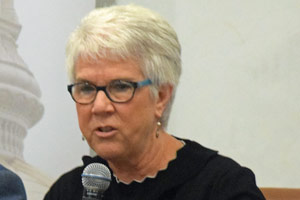
“We’ve really scratched the surface in New Jersey despite very great efforts,’’ agreed Adam Procell, president and chief executive officer of Lime Energy, a Newark company involved in energy conservation.
During a wide-ranging discussion, participants were more optimistic the new law could push the state into a leadership role in energy conservation, with some debate over the role of the state’s utilities and how much they should be rewarded.
Brand: ‘The utilities are fine’
Several speakers argued utilities — with well-established relationships with customers — ought to be the focus on bringing energy-efficiency to residents and businesses.

“The entire energy efficiency discussion cannot be about how are we going to pay utilities,’’ Brand said. “This is crazy. This is why nothing has happened. I see their books. The utilities are fine.’’
Others disagreed on whether the state can move forward with aggressive energy-efficiency goals without decoupling.
“Yes,’’ acknowledged Barber, “and probably not as easily; not as quickly, and not as certainly, I would add. It is the better direction to cut the link that is causing the utility to be simply focused on sales.’’
New Jersey Gas is one of two utilities in the state (the other is South Jersey Gas) to have an energy conservation program in its tariffs. It has helped 50,000 customers to cut gas bills, create 2,600 new contracting jobs, and generate $350 million in economic activity, according to Tom Massaro, a senior vice president at the company.
Gabel agreed decoupling is needed.
“The customer’s pockets are not going to be picked by this,’’ he said. “All you are doing is realigning the incentives. In fact, if sales growth increases on a net to net basis, customer rates are going to go down.’’
Brand, however, countered that such a program only transfers the risk to ratepayers, who will have no other option besides the utility.
Focus on low-income populations
“We will be monopolizing energy efficiency if we do this,’’ she said. “All of these companies that do the work will be beholden to the utilities to get the work. This is a really serious issue that we have to grapple with.’’
Those issues should play out in the next year as PSE&G is expected to file a multi-billion-dollar proposal within a few weeks, calling for huge investments in energy efficiency, as well as its pending rate case.
Any new statewide energy efficiency initiative, most participants agreed, ought to focus on low-income populations who have largely not benefitted from state efforts to promote clean energy.
“There are territories underserved; there are markets underserved,’’ Procell said.
