
Why did Dreeah Austin die?
Like other New Jersey women, often Black, she died of pregnancy-related causes, almost all preventable
Dreeah Austin gave birth to a healthy baby girl in early July. Two weeks later Austin, a 30-year-old Black woman, was dead, the likely victim of a blood clot that became trapped in her lungs.
Like 9 out of 10 women killed by a pregnancy-related cause in New Jersey, Austin did not have to die, according to multiple perinatal experts. Austin was healthy herself, her fiancé Saladeen Merritt said, and after delivering their child, she took medication daily to reduce the risk posed by the clot.
Now Austin has become one of the roughly two dozen women this year who will die after falling through a gap in New Jersey’s maternal health system. Merritt, a first-time dad, faces the future alone with their baby Sevyn.
“They took everything away from me,” Merritt told NJ Spotlight News. “I don’t know how I’m supposed to explain all this to our daughter.”


Nastassia Harris, a nurse and founding director of the Perinatal Health Equity Initiative, in East Orange, said Austin’s story is far too common. Black women in New Jersey are nearly seven times more likely to die from pregnancy-related death — and Hispanic women 3.5 times more likely — when compared to white mothers, an analysis of state data shows.
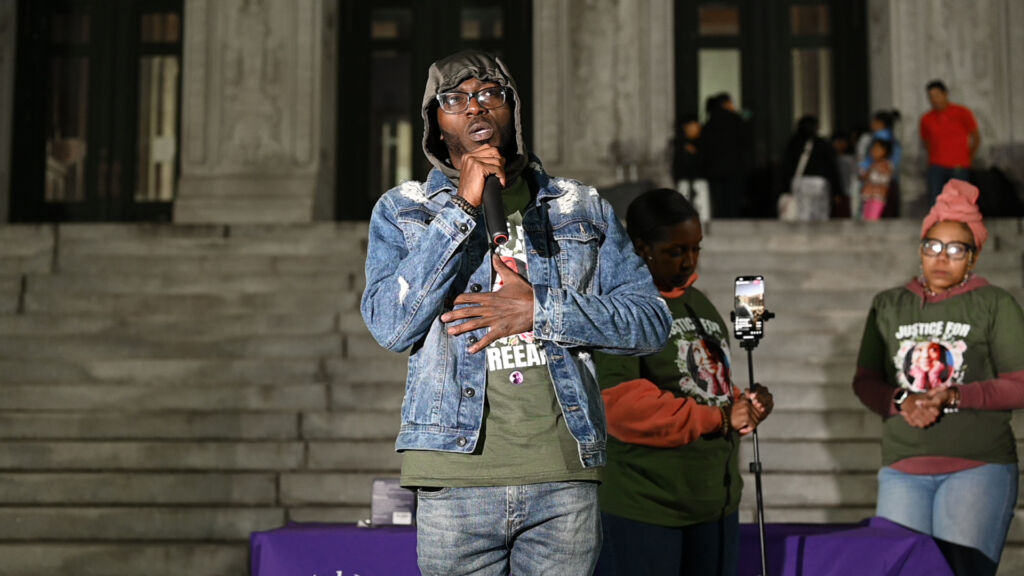
“This is what the seven times more likely looks like,” said Harris, who is publicizing Austin’s story and organizing support for her family. Her organization led a vigil for Austin on the steps of Newark’s City Hall earlier this month to highlight these racial disparities and the need for change.
“We need to make people aware we haven’t solved the problem,” Harris said. “I can see from the community firsthand how this is still happening.”
‘Now my lady is just another name on the list’
At the vigil on Oct. 10, Merritt said Austin was more than just a partner and lover, but his best friend and the fun, outgoing opposite to his quiet, mellow self. “Dreeah was a phenomenal woman, she was a phenomenal partner, one of my best friends,” he told a small crowd of family, friends and birthing advocates bundled up against the wind. “Above all, she was a great mom and a great woman.”
“Now my lady is just another name on the list that’s going to keep going and going and going, if we don’t do something,” Merritt said.
‘It’s our fault’
Under Gov. Phil Murphy — and the Nurture NJ campaign led by first lady Tammy Murphy — state officials have prioritized maternal health and committed significant time and resources to reduce deaths and racial disparities. The state has extended insurance coverage for pregnant women, taken steps to expand the maternal health workforce and created a government authority to sustain this work when the governor leaves office.
But links between prenatal care, labor and delivery and the postnatal period — the months following birth when more than half of all maternal deaths occur nationwide and in New Jersey — are inconsistent, perinatal experts said, often leaving women like Austin to negotiate medical questions alone. The maternal mortality rate in New Jersey, where more than 90,000 babies are born each year, remains higher than it is in Pennsylvania, New York and the average nationwide, according to the most recent federal data.
“It’s so easy to blame the victim,” said Mariekarl Vilceus-Talty, president and CEO of the Partnership for Maternal Child Health of Northern New Jersey, which provides perinatal health services and coordinates additional care.
“But I 100% blame the system,” she said. “It’s our fault.”
Austin “did not have the opportunity to have the best outcomes,” Vilceus-Talty added. “If we’re not setting her up for 100% success, then we’ve failed.”
‘I can’t wrap my head around this’
After delivering her first daughter, Elle, a decade ago, Austin was diagnosed with a blood clot in her leg, Merritt said. This clot — a condition called deep-vein thrombosis — increased her risk of pulmonary embolism, which happens when the clot travels and becomes stuck in the lungs, interfering with breathing. Pregnancy, which causes the blood to thicken, also increases pressure on the veins, lungs and heart, experts said.
When she became pregnant with Sevyn, Merritt said Austin first sought care from her regular doctor, but when told that physician was not in-network with their insurance he said they switched providers. Austin was prescribed an oral medication to reduce the risk of the clot dislodging he said, but the pills made her feel sick and unable to eat. “Of course she had to eat,” Merritt said, explaining why Austin stopped taking the medication. It is not clear if doctors considered surgically removing the clot, or if that was a viable option for Austin.
When it came time to deliver, the couple chose Cooperman Barnabas Medical Center, in Livingston, often regarded as a top option by women in Newark.
The delivery appeared to go smoothly, Merritt said. He left for work the next day but said the hospital placed mechanical compression pads on Austin’s legs, something experts said is a common treatment for patients with clot risk.
When she was discharged, Austin was told the clot was “stabilized,” he said, and she and Sevyn were scheduled to return for a postpartum checkup about two and a half weeks later. Austin was also prescribed an injectable medication to address the clot, which experts said was likely an anticoagulant sold as Lovenox. Merritt said she took this every day, including the morning she died.
“I still have it at home,” he said of the leftover medication. “I thought the blood thinner should have prevented” her death, Merritt said.
RWJ Barnabas Health, which owns Cooperman and nearly a dozen other hospitals in New Jersey, declined to comment on Austin’s experience or discuss its protocols for a delivery like hers. “Cooperman Barnabas Medical Center is committed to addressing healthcare inequities by providing the highest quality of care for our patients and their families. Due to patient privacy laws, we cannot provide comment on individual patients,” the hospital said in a statement to NJ Spotlight News.
‘She kissed me, she kissed Sevyn and Elle’
Austin returned home to their apartment in Newark, where she lived with Merritt and his mother, her daughter Elle and now Sevyn. Two weeks later, on a Sunday, Merritt said Austin woke feeling unwell. With the baby settled, he encouraged her to stay in bed and left for work, as he does seven days a week. “I told her to take it easy,” Merritt said.
When he returned some hours later, Austin was feeling somewhat better and was up and dressed, insisting she go to the store, Merritt said. She told him to stay home with the kids. “She kissed me, she kissed Sevyn and Elle and walked out of the house,” he said. “That was it.”


Moments later, Merritt said his cousin called from the street, saying something was wrong with Austin. When he got downstairs, Austin was sitting in the driver’s seat of her car, struggling to breathe and appeared to be having a seizure. With the help of his mother, Merritt said they lowered the seat back and his mother began rescue breathing. Austin regained consciousness briefly, but blacked out again, he said, and his mother switched to chest compressions.
“The whole time I’m thinking, I can’t wrap my head around this,” Merritt said. Elle had also come downstairs and was watching the battle to save her mother’s life, he said. “As hard as it is for me, I feel really bad for her,” he said.
Eventually an ambulance arrived. First responders took over the chest compressions, Merritt said, and soon called for another team that had a mechanical device to assist with the task. Austin was transported to University Hospital and put on life-sustaining machinery and the family was told she had no brain activity and would not recover, according to Harris of the Perinatal Health Equity Initiative.
Two days later Austin’s family made the decision to discontinue her care. She died at University Hospital on July 23, the result of a pulmonary embolism. Her postpartum visit was just days away.
‘I want this to change for our people’
Austin’s family is still processing the loss.
“I want this to change for our people,” Merritt said after the Newark vigil. “I want Dreeah to be the last name on the list.”

Harris said Austin’s death raises questions about many aspects of her care, including the medications prescribed early on, the level of support she received from prenatal providers and the hospital protocols. Harris also wonders why the original ambulance didn’t have all the supplies needed to care for Austin and has concerns about how her family was told of her death and the lack of support services they received in the aftermath.
Austin’s status as a high-risk pregnancy might have led clinicians at Cooperman Barnabas to conduct an ultrasound on her leg to confirm the clot was stable, according to some experts. Cardiovascular issues are the largest cause of pregnancy-related deaths in New Jersey, according to the state analysis, accounting for nearly a quarter of the fatalities recorded.
Just her status as a Black pregnant woman in Newark, where residents are more likely to experience high blood pressure — when compared to people statewide and nationwide — should have led providers to pay close attention, Vilceus-Talty, of the Partnership for Maternal Child Health of Northern New Jersey, said. High blood pressure is also an aggravating factor for deep vein thrombosis, she said.
At her discharge, experts said nursing staff likely counseled Austin on what to watch for — symptoms that include pain or swelling in the leg, or shortness of breath that could indicate the clot was unstable. Some hospitals send women home with a flyer or refrigerator magnet with color-coded warning signs for concerns like bleeding, heart attack or postpartum depression and clear steps on what action to take. The Perinatal Equity Initiative had this information available at the vigil.
‘Why is this not standardized?’
Harris and Vilceus-Talty said the tragedy underscores the systemic gaps that remain in New Jersey. They also hope it highlights the resources that are available to help women here. Hospital care is one part of the care picture, they note, but healthy births also depend on easily accessible prenatal, postnatal and primary care. Patients also need to have health care providers they trust and can easily reach when questions arise, they said.
“Where is the day-to-day scaffolding to protect these women?” Vilceus-Talty asked.
Vilceus-Talty believes one intervention that clearly could have helped Austin is Family Connects NJ, a state-funded initiative that dispatches a nurse to visit newborns and mothers at home, which was officially launched last year and will be available in 11 counties starting in January. In Essex County, the program — which is free to families and available regardless of income, insurance or immigration status — is overseen by the Partnership for Maternal Child Health.
Under the program, a Family Connects nurse will check the health of the mother and baby, answer questions from other family members and connect them with additional services as needed. Even if Austin had no obvious symptoms, Vilceus-Talty said the nurse might have identified the risk the clot posed and highlighted potential danger signs. But not everyone knows about the program or chooses to participate.
“These are the things that need to be put in place. Why is this not standardized?” Vilceus-Talty said. “We need to get the message out that there are services.”
Even with these interventions, Vilceus-Talty and others stressed that not every mother’s life can be saved. Others note that Family Connects only provides for a few nursing visits; families that need more support must be referred to separate programs that offer services longer term.
“You can do everything absolutely right and still have a poor outcome,” Vilceus-Talty said.
‘But I can’t be her mom’
The impact of Austin’s death reverberates beyond her immediate family. Elle, who just turned 10, does not want to talk about her mom, Merritt said. Because Austin had partial custody of Elle, she has since gone to live with her biological father, a man who, Merritt said, was not a consistent presence in her life before now.

Making matters worse, Merritt said Elle is still reeling from the loss of Austin’s parents — her grandparents — who both died within the past two years. In a short span, the girl “has lost three of the most important people in her life,” Harris noted.
The situation is hard on Merritt, who said he feels like “that’s my kid too.” He also worries how he will explain Austin’s death to Sevyn and how she will fare growing up without her mother. “I could be the best father I can be, the greatest dad in the world,” he said at the vigil. “But I can’t be her mom.”
The ripple effect of deaths like this also haunts Vilceus-Talty, who thinks about the impact on the community, in addition to the family and kids. “This is a reverberation throughout generations,” she said. “There are so many ways their life is going to be affected down the road.”
Editor’s note: The Perinatal Health Equity Initiative has set up several ways for people to help Dreeah Austin’s baby Sevyn:
