
Border Dispatches: A tale of T-shirts in Ukraine
How clothing donated in New Jersey sometimes ends up on the front lines
The people at the supply warehouse where I’m working in Kyiv knew I rented a two-bedroom apartment nearby and asked me if I could accommodate a recovering wounded soldier for the night.
When Andrew — who agreed to let me use his first name and picture — showed up, he looked the part: tall and upright, lean, with a handlebar mustache in the tradition of the Cossacks, known for their ferocity in war. With a full camouflaged pack on his back and a stuffed gunnysack in one hand, he moved fluidly and soldier-like, despite the healing scars from a fistful of shrapnel he took in the side from a tank blast in Donbas.
What was out of place was his T-shirt. It was black with gold highlighted letters that said, “Highlanders Softball.”
One of the millions of sometimes useful facts that have accumulated in my brain living and covering New Jersey as a reporter, is that black-and-gold and Highlanders are the colors and nickname of West Milford High School.
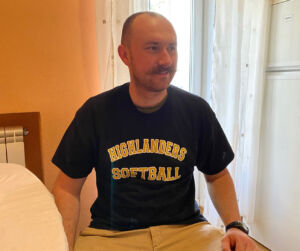
I also knew this career sergeant had no idea of the shirt’s meaning or its origin and if he did, it wouldn’t matter, anyway. It was functional and, as a bonus, it fit. Such are the needs of the Ukrainian military, which suddenly found itself in short supply when Russia invaded the country six months ago.
At my apartment, as he cooked us a dinner of basil-rich macaroni with shredded chicken and mushrooms, I pulled up a West Milford softball Facebook page.
“Game of baseball,” he said.
I knew this particular T-shirt came to Kyiv from the Ukrainian American Cultural Center of New Jersey, in Whippany, which has sent 17 shipping containers of food, clothing, military gear and medical supplies to the warehouse where I’m working.
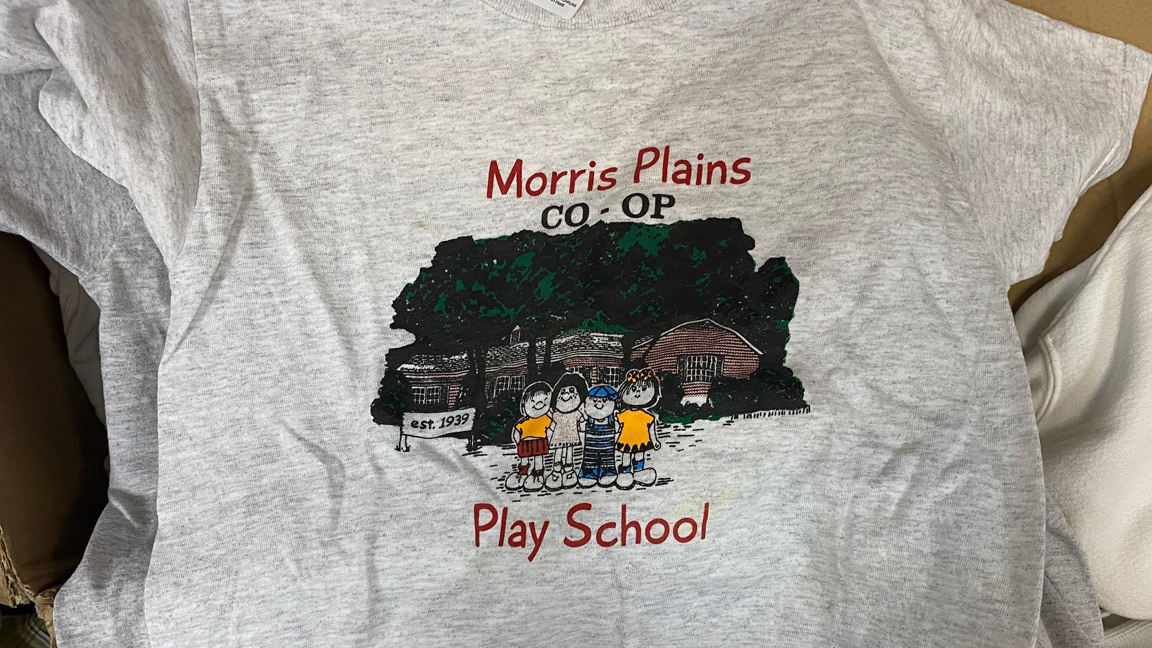
Two boxes from the Morris Plains Co-Op Play School contained child- and adult-sized T-shirts and sweatshirts.
And while I wasn’t sure if the Highlanders shirt was a single or bulk donation, the warehouse had other collections of new, probably overproduced, Jersey wear.
‘Making history’
There were two boxes of white tees with green lettering from “Ridge (High School’s) Senior Bash.” The flip side showed a graduation cap under the words “Making History,” an almost embarrassingly ironic slogan considering the men and women who would eventually wear them.
Two boxes from the Morris Plains Co-Op Play School, with four happy cartoon children on the front, contained child- and adult-sized T-shirts and sweatshirts. The smaller shirts would go to a refugee center, but the big sizes were held back for the military to use as undershirts.
More than 100 blue tees with a BNY Mellon logo came from the investment company’s Morris County operations.
Atlantic Health Systems, headquartered in Morristown, sent about 100 gray, zip-up fleeces all in extra-large and double-X sizes. The embroidery said they were made for “Overlook Medical Center’s Nurse Resources,” and they were already monogrammed, mostly with women’s names.
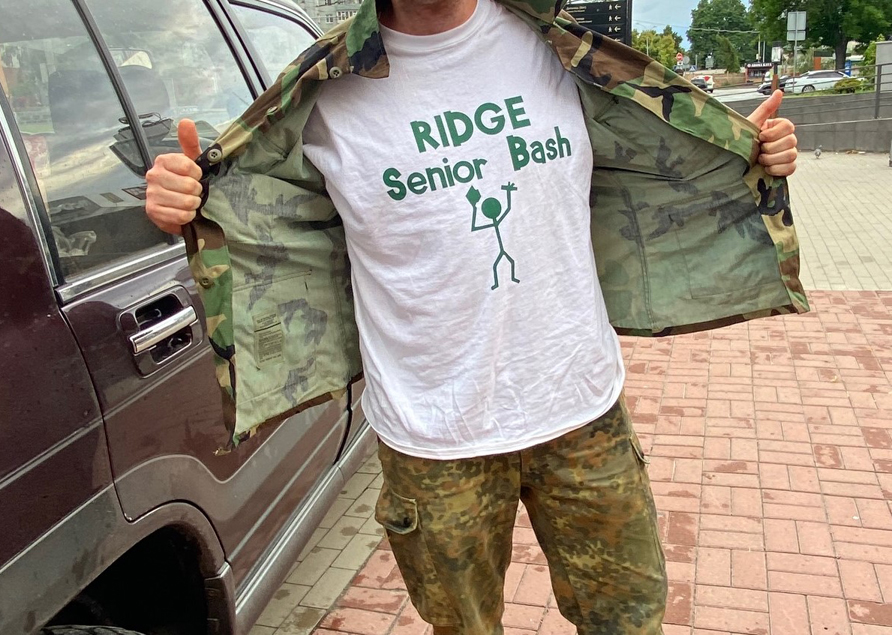
I wore one of those donated fleeces on an excursion north out of Kyiv to Chernihiv, less than 30 miles from both enemy borders of Russia and Belarus, to deliver a truck to soldiers stationed near there. The vehicle was purchased by the Whippany center and filled with supplies donated by it.
My fleece was made for someone named Patricia and more than warm enough for a chilly summer night in northern Ukraine.
‘Roksolana … Roksolana’
At the drop-off point in the parking lot of a closed McDonald’s, I noticed the green lettering of the “Ridge Senior Bash” tee peeking out from one soldier’s open fatigue jacket.
When I mentioned the shirt came from my part of New Jersey, the soldier touched his new pants and shirt and said, “Roksolana … Roksolana.”
Roksolana is Roksolana Vaskul, an anesthesiologist at Cooperman Barnabas Medical Center in Livingston. Since the beginning of the war, she has organized the delivery of tons of essential goods to Ukraine through the Ukrainian American Cultural Center of New Jersey, including fatigue-style uniforms worn by several Ukrainian combat and the national guard units.
She also raised money for the heavy-duty, four-wheel drive SUV I delivered to Chernihiv and three others, one of which I drove to soldiers near Poltava, 200 miles east of Kyiv.
At every military drop-off I’ve made, when I explain where I’m from, the soldiers say ‘Ahh, Roksolana.’
In addition to the uniforms, Vaskul has sent thousands of items for the military, new and used: backpacks, helmets, boots, gun and grenade belts, walkie-talkies and communication radios, night-vision goggles and binoculars, socks and underwear.
Breaking the language barrier
At the warehouse, the donated medical supplies fill one room and go out at a measured pace, except for military-grade first-aid kits and other frontline needs.
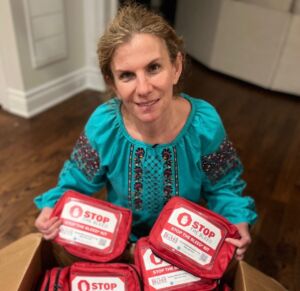
They go out double-time, including the tourniquet and hemostatic bandage kits donated by the STOP THE BLEED Coalition of Mendham. The first box of 100 kits were gone in a day and fundraising for them remains active.
The military gear goes out as fast as it comes in, and for the military units that steadily receive these items “Roksolana” is synonymous with their U.S. source. At every military drop-off I’ve made, when I explain where I’m from, the soldiers say “Ahh, Roksolana.” It’s a language barrier breaker.
The other well-understood word is “diaspora.”
The Ukrainian soldiers know people from their country or who share their heritage in America, are behind them with a sustaining effort that not only supplies them equipment but lifts their morale.
“All this makes us feel America is behind us,” said the soldier in Chernihiv who credited “Roksolana” for his uniform parts. “Now we have weapons, too.”
— All photographs courtesy of Mark Di Ionno. The cover photograph shows part of a warehouse in Kyiv, where boxes of donated goods are sorted, including those sent by the Ukrainian American Cultural Center of New Jersey.