
Are home visits by nurses the key to better maternal and infant health?
NJ Spotlight News series looks at New Jersey challenges and possible solutions
This is the first in The Change Project series examining New Jersey’s social and economic challenges — and focusing on promising actions that have led to positive change.

When Yashirie Benitez, a maternity nurse, gave birth last summer to her second child, she had a team to help her after her discharge from the hospital including her fiancé, sister and her older daughter who volunteered to change diapers.
But despite her own professional knowledge and all the family support, Benitez said she struggled with breastfeeding, exhaustion and keeping herself and baby Brooklyn on a schedule.
Potential for change
A new home visitation program aims to improve birth outcomes in New Jersey, where the maternal mortality rate is high, especially for Black women.
Elsewhere, Family Connects has shown results, including:
- 50% fewer ER visits in baby’s first year
- 28%+ less postpartum depression and anxiety
- 44% fewer child abuse reports
“I’m a nurse, I work for [a postpartum care] program, but the moment that I was discharged and went home, everything went out the door,” she said, laughing. “I forgot everything.”
Reassurance came soon with the arrival at her Mercer County home of a fellow nurse from Family Connects NJ, a maternal home-visit program that is being introduced in New Jersey.
Armed with a baby scale and other medical equipment, the nurse charted Brooklyn’s weight and height, checked Benitez’s blood pressure and other vitals, and spent more than an hour with the family.
“For me it was a lot of reassurance and encouragement, which I thought was so important,” said Benitez, who works for the Central Jersey Family Health Consortium, which runs the region’s Family Connects NJ program.
“Also, thank you for asking about me,” she added. “A lot of emphasis with family and your friends who are visiting is ‘baby, baby, baby, baby.’ … Mom’s on the back burner, when you’re actually burning.”
Tag us using #ChangeProjectNJ on social media and stay tuned for live events.
New Jersey has embraced the Family Connects model, now in use in communities across 19 states, as a way to reduce its high rate of maternal mortality and boost the health of mothers and babies. The program — which is free to participants, voluntary and available to all, regardless of income level, insurance or immigration status — is the latest step in the state’s ongoing march to improve maternal mortality rates that are among the worst in the nation, especially for Black moms.
Family Connects is also one of the promising practices that NJ Spotlight News plans to highlight in the coming months in The Change Project, a multimedia series focusing on possible answers to some of New Jersey’s most pressing problems. For instance, the series will explore effective models for teaching early reading, possible state budget reforms, and new strategies to ease food insecurity.

Family Connects NJ is “not a Band-Aid but actual bedrock in the foundation of providing good care,” said Dr. Donald Chervenak, an obstetrician based in Florham Park and current president of the Medical Society of New Jersey.
He called home visits by nurses “a godsend” that will help close gaps in postpartum care. New Jersey is just the second state after Oregon to codify a statewide Family Connects program in law, something supporters said reflects state leaders’ commitment and bodes well for its sustainability.
The rollout has come with some challenges, but those involved say there is real potential to lift struggling families and set children on a healthy path for life, successes that would also benefit the community.
“We are at the forefront of changing the paradigm. We’re taking into account maternal and child health and population health,” said Mariekarl Vilceus-Talty, the president and CEO of the Partnership for Maternal and Child Health of Northern New Jersey, which is based in Newark and oversees much of the Family Connects work in Essex County. “We’re leaders in that journey.”
New Jersey’s challenge
Roughly 100,000 babies are born in New Jersey every year, a number that hasn’t changed much in the past decade. Most are healthy births, but between 2016 and 2018, some 125 women died while pregnant, in labor or within a year of giving birth, according to the most recent analysis by state experts. Pregnancy or delivery were factors in more than one-third of the deaths, all but one of which was found to be preventable. New Jersey also lost 400 newborns in 2020, the latest data available, for an infant mortality rate of 4.1, below the national average of 5.2.

A federal analysis of maternal mortality rates from 2018 through 2021 helps put New Jersey’s challenge in wider context. New Jersey had 25.7 fatalities per 100,000 births for that period, compared to 21.6 in New York and 16.7 in Pennsylvania. Nationwide, the rate was 23.5 over that time. More than half of all maternal deaths nationwide occur postpartum, federal data shows, and nearly a quarter in the first six weeks after delivery.
The racial disparity in these deaths in New Jersey is also among the worst in the nation. For deaths related to pregnancy or birth, the maternal mortality rate for white women was 5.9 per 100,000 births between 2016 and 2018, the state analysis found, compared to a rate of 20.6 for Hispanic women and 39.2 for Black women.
The challenge is not just in preventing fatalities. New mothers can easily feel overwhelmed caring for a newborn postpartum, a period when they themselves are vulnerable to infection, blood pressure and hormonal irregularities, depression and other health challenges.

New Jersey has improved some maternal health outcomes, like reducing its high rate of surgical births, or cesarean sections, which increase health risks for mother and child. But preterm births have been ticking up over the past decade — with 10.5% of moms delivering early, versus 9.2% nationwide — and nearly 5.2% experiencing dangerous heavy bleeding, a leading cause of maternal death, a rate that is slightly above the national average.
Standard practice is for obstetricians to schedule a postpartum visit for most new moms at six weeks, or sooner if they face other health risks. But that could be too late for lifesaving intervention. (Infant care falls to the pediatrician, with its own schedule of post-birth checkups.)
But some new mothers skip that follow-up visit if they feel fine or if it means a long trip by bus or train, especially with a baby or other children in tow. These challenges are compounded in rural areas like parts of South Jersey, where public transit is limited and obstetricians and other maternity care providers are relatively scarce. Studies show that nationwide some 40% of new moms don’t attend this appointment.
The Murphy administration launched the Family Connects NJ program in part to help close these gaps in care. The initiative, based on a model developed by child welfare experts at Duke University two decades ago, began here in January across five counties — Cumberland, Gloucester, Mercer, Middlesex and Essex — and others will be added each year, through 2027.

A team of nurses from the Southern New Jersey Perinatal Cooperative, which is handling much of the work in Cumberland and Gloucester counties, made the state’s first official visit to a new mom in Gloucester County on Jan. 16, the day after the program started — and during a snowstorm.
“This is really about bridging that gap between discharge from the hospital and their early postpartum visits,” said Jennie Sherlock-Loeb, the cooperative’s chief clinical officer.
Origin of the Family Connects program
Family Connects programs now operate in 30 communities nationwide, according to Family Connects International, a Durham, North Carolina nonprofit that provides support for this work. Some are county-based, like in Colorado, others were built in cities like Philadelphia, and Chicago is now rolling out a program. Oregon’s program, which covers a handful of counties today, will be phased in across the state in the years to come.
Specifically, the model calls for a trained nurse to visit the mother and newborn at home within a few weeks of hospital discharge to assess their clinical and social needs, based on a detailed checklist and a four-point scale of risk. In New Jersey, visits are also available to families that have adopted a baby or experienced a stillbirth.
Nurses on the front line of change
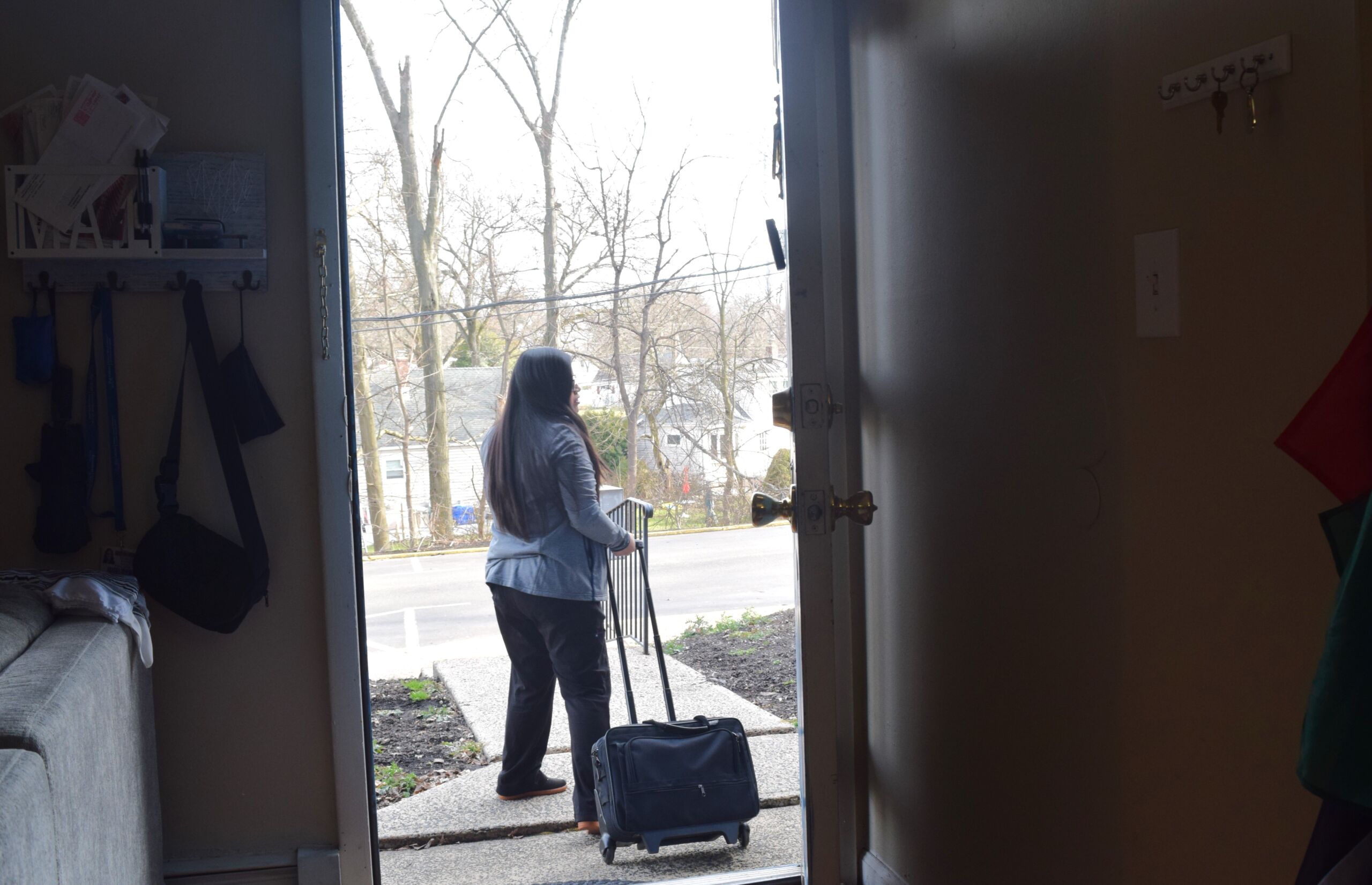
Like many of her colleagues, maternity nurse Grysmeldy González has seen firsthand how the health care system regularly fails new moms and infants.
The nurse will check the baby’s growth and development, confirm the mother is healing well after the delivery, conduct a formal screening for postpartum depression and make sure the infant has a safe place of its own to sleep. They can also suggest ways to comfort a cranky child and share other parenting tips.
Based on the assessment, the nurse can then connect the family with vetted health and social services. These could be a lactation specialist or case manager to help them manage a chronic condition; others may need a crib or food vouchers.
A Family Connects case manager follows up with the family a month later to make sure they got what they needed. When gaps in the social service network are found, a so-called community alignment specialist is tasked with knitting it back together, something program leaders said is critical to making the model successful.
“One of the challenges of our system is that it’s very fragmented,” said Jenny Jensen, acting CEO of Family Connects International. “There isn’t someone who can just look at the family as a whole and help support the whole family.

“At Family Connects, (we) really take care of mom, take care of baby, even take care of the partner, the grandma, anyone who’s there.”
In the first Family Connects program in North Carolina, randomized trials that began in 2009 showed participants reported half as many emergency room visits for mother and baby over the following year, compared to those not in the program. Participants were also 28% less likely to report depression or anxiety and experienced 44% fewer child abuse investigations. Participation was strong, with 8 out of 10 families agreeing to the nurse’s initial home visit.
“The Durham Connects program offers a novel, feasible, and effective public health policy for families of newborn infants,” wrote Kenneth Dodge, a Duke University psychologist who helped create the model, in an article published in the medical journal The Lancet last year.
“It combines a top-down commitment by community agencies to align services according to a preventive system of care model with an individually administered, brief nurse home-visiting program that aims to reach every family.”
When implanted correctly the program can have broad impact, practitioners said. “It’s not just an intervention at the level of the family, it’s a community intervention as well,” Jensen said.
‘Nobody is successful alone. But you can be successful by surrounding yourself with support.’
Kenneth Dodge, Duke University psychologist
The concept is not new. Postpartum care is ingrained in the culture, tradition, community and government in many countries, just not as much in the United States. In the Netherlands, after-birth planning begins long before delivery, studies show, and in Spain a community midwife visits new moms at home. In China, Mexico and some areas in Eastern Europe, women rest at home for up to a month after they give birth.
In the U.S., nurses and other child welfare workers have long visited new mothers at home, but these interventions target families struggling with addiction, poverty, violence and similar issues. More than 6,000 families in New Jersey continue to benefit from these programs each year, state officials said, with much of this work handled by the community nursing organizations also involved in Family Connects NJ.
But the fact that the Family Connects model is universal sets it apart from other home visitation programs, like the Nurse Family Partnership, which has been used by dozens of states for decades, including New Jersey. Experts said this helps to broaden the reach of Family Connects.

“It’s not stigmatizing that way,” Dodge said. “One thing we’ve learned from our scientific research is that nobody is successful alone. But you can be successful by surrounding yourself with support.”
Family Connects is also defined by its commitment to use nurses for the home visits instead of social workers or community health workers. Dodge said this is based on studies that show a deep level of trust in the nursing profession and test runs that revealed families were more likely to open their door to a nurse than a social worker.
“It’s really important to have somebody who’s highly qualified and skilled, licensed and trained, to be able to come to the home and do that assessment,” Jensen said. “It’s critical to the success of the program.”
How it’s going to work
Overseen by the Department of Children and Families, Family Connects NJ is based on a law Gov. Phil Murphy signed in 2021 and is fueled by an initial $35 million, a mix of state and federal money allocated through three annual state budgets. Of this, $17 million was identified for the new program through “right-sizing” existing home visitation programs, a department representative said. The nursing component for the initial five counties will cost $2.9 million in the first year, he said, a cost that will grow as the program expands to top $11 million annually for these first counties in 2028.
The program also is a major plank in the Nurture NJ campaign created by first lady Tammy Murphy to reduce maternal mortality and eliminate racial disparities in maternal health outcomes. With Tammy Murphy now running for U.S. Senate in a campaign that has focused on maternal health issues, the initiative could have political ramifications, too.
“This is literally how lives are going to be saved,” said Tammy Murphy at an event in January announcing the rollout. “This is how we build a state that puts mothers and babies first.”
To implement Family Connects NJ, the department contracted with the three regional maternal health organizations — Central Jersey Family Health Consortium, Southern New Jersey Perinatal Cooperative and the Partnership for Maternal and Child Health — to oversee the nursing visits in the five initial counties. These organizations also coordinate the support-service network in a few counties, while other nonprofits are responsible for the referral system in the remaining counties, including some places where the program is not yet active.
Among challenges with the rollout, hiring Black and Hispanic nurses — something that is important to build trust and participation — has been particularly difficult in some parts of the state. Eventually the statewide program will need some 250 nurses, officials said, roughly five times the number now engaged. And getting the word out to new moms and convincing them to participate has not always been easy. Nurses know they must help sell the program, but enrollment largely falls to other staff members who are working with hospitals, doctors’ offices, agencies that assist families and parent groups.
“Most of our efforts now are going towards what is the most effective way to recruit” participating families, said Grysmeldy González, a nurse manager with the Central Jersey Family Health Consortium, which oversees the visits in Mercer and Middlesex counties.
González said there’s a special focus on hospitals and engaging the maternity staff there. “I think the key is to get the buy-in from the nurses that are discharging [new moms], to say, ‘here’s a one-pager with a QR code, make sure you sign up before you leave.’ We really want to catch them in the immediate postpartum period,” she said.
New Jersey aims to connect 70% of new moms with the program by 2028, according to those involved, a level they know is a reach. Experts at Family Connects International said the model aims to engage at least 60% of the families giving birth in a program area, a threshold needed to truly benefit community health. But they also concede not all programs reach that level quickly.

“It’s definitely ambitious, but we know the families are interested,” said Emily Haines, the chief nursing officer with the Partnership, in Newark.
New Jersey’s law calls for the state’s publicly subsidized Medicaid program — which insures 40% of new mothers here — to pay for the nursing visits and establishes a process to require commercial insurance companies to do the same. State officials said they are working to implement these requirements and chose to use public funding up front, to get the program started.
According to Family Connects International, the model costs roughly $700 per family to implement and studies have shown that home-visit programs in general pay for themselves many times over.
Lessons learned
Oregon’s Family Connects program, codified into law in 2019, also mandates insurance coverage for the nursing visits and launched with $13 million in state and federal funding over two years, according to Afiq Hisham, a spokesperson for the Oregon Health Authority. The rollout was paused for nearly three years because of the COVID-19 pandemic, he said, in part because of staffing challenges. When it started, insurance payments did not cover all the costs, shortchanging the local health agencies implementing the program.
Family Connects programs are now up and running in nine of Oregon’s 36 counties, Hisham said, with several more expected to start this year. Currently, about 1 in 5 families agree to participate, he said, and the state is still compiling data on the program’s impact. “All that said, families served are reporting very high levels of satisfaction with the service, which tells us we are on the right track,” Hisham said.
New Jersey’s program is also informed by a Mercer County-based Family Connects initiative that conducted visits from December 2021 through the end of 2023. Now considered a pilot for the statewide rollout, those involved said this effort — funded with roughly $2 million from the Princeton-based Burke Foundation — assisted at least 1,050 families, roughly 30% of the births in the area. Almost all feedback from participants was positive, according to those involved.
While the program did assist some middle-class mothers, nurses said they visited many families who were struggling. Some faced eviction or lived in infested homes; many spoke little English and didn’t have legal residency status, leaving them afraid to complain. Cribs, car seats, strollers and diapers were common requests. Half were uninsured.

González — who is bilingual and participated in the pilot — recalled one visit she made to an undocumented new mother who also had an older child in her home country and was struggling with depression. “It was quite a lengthy visit,” she said. “But I really felt that she felt it was the first time that she was really heard, especially with the language barrier.”
Videsha Joshi, a senior manager with the Trenton Health Team, a nonprofit that oversaw the Mercer County pilot, said this level of commitment takes time. Nurses spent nearly half their working hours on case management duties, she said, and moms occasionally called their nurse weeks after “graduating” from the program. “I feel like that was the most unique part of this model, that connection to community resources. It comes at such a pivotal time for the family, when you’re in such a vulnerable state,” Joshi said.
Lessons from the pilot program are now informing the statewide rollout. “The model perhaps underestimates the amount of time and effort needed to bring an evidence-based model to reality,” said Gregory Paulson, CEO of the Trenton Health Team. “New Jersey is one state, but it is not one community and the realities, place to place, are very different.”
Paulson said the process also presents the state an opportunity to strengthen this network of clinical and social service referral agencies. “When we look at maternal health outcomes, those outcomes are largely related to places where the system fails,” he said. “This is about finding the places where things are getting stuck. And how do we fix them.”
As New Jersey builds its program, much of that work falls to the community alignment specialist, whose role it is to develop and maintain this support network, work that depends on building relationships. When mothers in the Mercer County pilot had trouble getting birth control from a Trenton clinic, nurses met with leaders there and discovered a scheduling issue that they could then resolve together, restoring access for the families.
‘When we look at maternal health outcomes, those outcomes are largely related to places where the system fails. This is about finding the places where things are getting stuck. And how do we fix them.’
Gregory Paulson, CEO, The Trenton Health Team
González said these relationships make the referral process more effective and underscore the importance of the community alignment specialist, who is “really looking for gaps in the community … and how we can fill them.”
While nursing visits are now limited to the initial five counties, New Jersey has been working for several years to strengthen its regional networks of support services, previously known as “central intake.” Now called Connecting NJ, it’s a database that links state and local government agencies, community groups and faith-based service providers, and some said this is already paying off.
“It really did improve the understanding and comfort level among stakeholders,” said Helen Hannigan, president and CEO of the Southern New Jersey Perinatal Cooperative. “We are building on existing infrastructure,” she said, “and it can bring about real change.”
Hisham, in Oregon, and others commended New Jersey for this early investment. “The number of relationships that you can build really [does] help with the success of the program,” said Family Connects International’s Ana Alvarez, a program specialist who is assisting New Jersey with the implementation.
What’s next?
The program New Jersey launched in January will not recruit mothers in the same way it was done during the Mercer County pilot. In the pilot, a team member regularly visited the birthing ward at Capital Health Medical Center in Hopewell to sign up families face to face.
But that approach — also used in the highly successful Durham program — presents a logistical challenge statewide, according to those involved. South Jersey moms may give birth at hospitals scattered across seven New Jersey counties or at facilities in Delaware or Pennsylvania, Hannigan noted. Newark residents have easy access to at least three birthing facilities.

Given that, Family Connects will now enroll moms through obstetric and pediatric practices, maternal health organizations, parenting groups and other community outlets, nurses said. But those involved said the three community nursing agencies involved are well positioned to make this work.
“Here’s the beauty of the consortia leading this, because, since the early ’90s, we’ve had relationships with all our hospitals,” said Robyn D’Oria, CEO of the Central Jersey Consortium.
With the program just beginning, data is limited, but at least 40 families across the five counties received visits from a nurse during the first month of New Jersey’s program. Nurses can’t share details for privacy reasons, but they feel certain they are making a difference for these families. Most of the visits result in referrals to services like lactation counseling, mental health support or help getting insurance coverage, but a few have needed a more urgent response: a mother with blood pressure problems, a baby with complex health conditions.
More resources
Family Connects NJ website
New Jersey Maternal Mortality Report, 2016-18
New Jersey’s home visitation law
Family Connects International: Evidence
Healthline: What Postpartum Care Looks Like Around the World, and Why the U.S. Is Missing the Mark
“It’s been really good so far,” said Siomara Diaz, nurse supervisor with the Partnership in Newark. “We’ve even had some of our experienced parents stating how much they’re learning with this birth because of this program, and having a nurse really come in, giving you the time to have more conversation and answer any questions or concerns they may have.”
The Family Connects model was initially developed in response to high rates of child abuse, not postpartum fatalities, and while participants said it has clearly saved lives, its impact on maternal mortality has not been tested.
“Do I think that we have saved lives? Yes. There are individual cases I can recite to you,” said Dodge, at Duke University, noting he is now working on a more extensive model that may have more impact on maternal mortality specifically.
Benitez, the new mom and nurse with the Central Jersey consortium, sees other ways in which the Family Connects model is changing the paradigm of maternal care.
”For the first time, women are put in the forefront, with our needs being heard,” she said. “We’re going to give you the tools to succeed. It’s just a lens to say, even if you’re not OK, we’re going to help you get OK.”
Cover photo: Yashirie Benitez feeds her daughter Brooklyn Hunt. (Credit: John Mooney/NJ Spotlight News)
More from NJ Spotlight News
About this project
The Change Project is a part of the Chasing the Dream multiplatform public media initiative from The WNET Group. We are reporting on challenges facing New Jersey in a variety of areas involving social justice and equity, as well as showcasing promising remedies. Our reporting focuses on inequality in many aspects of life, from birth through school to finding an affordable place to live. We are also focusing on what has worked elsewhere to make life better for people, and what lessons we can learn for the future.
Major funding for The Change Project and Chasing the Dream is provided by The JPB Foundation
Help us continue to report on important issues by supporting our work.
