Harm reduction or criminalization: How does NJ rate?
The state facilitates harm reduction, but advocates fear lawmakers still want to criminalize substance use
This is part of The Change Project series examining New Jersey’s social and economic challenges — and focusing on promising actions that have led to positive change.

New Jersey has embraced “harm reduction” strategies against the addiction crisis in recent years, but advocates say there remains a long way to go to move away from the era of a more punitive approach and to overcome the often divisive politics of the issue.
Over the last several years, the state has legalized cannabis, expanded harm reduction centers and provided thousands of doses of naloxone, a drug that reverses the effects of an opioid overdose. Some $1 billion from the settlement of a federal case against four companies for their role in the opioid crisis will expand that work through 2038.
Tag us using #ChangeProjectNJ on social media and stay tuned for live events.
Since those initiatives have taken place, overdose deaths have decreased among white residents in New Jersey over the last two years and increased among Black and Hispanic communities.
But the continuing existence of bills in Trenton that would increase fentanyl-related penalties and impose other punitive measures has harm reduction advocates concerned that more substance users will potentially be harmed, rather than helped, due to fentanyl’s widespread availability — and potentially hurt communities of color already overpoliced by the war on drugs.
“Right now, there’s a lot of talk about increasing the criminal penalties of fentanyl,” said Sandy Gibson, a harm reduction practitioner and professor at The College of New Jersey. “So you’re just going to further criminalize everyone, further make it so that more and more people can’t ever enter the legitimate economy, and destroy families.”
Tougher penalties?
In late 2022, state Sens. Paul Sarlo (D-Bergen) and Joe Lagana (D-Bergen) introduced a bill (S-3325) that would toughen penalties for creating and distributing fentanyl.
Despite a backlash from drug policy experts and people who have used drugs, the bill cleared a Senate committee vote last summer. It did not go any further in the last legislative session and was reintroduced this year, alongside similar Republican-backed bills that seek to further criminalize the drug.
‘The vast majority of people who engage in harm reduction services do actually seek treatment and an abstinence-based life ultimately.’
Sandy Gibson, The College of New Jersey
In a statement released last year when the bill advanced in the Senate committee, the senators lauded their victory even after testimony from harm reductiontists and former substance users that the bill would cause harm.
“We must be more proactive in tackling a fentanyl crisis that is harming communities, devastating families and causing senseless deaths. The concentrated potency of fentanyl and its frequent addition to other drugs requires updated laws that focus on manufacturers and dealers,” Sarlo said.
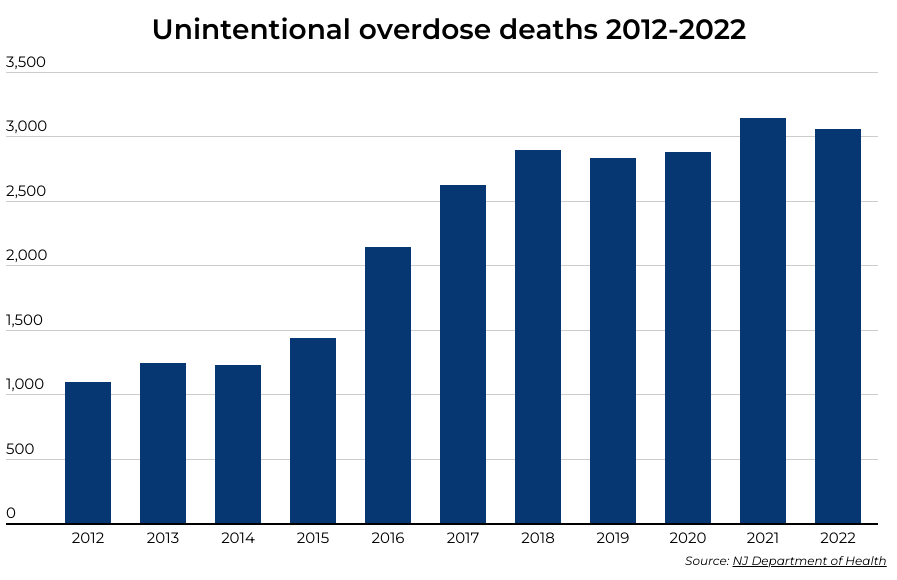
Supporters of harm reduction practices said they hope that the bill won’t move forward this year, and that instead legislators will continue building on the work the state has already done to bolster harm reduction practices.
They emphasize that the “old” ways of trying to stop people from using drugs — promoting abstinence, arresting people for substance use or distribution, forcing detox through probation rules or family interventions — don’t necessarily work, which makes harm reduction even more critical to saving lives.
“There’s research out there that shows [when] we mandate abstinence for anyone on probation and parole… the minute the legal leverage [was] lifted, people returned to use — because it wasn’t something that they chose for themselves,” said Gibson.
“The vast majority of people who engage in harm reduction services do actually seek treatment and an abstinence-based life ultimately,” she added.
In some ways, New Jersey has made a significant shift toward harm reduction over the last few years. Gov. Phil Murphy signed a bill in 2022 which allowed the state Department of Health to authorize needle exchange sites, programs that could previously be blocked by municipalities.
Originally, there were seven sites, and the Health Department announced its plans to expand the number of full-service harm reduction centers across the state. As of May 2024, there are around 20 organizations authorized by the state to provide harm reduction services.
Jenna Mellor of the New Jersey Harm Reduction Coalition said New Jersey has made the process for state authorization easier.
“People should be able to get safer use supplies anywhere they’re going for support, whether that’s mutual aid offerings, whether that’s faith-based organizations, whether that is community outreach groups, whether that is health care providers. And we’re seeing that and who’s applying to become an authorized harm reduction center,” Mellor said.
In February, Murphy and state Attorney General Matt Platkin also announced the initial plan for the $1 billion in class action settlement money over the next 14 years to help mitigate the opioid crisis.
While the plan was put together alongside harm reduction practitioners and will funnel millions toward harm reduction services and expanding housing programs, advocates said the state should use the opioid settlement money to invest directly into communities of color that were harmed by the war on drugs. There are currently no such measures in the plan. Murphy’s office did not respond for comment on any plans it may have to address racial disparities with the settlement money.
Harm reduction advocates say that New Jersey still has a lot of work to do, and that it’s behind other states like Washington. For instance, New Jersey was one of the last states to have a legal path toward syringe access, said Mellor. And the opioid settlement money can only go so far, they say, if punitive drug measures are not also addressed.
“All of that [harm reduction work] is undermined when we still continue to criminalize people, because at the end of the day, it’s almost like the state [is] sending two messages. On one hand, it’s ‘criminalization, criminalization, criminalization,’ and on the other hand, it’s ‘Trust us. We have public health resources that can help you,’” said Ami Kachalia of ACLU New Jersey.
“And in an environment where people have faced for decades the first message, it becomes really hard to overcome that unless we’re actually actively working to end criminalization and really and truly shift to a public health approach,” she added.
Cover photo: NJ Spotlight News file photo
About this project
The Change Project is a part of the Chasing the Dream multiplatform public media initiative from The WNET Group. We are reporting on challenges facing New Jersey in a variety of areas involving social justice and equity, as well as showcasing promising remedies. Our reporting focuses on inequality in many aspects of life, from birth through school to finding an affordable place to live. We are also focusing on what has worked elsewhere to make life better for people, and what lessons we can learn for the future.
Major funding for The Change Project and Chasing the Dream is provided by The JPB Foundation
Help us continue to report on important issues by supporting our work.