
Harris inspires Indian American women to get out the vote
Strong push to register voters and boost turnout, but Israel-Gaza contentious issue for some
This story is part of the NJ Decides 2024 Reporting Fellowship, in collaboration with six local and community news organizations and the Center for Cooperative Media at Montclair State University. The stories in this collaboration focus on the presidential election from the perspectives of diverse communities in New Jersey.
This story, examining how Indian American women have been inspired by the nomination of Vice President Kamala Harris, is being published simultaneously by Central Desi.
The Diwali holiday season is taking on new fervor this year for supporters of Kamala Harris, as the large Indian American population rallies at the possibility of the first American president with South Asian, or Desi, roots.
At community gatherings across the Garden State to celebrate the Hindu festival of lights this month, members of the South Asian caucus of the New Jersey Democratic State Committee have been pushing voter registration and turnout for the potentially historic election.
“From a South Asian perspective, this is a moment of pride for us,” said Parul Khemka, the newly appointed co-chair of the caucus.
“When she talks about idli and dosa,” said Khemka, referring to Harris’ mentioning South Asian foods, “she’s just like one of us.”
Harris’ mother immigrated to the United States from India, and her father from Jamaica. Her ascendancy to the top of the Democratic ticket has galvanized many Indian Americans, in New Jersey and beyond.
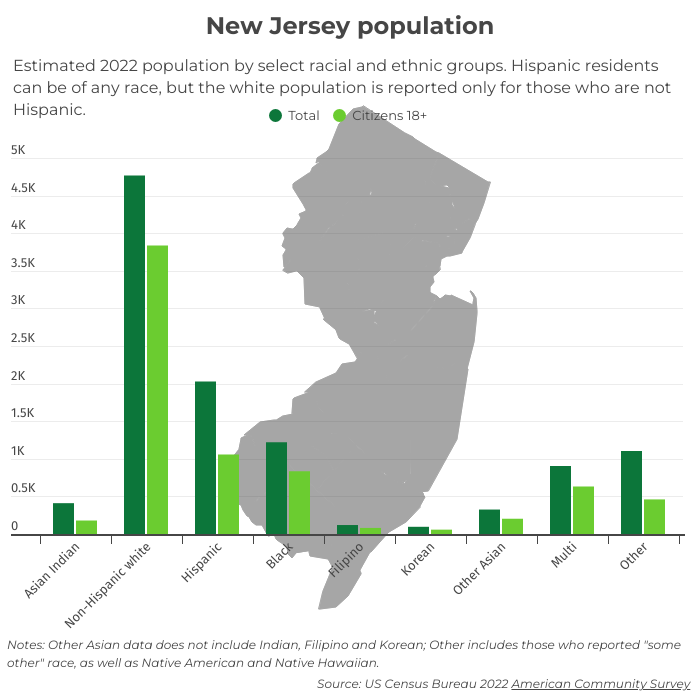
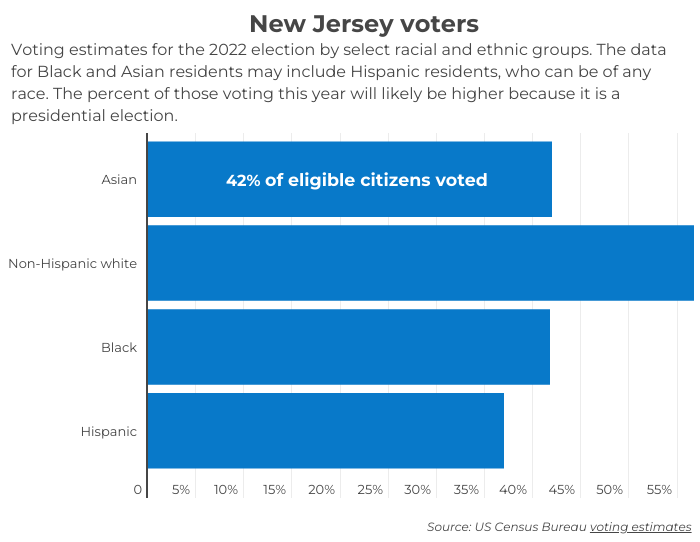
Close to 410,000 New Jersey residents are of Asian Indian descent, making up about 12% of the state’s population, according to data from the U.S. Census Bureau. The data shows that roughly 45% of the state’s Asian Indian residents are citizens age 18 or older and eligible to vote.
Although there is no state-by-state breakdown of voting, the political preferences of New Jersey’s formidable Indian population lean Democrat.
In a broader count, close to two-thirds of Asians in New Jersey self-reported last year that they voted for Democrats for state Assembly or Senate, according to exit polling conducted by the Asian American Legal Defense and Education Fund. In addition, the state is home to a growing number of South Asian elected officials, most of whom are Democrats.

Nationally, support for the Democratic ticket jumped 23 points among Indian Americans after Harris became the presidential nominee, from 46% for President Joe Biden in May to 69% for Harris in September, according to multiple surveys by APIAVote. There was an increase of more than 18 points among Asian Americans overall.
During the same period, support for former President Donald Trump fell four points among Indian Americans, from 29% to 25%, the surveys found. More than three-quarters of Indian American respondents said they had a favorable impression of Harris.
Women in particular reported that Harris’ gender and ethnic identities matter to them, and much of the organizing happening in the South Asian community as the Nov. 5 election approaches is being led by women.
In New Jersey, that is translating into more Desis of all ages knocking on doors, taking buses to Pennsylvania — a potential linchpin in the presidential race — and writing handwritten postcards to undecided voters.

“Before, aunties and uncles voted. Now, you see them coming out to local events and volunteering,” said Kinn Badger, co-executive director of the New Jersey Democratic State Committee.
Badger, who is biracial and part Desi, said this is a moment of pride for her. “I never thought in my lifetime I’d ever see a South Asian woman running for president.”
The fact that many community members are attending Diwali festivals presents a prime opportunity to get the word out, Badger said.
On Oct. 7, a coalition of Democratic organizations, including the South Asian caucus of the state Democratic State Committee held a “Diwali Rally and Canvass” event in the 7th Congressional District, whose population is nearly 9% Asian. The event included door knocking and a rally with U.S. Senate candidate Andy Kim (D-3rd) and Sue Altman, who is the Democratic congressional candidate in the 7th District, running against Republican Rep. Tom Kean Jr.
Lavanya Raghavan, a community organizer in Montclair, said she has personally distributed more than 2,000 postcards for volunteers to mail to swing states. Her friends have organized postcard-writing cocktail parties.
“It’s been heartening to witness the renewed level of engagement after the very sluggish start to the election year,” Raghavan said.
Gaza, taxes raise concerns
Still, there are policy difference preventing some Desis from rallying behind Harris. At a recent banquet for the New Jersey chapter of the Council on American-Islamic Relations, Raghavan said she heard many attendees voice support for Jill Stein, the Green Party candidate.
Young people are especially struggling with “the horror of American foreign policy,” Raghavan said.
The political actions around the festival of Diwali primarily focus on the Hindu part of the community.

About a quarter of South Asians in the United States are Muslim, and their enthusiasm for Harris is more muted, according to former state Assemblywoman Sadaf Jaffer, who was the first Muslim to become a mayor in New Jersey.
Many Muslims are feeling disconnected this election cycle because neither Harris nor Trump appear likely to diverge from the Biden administration’s support for Israel’s attacks on Gaza and Lebanon which, according to the Palestinian Ministry of Health, have killed more than 42,000 people and injured twice as many, including many women and children.
“For that segment of the South Asian community, it’s a very, very difficult time, and I think that is impacting their connection to this election,” Jaffer said.
When Khemka attends community events on behalf of the caucus, she said people often ask about the war from an economic standpoint, such as why the Biden administration is spending so much to support Israel.
There are other issues, too. They also express concerns about whether Harris will raise long-term capital gains taxes. Many Desis own small businesses, she noted, adding, “There is some kind of belief that Trump is going to be great for people that have businesses.”
Illegal immigration also comes up through a monetary lens.
“People say, ‘I don’t have money by the end of the month to buy my groceries, but these people are living in five-star hotels in New York,’” Khemka said, raising what has been a false rumor about immigrant housing.
What she hears less often is concern over how Harris as president would receive Indian Prime Minister Narendra Modi, who has a friendly relationship with Trump. Raghavan said that support for the right-wing Modi is more prevalent among newer Indian immigrants, many of whom are not yet able to vote, and older Indian Americans.
Khemka said she believes Harris’ Indian background would benefit U.S.-India ties, which are based largely on mutual economic benefits and strategic alliance and thus likely to continue no matter who wins.
“I tell people, ‘We have to start thinking about what is good for the United States, because if we’re not good here, it doesn’t matter what is happening in other countries,” said Khemka.
She immigrated from India at the age of 21 and said she hasn’t missed an election since becoming a citizen in 2019.
Not a monolith
Sujana Chandrasekhar, a doctor in Essex County and lifelong Democrat, said the Indian community in New Jersey is hardly a monolith, and that is true for its politics and how it votes, too.
“We break down less as Indian people and more as whether our overall politics are more Democratic or Republican in general,” she said.
Among her friends and those of her four children, all in their twenties, she said there is a lot of excitement for Harris. It’s not just that Harris has Indian roots, but the facts that she is biracial, the child of immigrants and a woman.
Earlier this month, Chandrasekhar attended a luncheon in Trenton hosted by Higher Heights for America, a political organization for Black women that invited her and other Indian Americans to attend in traditional clothing to “show all that Kamala is.”
Chandrasekhar donned a sari.
“The sisterhood is there,” she said. “This is an opportunity for us to get past what may be ailing us and see each other for who we are.”
Cover photo: Kamala Harris supporters gathered at a fundraising luncheon hosted by Higher Heights for America in Trenton on Oct. 5.” (Photo courtesy of Sujana Chandrasekhar)
