
How much fight left in Atlantic sturgeon?
Life in the Delaware River has not been kind to it
In the late 1800s, 300,000 or more Atlantic sturgeon swam in the Delaware River in the Camden area. Today, the fish is on the federal endangered species list, nearing extinction.
First, the sturgeon fell victim to overfishing more than century ago as people sought their eggs — Philadelphia was considered the “caviar capital of North America.” The pollution that plagued the Delaware in the mid-1900s hurt their offspring. Dredging and saltwater intrusion have also hampered the fish’s ability to spawn successfully. Today, vessel strikes further imperil it.

Environmental groups, including the Delaware Riverkeeper Network, say the Delaware River Basin Commission — a multistate body that oversees the river and watersheds surrounding it — can and should do more to ensure that the sturgeon, which dates to the Cretaceous period, doesn’t go the way of the dinosaurs. Last year, the group was among a number of environmental organizations that petitioned the Environmental Protection Agency to use its authority under the Clean Water Act to supersede the Delaware River Basin Commission and impose higher water quality standards in the area.
The Delaware River population was estimated at less than 250 in a recent study by the U.S. Geological Survey.
Recent action by the EPA could throw the fish a lifeline: The agency announced in December that it planned to use rule-making to toughen the water quality standards in the area. And the National Oceanic and Atmospheric Administration has designated the section of the river from Trenton to the mouth of Delaware Bay as critical habitat for the sturgeon.
The Atlantic sturgeon, which can grow to 16 feet long and 800 pounds, is not exactly cute. Bluish-black or olive brown in color, the prehistoric-looking fish has five rows of bony plates along its body, a snout with four projections that look like thick whiskers and a shark-like tail. A campaign in 2022 by the Delaware Riverkeeper Network to save the sturgeon involved highway billboards that drew attention to the “Dino in the Delaware.”
In 2012, five distinct population segments of Atlantic sturgeon were listed as endangered under the federal Endangered Species Act. The Delaware River and Bay segment, which is a part of the New York Bight population, is the most critically threatened. (Another sturgeon population in the Delaware River Watershed, the shortnose, is also federally listed as endangered.)
The Delaware River population was estimated at less than 250 in a recent study by the U.S. Geological Survey.

“Our Atlantic sturgeon population has been at this very low level for a number of years now and our government officials continue to resist taking action to upgrade the standards and protect the sturgeon, even though they literally hang at the brink of extinction,” said Maya van Rossum, who as the Delaware Riverkeeper oversees efforts by private and nonprofit groups to keep the river clean and healthy as possible.
A main problem the sturgeon faces is having enough oxygen throughout the year to support propagation, van Rossum said. “So if we were to increase the oxygen levels, it would be very beneficial for fish propagation and helping to restore the sturgeon population.”
The life cycle
After hatching, the Atlantic sturgeon heads out to sea, then returns to the river to lay eggs on reaching adulthood. A 2016 study by researchers from the Delaware Department of Natural Resources and Environmental Control found close to 3,700 juvenile sturgeon in the Delaware estuary. But one expert on the Delaware River’s sturgeon reported that one female has 2 million eggs and fewer than 10% of juveniles survive long enough to spawn.
‘There’s this sort of underlying, low-level consistent constant harm that’s having its own impact, while at the same time we have things like dredging, we have pollution input, we have sea-level rise that is moving the salt line further upriver which has impacts on the Atlantic sturgeon.’
— Maya van Rossum, Delaware Riverkeeper
The Delaware River Basin Commission conducted a five-year study of the dissolved oxygen criteria for aquatic life in the 38-mile urban area around Philadelphia, Camden and Wilmington, Delaware.
The commission had first set 3.5 milligrams per liter as the standard for dissolved oxygen content in the river’s water 55 years ago. A 2018 report by The Academy of Natural Sciences of Drexel University found the sturgeon needs 6.3 milligrams per liter. Wastewater discharges from sewage plants along the river meet the commission’s standard, but keep the oxygen level in the waters around Camden and Philadelphia below that higher threshold.
Last September, the commission’s report agreed a stricter standard is needed in the area and planned to set new rules for nine sewage treatment plants. When the EPA three months later agreed with environmentalists’ petition for higher water quality standards and vowed to write a rule within 12 months increasing the standards, environmentalists cheered. But the sturgeon face other problems.
Sturgeon versus ships
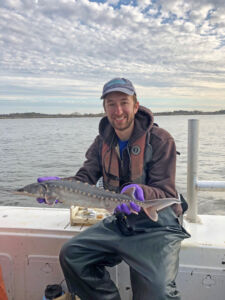
Dewayne Fox, a Delaware State University fisheries professor who studies the Delaware watershed cohort of Atlantic sturgeon, said in an interview with NJ Spotlight News in April 2022 that the greatest damage from a channel-deepening project in the river was the destruction of the Atlantic sturgeon’s most important spawning area. Atlantic sturgeon eggs are sticky; they adhere to the first thing they touch. If that thing is sand, silt or mud, the eggs will quickly be covered over and smothered. Rock surface, then, becomes virtually the only substrate in the Delaware River that Atlantic sturgeon eggs can attach to and survive long enough to hatch.
“There’s this sort of underlying, low-level consistent constant harm that’s having its own impact, while at the same time we have things like dredging, we have pollution input, we have sea-level rise that is moving the salt line further upriver which has impacts on the Atlantic sturgeon,” van Rossum said. “All of these dredging projects are bringing in bigger and bigger boats and when those boats strike [the sturgeon], they kill them. Those vessel strikes are actually considered to be at this point one of the most significant harms to the sturgeon.”
The Delaware River Basin Commission does not control boat traffic in the river, said Kate Schmidt, a commission spokeswoman.
— Andrew S. Lewis contributed to this story.
This article is part of a special series by NJ Spotlight News and funded by the William Penn Foundation. Go to njspotlightnews.org/Delaware-Watershed to visit the project homepage. Send us your stories and photos about the Delaware River region.
