
After a stranger brutally assaulted me in the street, I became ‘Victim EY’
Healing with horses while court proceedings crawl
Editor’s note: This story contains graphic images that some may find disturbing.
The first morphine dose didn’t touch the pain shooting through my face. Neither did the second. Writhing and sobbing in NYU Langone’s post-anesthesia recovery unit, I felt a nurse grab my hand. “We’re giving you fentanyl,” she said. The agony vanished. I slipped into merciful nothingness.
I’m an intensely private person. I don’t have a Facebook account. I’ve never made a “Some personal news” post on Twitter. As a career journalist, my name is supposed to appear as a byline atop news articles, not within the stories themselves. Today, though, is different. Two years ago, I underwent craniofacial reconstruction to address the damage from a beating inflicted by a stranger, a 25-year-old Trenton woman who may have been in the throes of severe mental illness.
It was in my own historic Trenton neighborhood
where my attacker set upon me in September 2021.
She scarred me physically and emotionally. And unwittingly, she led me back to horses. As a child they were my first love. Later, in high school, when I was bullied for a facial birth defect, they were my salvation; as an adult, they were my partners in competition. Then I bought an old house whose restoration and upkeep left no time or money for horses, and my tack trunks were relegated to the basement.
It was in my own historic Trenton neighborhood where my attacker set upon me in September 2021. Armed with a metal-lidded Mason jar drinking glass, she sliced my forehead, tore my lip, broke my nose, crushed my sinuses and fractured my cheekbones and eye sockets. I suffered a concussion so severe that it took months of rehab to stop the dizziness and nausea, regain balance and coordination, coax my eyes to work harmoniously, process more than a written paragraph at a time and thaw neck and back muscles frozen by whiplash.
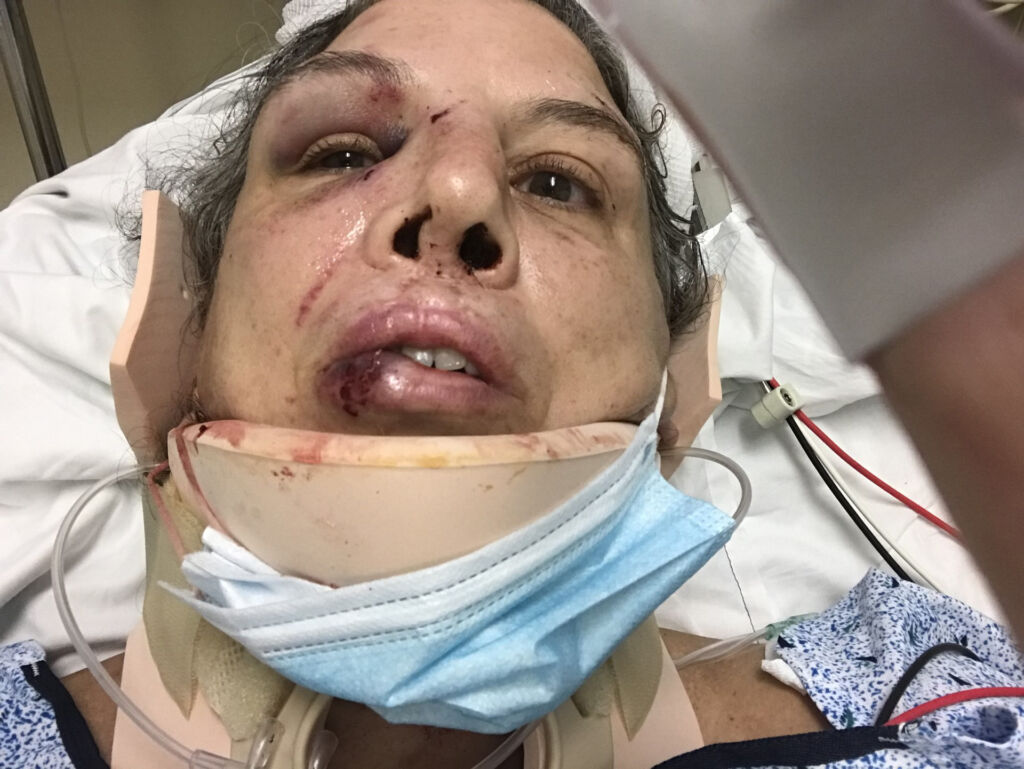
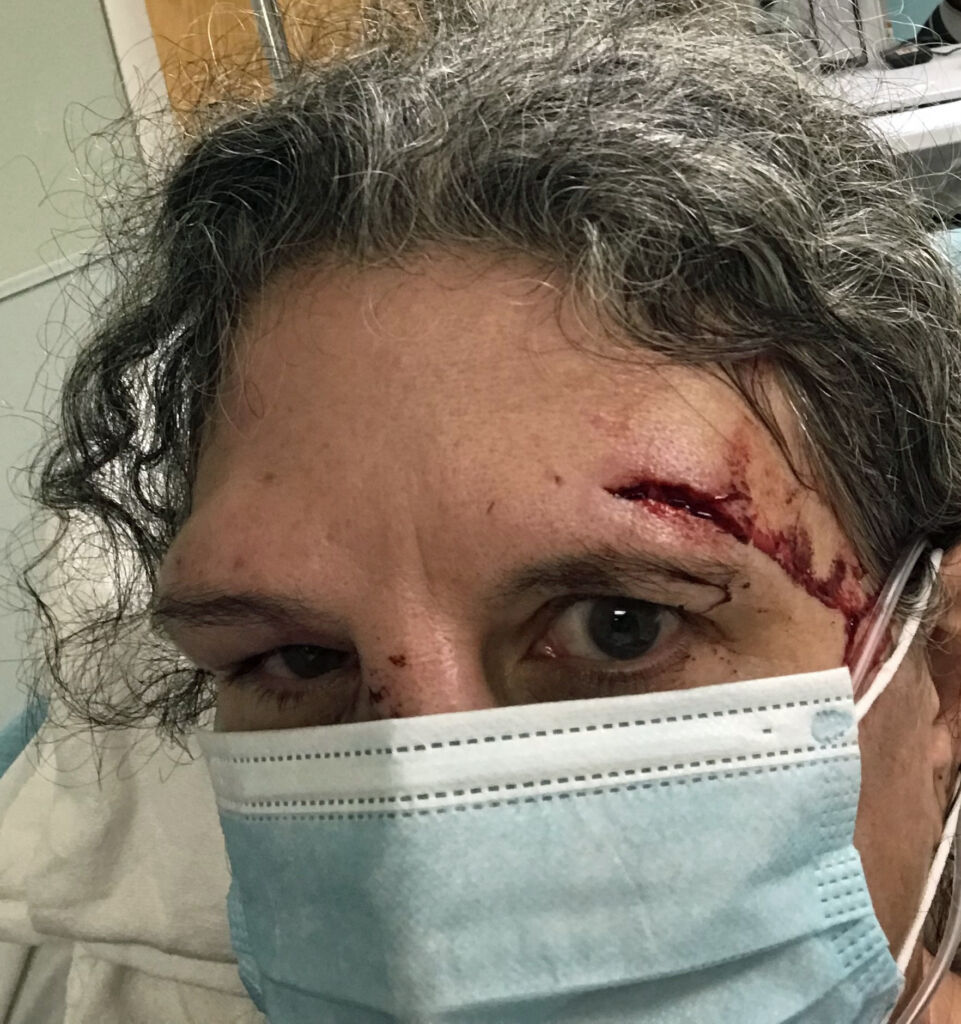
Amid all that physical therapy it came time to fix my face, and I knew what lay ahead. Unfortunately — fortunately? — I’m a plastic surgery veteran: Born with a bilateral complete cleft lip, with a massive fissure in the bone between my mouth and nose, I had my first in a series of a half-dozen operations at eight weeks old. The most recent, which should have been the last, was when I was 25.
ELISE YOUNG IN AN EXTENDED INTERVIEW WITH BRIANA VANNOZZI
This mess was something else entirely. The earlier operations had caused so much “insult,” a term used by doctors to describe extensively manipulated tissue, that the surgical challenges were immense. The plastic surgeon in the Trenton trauma bay could suture the cuts that went to the bone. The next round was up to an NYU Langone surgeon, who is a specialist in cleft reconstruction and a veteran of pioneering face-transplant procedures. I recuperated at the home of my mother, my lifelong partner in dressing changes and prescription pain-med charts and food that doesn’t need to be chewed.
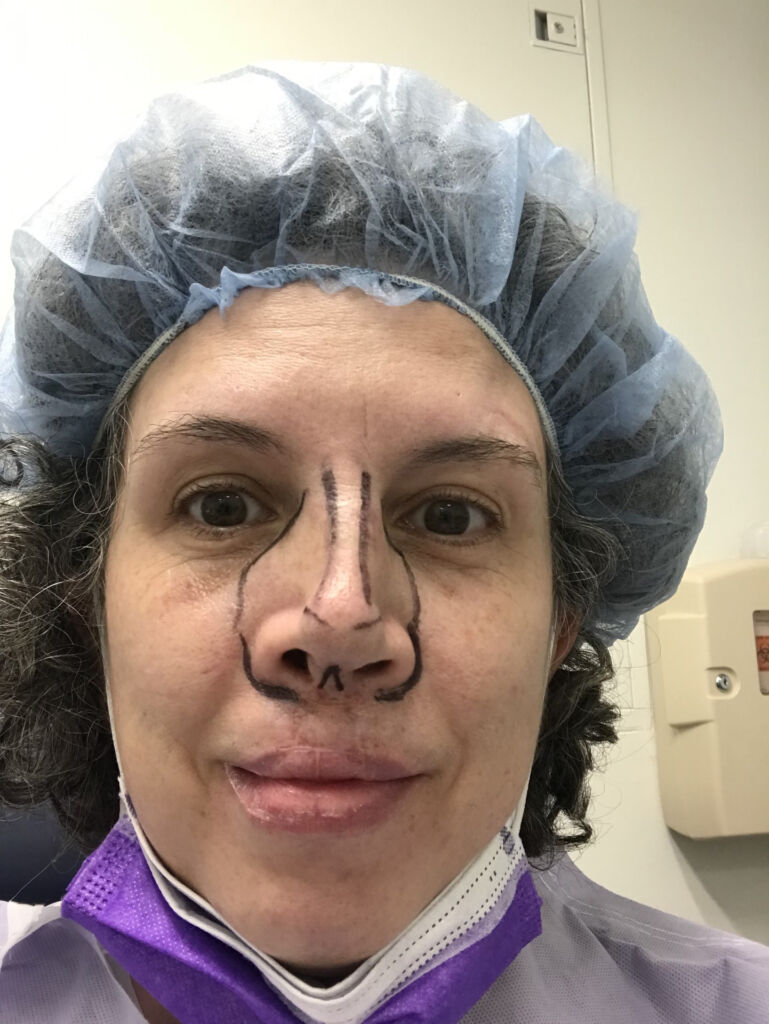
Months later, my face back together — to the extent that it could be put back together — it came time to find a trauma therapist. But I couldn’t find the right fit. And then it hit me: horses.
I had been gaga about horses since I could walk. A family photo shows me, no more than 3 years old, clomping around in my mother’s snow boots, which came up to my hips. I distinctly remember that I had fancied myself heading to imaginary stables. I was 8 when my parents gave in to the constant begging and enrolled me in lessons and sprang for all the horsey trappings necessary. It was a gift that was supposed to last for 10 weeks. That turned into about 20 years, on and off.
As a novice, horses were my pals. Later, as a teenager, they were my salvation: Many of my classmates, obsessed with my cleft scars and wonky nose, were bullies of the cruelest sort. For solace I had my other world, where no one ever pointed out that my face was different. A female coach molded me into a reasonably decent rider. I made a friend of my own age who to this day remains dear.
I found the perfect woman-owned stable and girl gang in December 2022.
After the attack, I reasoned, a return to riding would mean a peaceful environment, miles from my blighted urban neighborhood. I could run from the memory of the woman who harmed me and find my grounding again in horse girls, as we call ourselves, no matter our age. My attacker was where she needed to be: first, in jail, then — as now — in New Jersey’s state-run maximum-security psychiatric hospital. And I needed my own place to process the trauma’s fallout, to extract and maybe conquer the new anxieties and fears that no psychoanalyst could reach.
Horses, humans, healing

I found the perfect woman-owned stable and girl gang in December 2022. I acquired Victoria, a lovely British warmblood mare, four months later. Many lessons later, I resumed competing, even winning ribbons in three classes that we had entered merely as a dry run, with no hope, let alone aim, of triumphing. My return was at a benefit for my coach’s onetime employer, a European Championship gold medalist and Olympic equestrian who in a 2019 fall suffered a devastating spinal injury. That athlete, Kevin Babington, continues to teach from a wheelchair. He also oversees a foundation whose work supports fellow injured show jumpers and supports medical research that may lead him and other people with paralysis to walk again.
On the second anniversary of my facial surgery, I headed to my stables. It was snowing for the second time in a week, and the all-girl crew could use a hand with tough work that will make me cold and sore. And joyful. Joyful that my attacker didn’t kill me, that I’ve overcome so much physical and emotional wreckage. Joyful that horses and horse girls accept me, once again, just as I am, so scarred and so very imperfect. Joyful that I’ve befriended a young fellow rider who — get this — has a bilateral cleft lip.
In a few days I’ll be back in criminal court for yet another hearing to determine whether my attacker goes to trial or pleads guilty by reason of insanity. Afterward, so long as I’m not on deadline, I’ll go back to the barn. I’ll get dirty. I’ll be grateful.
Six weeks before my attacker turned up on my street, she was in another part of town, where she allegedly had beaten another woman.
I’m sitting in Courtroom 3D on a Monday in January 2024. It would be ideal, at this moment, if my damn pants weren’t falling off.
Pre-assault, these trousers fit just right. But my muscle tone has improved since my return to riding horses. So I’m left to squirm and tug at the waistband here in what I’ve come to call The Living Theater of Regrettable Life Choices. I’ve been through this drill at least a half-dozen times since the attack that left me with a crushed face and a traumatic brain injury, and the few people in my life who are familiar with the case ask: How do you have the emotional strength to show up in court for hearing after hearing?
Well. I’m a journalist. I carry a narrow pad labeled “Reporter’s Notebook” in which I jot whatever might make for a good story. When I slip into professional mode in the courtroom at that moment, I mostly overlook that my attacker and her supporters at times have sat mere feet from me. I tell myself that I’m writing about a misfortune, not my misfortune. So loose pants, while uncomfortable, become a welcome distraction, an excuse to hunt (unsuccessfully) in my handbag for a safety pin.
The judge reads a list of roughly 50 defendants on the docket, and I’m writing chunks of this essay in longhand. When that gets tedious, I have a book, “Dressage Between the Jumps: The Secret to Improving Your Horse’s Performance Over Fences,” by the late Olympic coach Jane Savoie. It’s a gripper. At the stables with Victoria, I’m working on a three-part exercise involving haunches-in at the circle (Got!), three half-halts (Yup!) and renvers to flying change (Come on, now, Jane. Seriously?).
In this case’s legal papers I don’t have a name. I’m identified as “Victim EY.” The short reason I’m here, of course, is because someone hurt me and I need to see justice served. A more complicated reason for my presence, though, is a lot more interesting and far-reaching.
Six weeks before my attacker turned up on my street, she was in another part of town, where she allegedly had beaten another woman. That’s felony territory with a potential for 10 years in prison.
I know what you’re saying: “Wait. What? She was arrested and charged? Why wasn’t she in custody? Why was she running around?” Here’s an explainer from the New Jersey courts website: “On Jan. 1, 2017, the state moved from a system that relied principally on setting monetary bail as a condition of release to a risk-based system that is more objective, promotes public safety and is fairer to defendants because it is unrelated to their ability to pay monetary bail.”
Today, more than two years after my neighbor found me stumbling in our street,
the case against my attacker is unresolved.
Had she been arrested prior to 2017, my attacker would have avoided detainment only if she could hand over cash. New Jersey was one of the nation’s leaders on eliminating that requirement, a system that critics — among them Chris Christie, a career federal prosecutor, Republican governor and two-time failed presidential candidate — had said unfairly burdened defendants of little means and drove up taxpayer costs. In the first five months of the new system, according to state data, New Jersey’s jail population dropped almost 20%. That is, one in five defendants — all innocent until proven guilty, after all — could go about their lives as the cases against them took shape.
My attacker, when she was charged in the earlier alleged assault, was the subject of some debate as to whether she could remain free pending more court dates. The prosecutor argued that alleged violence this severe was cause for detainment. But her public defender said she had no criminal convictions, didn’t appear to be a flight risk and was looking for employment. The judge, guided by those arguments and also a standard risk assessment, sided with the public defender. He let my attacker go with some stipulations, including that she stay away from the alleged victim and keep scheduled appointments with court officials.
It appears, though, that chats with her local justice-system professionals weren’t on my attacker’s short list of things to do in late summer 2021. For right around the time a trauma team was pushing fluids into me to help counteract blood loss, Trenton police were arresting my attacker. She was wanted, they learned, on a warrant for allegedly violating the earlier terms of her release.
As I walk home, along one-and-a-half miles through one of New Jersey’s poorest and most dangerous cities, I start to shake off reporter mode, and my thoughts shift to horses.
Today, more than two years after my neighbor found me stumbling in our street, the case against my attacker is unresolved. Nothing happened in court the morning I spent there because the hearing was pushed to February. No one had given me the courtesy of informing me.
My attacker remains at the state-run Anne Klein Forensic Center, a maximum-security psychiatric hospital, whose doctors are trying to make her competent enough to understand the criminal cases against her.
I leave the courtroom and wonder how many bench warrants the judge will issue today for any defendants who skipped their hearings. As I walk home, along one-and-a-half miles through one of New Jersey’s poorest and most dangerous cities, I start to shake off reporter mode, and my thoughts shift to horses.
One hand pinches my waistband; the other carries a dressage textbook. Tomorrow, Victoria and I will get cracking on that renvers riding maneuver. Then I should go shopping for pants that fit.

All photographs are courtesy of Elise Young.
Editor’s note: An earlier version of this material appeared as essays on a social media site.