
NJ Voters Guide: 30th Legislative District
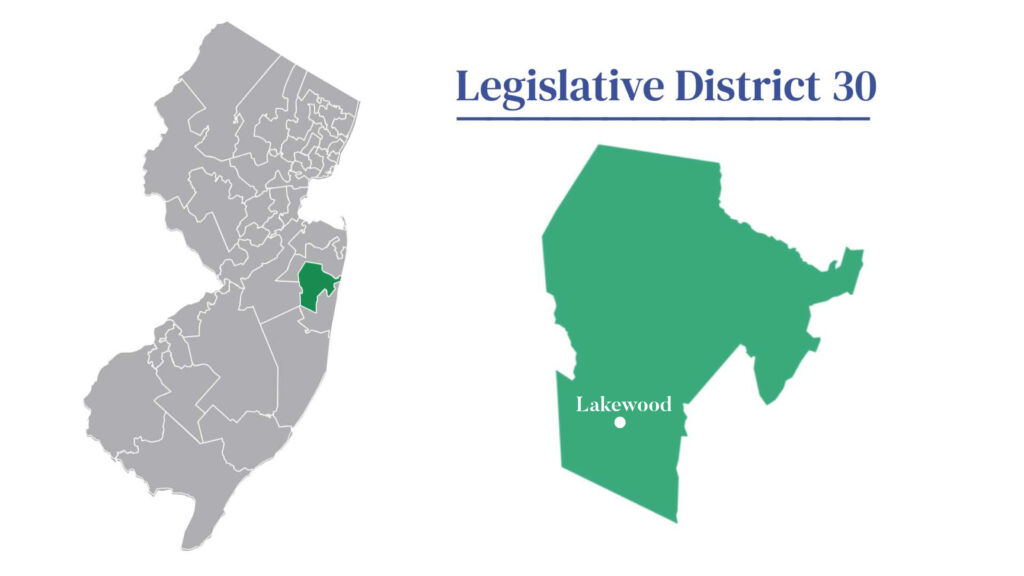
New Jersey’s 30th Legislative District covers Lakewood in Ocean County and Avon-by-the-Sea, Belmar, Farmingdale, Howell, Lake Como and Wall in Monmouth County.
The district had been a Republican stronghold since the early 1990s, but a Democrat won an Assembly seat in 2023 and now representation is split between the parties. Republican registrants dominate, comprising 43% of all, compared with 21% who are Democrats and most of the rest are unaffiliated.
Republican Assemblyman Sean Kean, an attorney in Matawan who took office in 2012 after serving in the state Senate in a different district, is running with Edward Thomson, a pension actuary and former mayor of Wall who lost his seat two years ago.
Democratic incumbent Alexander “Avi” Schnall of Lakewood is also seeking reelection. Joanne DeBenedictis, a retired teacher from Belmar, was a late replacement for Claire Deicke, who had won the other Democratic nomination in the primary but withdrew from the race.
Editor’s note: All candidates were contacted multiple times for the NJ Decides 2025 voting guide Q&As. Click on a candidate to see any answers provided.
The candidates
Age: 62 Hometown: Wall Township Occupation: Attorney Personal or professional background: I am a life-long New Jersey resident. I grew up in Deal and graduated from Red Bank Catholic High School. Then I went to Seton Hall University for my undergraduate degree, Columbia University for my master’s degree, and earned a law degree from Seton Hall University Law School. I am employed as an attorney. I currently live in Wall Township with my wife and three children. What is your top issue this year? I believe the top issue this election is affordability. The increasing cost of electricity, the tremendous cost of property taxes, and the high cost of living is making life in New Jersey very difficult. What are your specific proposals for making New Jersey more affordable? First, we need to scale back the state budget. The FY’ 26 budget was $58.8 billion including $846 million in pork projects. In addition, state spending has increased by 70% since 2018. This level of spending is not sustainable. Governor Murphy’s Energy Master Plan should be sidelined. He has prioritized expensive renewable energy to the detriment of ratepayers. In 2018, Governor Murphy signed legislation to reach 35% renewable energy by 2025 and 50% by 2030. Further, this plan is dependent on a 9% surcharge on every electric bill in the initial years, and then a perpetual minimum 7% tax. We need to consider other options such as natural gas and nuclear so that we have reliable and affordable energy. Do you support the state law designed to increase the amount of affordable housing and if not, how would you make housing less costly for residents? I am not opposed to the concept of more affordable housing; however, the number of units being mandated is excessive. Further, the affordable housing law has had a disastrous impact on our environment. Iconic open spaces are being paved over for construction of multi-unit housing. Farms are quickly disappearing. Increased pollution with cars and run-off into rivers and streams. The environmental lobby is silent on these issues and they have become complicit in the efforts that destroy the natural beauty of our rural communities How would you manage federal funding cuts to social services, health care, education, and other areas, particularly in light of the state’s budget challenges? Not all of these funding cuts will need to be restored. While I do not want to see any New Jersey resident lose benefits and services that they need, some of these changes are cost cutting measures that will reduce federal spending. One of the changes to the Medicaid program is that “able-bodied” adults will face a requirement to work 80 hours a month, starting as early as January 2027, and no later than January 2029. Students, caregivers or individuals with a disability could qualify for an exemption. That said, New Jersey can closely examine its budget and see where cuts can be made up. If we stop pork projects from being added to the state budget, that could save $846 million (the amount spent on pet projects in the FY’26 budget). 
The candidate did not respond to the questionnaire.
The candidate did not respond to the questionnaire.
