
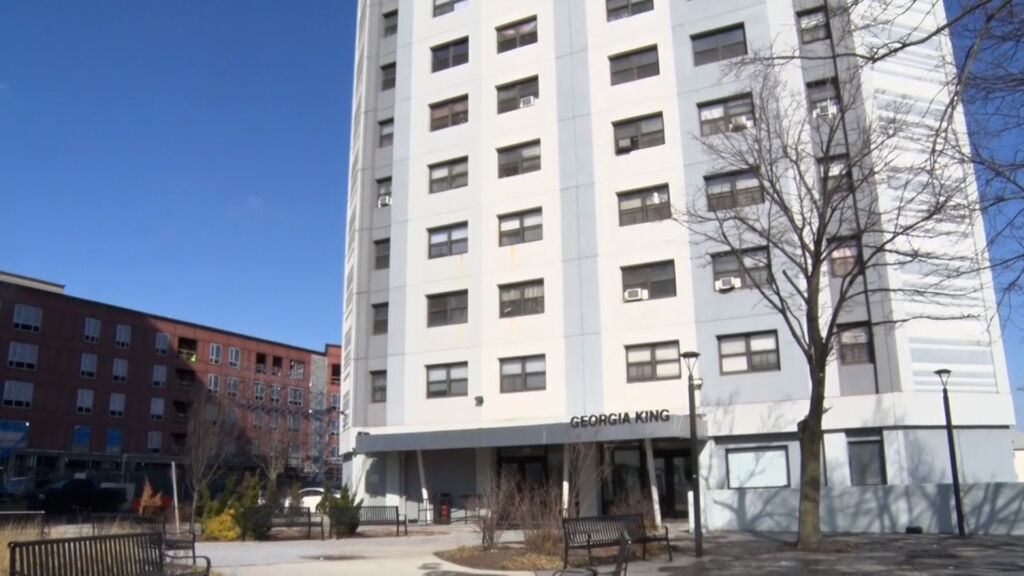
 Credit: (NJ Spotlight News)
 As primary housing falls further and further from the reach of working families, it is incumbent on municipal governments to make rents affordable for residents and protect them from predatory landlords.
In Newark we are putting forth several pieces of legislation that will give even minimum-wage earners a chance to rent quality market rate apartments.
Broad guidelines for affordable housing, while well-meaning, may not fit the needs of residents in many of our cities. Newark is one of those places.

Federal and state governments allow developers to set unit low-income rental prices based on area median income levels. For Newark, that’s $138,400, set by the U.S. Department of Housing and Urban Development
But the city’s median income, $58,490, is less than half that. The problem is that Newark is grouped into a larger housing region that includes much wealthier communities. As a result, housing costs are often based on incomes that bear little resemblance to what many Newark families earn. Housing built to federal guidelines makes units that for many residents are still unaffordable.
When a city with a median household income of $58,490 is measured against an area median of $138,400, working families can find themselves priced out of the very programs designed to help them. Affordable housing should be affordable to the people who live here.
Renters to homeowners
We can no longer rely on broad regional formulas to address local housing challenges when the wealth gap is as vast as it is in our communities. These policies, while well-intentioned, are increasingly excluding the very residents they were meant to serve.
This week, we introduced four pieces of legislation, and I signed an executive order as a step toward housing equity.
The first ordinance asks the Newark Central Planning Board to use $58,490 median as the income measure for developers in our inclusionary zone, where projects involving 15 or more new or gutted units must have 20% with affordable pricing. Families with incomes of $23,396 to $70,1888 will have access to all new affordable units under the inclusionary zone ordinance.
These prices reflect 17% to 51% of the HUD median income, and our second ordinance will make sure 13% of these units are set aside for people making $30,000 or less. This is especially good news for people making New Jersey’s minimum wage of $15.92 an hour, which based on full-time, year-round employment comes to $33,116 a year, well in range for quality housing.
The second initiative is to help increase homeownership in our city with down payment assistance of $30,000, up from $20,000. Saving a down payment is the largest obstacle to securing a mortgage. Seventy-four percent of Newark residents are tenants, and as their rents rise, their ability to set aside money for a down payment diminishes. This amendment to our Live Newark ordinance will help working families get ahead of the rent increase curve and begin to build generational wealth through home ownership.
The third ordinance is aimed at those who buy city-owned properties to flip as land values increase. These actions are contrary to the spirit of our redevelopment plans, which is to increase homeownership and neighborhood stability. Under the new ordinance, anyone who buys city property and tries to sell it before it is properly improved will pay the city 90% of the sale price.
The city will also require that redevelopment projects of more than 30 units must present a plan to hire local workers and local contractors, and guarantee that more than half the workers are paid union wages.
To further protect our renters, we are establishing a “bad actors fund” which will allow the city to recoup all expenses associated with code enforcement against landlords who fail to maintain their properties. This is part of an overall crackdown on bad landlords. And I will sign an executive order to prohibit the eviction of rent-control tenants if the owner is out of compliance with our housing codes.
High rents and stagnant housing stocks are hurting longtime renters and those trying to live in and stay in Newark. Municipal governments have better insight into local problems than the distant lens of federal or state agencies. It is important that mayors and other municipal officials don’t accept blanket policies that might not fit their constituents, but work to tailor the best solutions possible for their residents.
The measures we introduced are an important step toward keeping Newark affordable.