
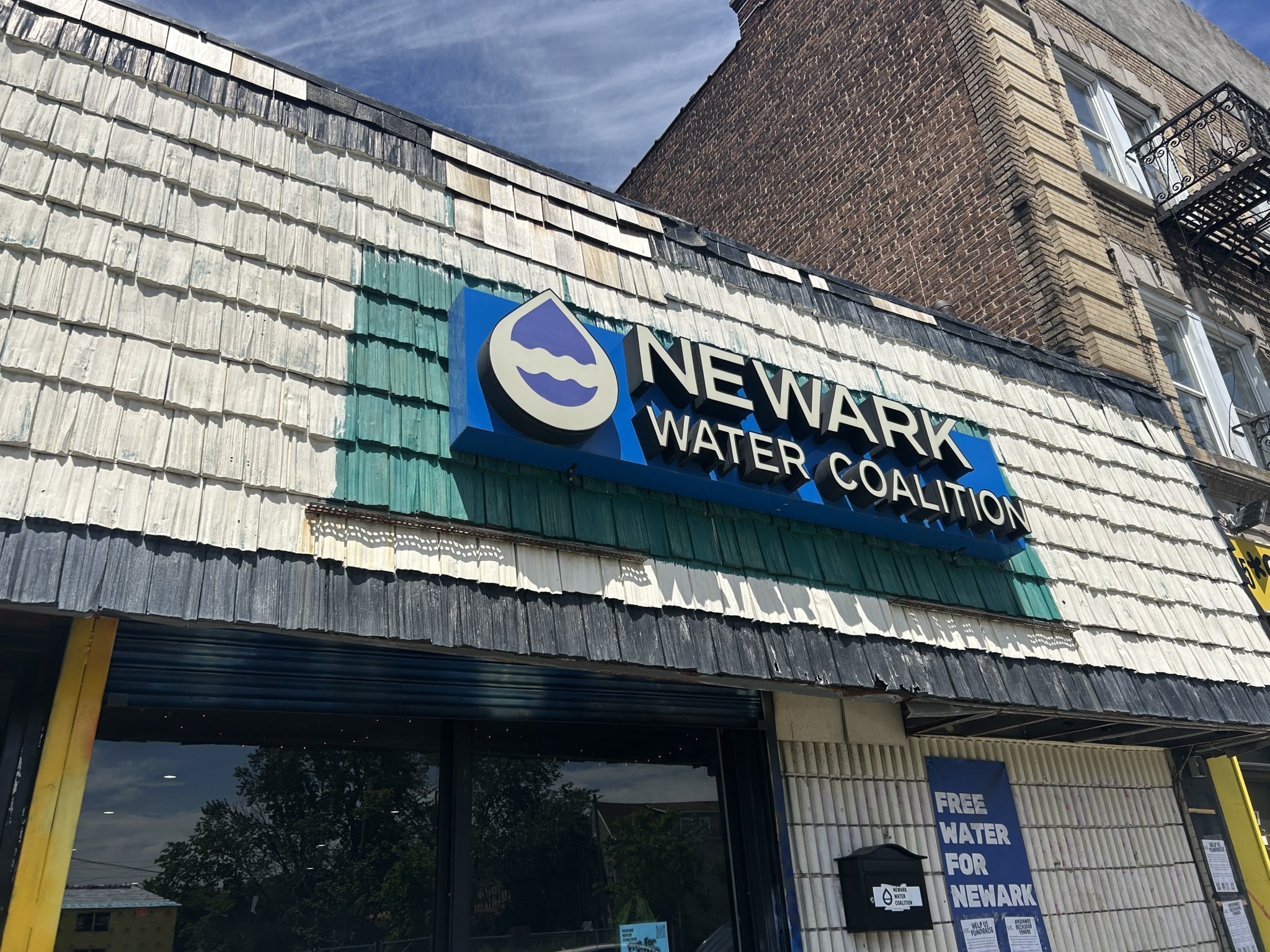
 Credit: (Sarah F. Griffin/NJ Urban News)
This article was reported and written by New Jersey Urban News, a publishing partner of NJ Spotlight News.
One day in 2018, Anthony Diaz asked himself a question: If there wasn’t a problem with Newark’s water, why was the city handing out water filters?
Newark’s water crisis was national news in the mid-2010s. In 2016, the city advised 30 school buildings to stop using tap water after testing found elevated lead levels. By 2017, Time reported more than 10% of Newark homes had lead levels twice the federal safety threshold, and the story drew coverage from ABC, MSNBC and The New York Times.
Despite the mounting evidence, city officials downplayed the problem. Diaz said that when he raised it in 2018, the mayor at the time told him not to worry. Months later, the city began distributing water filters to residents anyway.
That contradiction is what led Diaz and a friend to hold the first meeting of the Newark Water Coalition at a local church on December 18, 2018.
Diaz at the time, was running for Newark City Council to represent the Central Ward. During the election, Gayle Chaneyfield Jenkins, a mayoral candidate and a Central Ward councilwoman, told Diaz the city “was covering up that there was a water crisis.”
When Diaz looked into the claim, he says, “science said that we had elevated lead levels in our water supply.”
Doing the work
Since that first meeting in 2018, the Newark Water Coalition has expanded, offering not only water, but also food, housing and other resources throughout the city and the state.
The coalition views food, water, and housing as an “ecosystem,” it says, and it works “to activate and empower” community members “to provide for their own needs so they can begin to advocate for themselves.”
The organization offers water quality testing and lead paint scanning, or a kit for residents to do it themselves. To date, the Coalition has distributed more than 500,000 gallons of water and at least 500 filters, plus roughly 700,000 pounds of food.
It is also known around town for its Water Box dispensers, a project with 501CThree, a nonprofit group that uses technology to combat climate change. The kiosk takes “the water from the city service and runs it through a three-stage filtration system and a UV filter,” Jaron Rothkop, director of 501CThree, says in a YouTube video.
“Once the water has gone through these three filters and the UV treatment, it is typically cleaner than the bottled water you can buy in the stores,” Rothkop says in the video.
Volunteers partly run the Newark Water Coalition, and anyone can join. On their first day, volunteers can get right to work filling jugs with filtered water or pulling out clothes for distributions.
Muta El-Amin, a volunteer with the nonprofit, said he chose to work with the group because “I grew up in this area and I realized the need for it” and saw how much the coalition was giving back to the community. Newark, the state’s largest city, has a poverty rate of roughly 24%. As a volunteer, El-Amin said, he learned that Newark is underserved and has a resource gap.
Funding challenges
Newark Water Coalition’s office on South Orange Avenue, in the Central Ward, doubles as a bulletin board for causes well beyond water.
Some of the decorations are aligned with the water mission, like a sign sticking out of a plant that reads “Clean Water is a human right,” a banner reading “We Demand Clean Water” and paintings in the shape of water drops with messages like “Agua es Vida” (Water is Life) and “No More Lead Pipes.”
Near a Water Box in one corner, a “Free Palestine, Save Gaza” flag was displayed. That mix is intentional, Diaz said. “Our value systems aren’t like other nonprofits.”
The location of his desk makes the same point. Diaz called other nonprofit offices “very sterile,” with “a boundary between the executive director and the public.”
“Here, you can come into this office, and I’m sitting at my desk – you have immediate access to the executive director of the Newark Water Coalition,” Diaz said.
That accessibility is also an asset, Diaz said, “because we have such a direct connection” to the community, and “a different understanding of what is needed in the community.”
“But at the same time, because we’re so different, that’s why we also face a lot of the funding and economic challenges that we face,” Diaz explained.
It comes with a cost, he added, noting that the organization’s “politics and [stance on] social justice keep us from getting funding,” a trade-off he said is worth making.
“It is crucial and vital to be independent enough and to have values enough where you’re able to talk about any subject as long as you’re held accountable to [your] community,” he said. “The Newark Water Coalition is a constant and consistent reminder that no one is going to do it for you.”