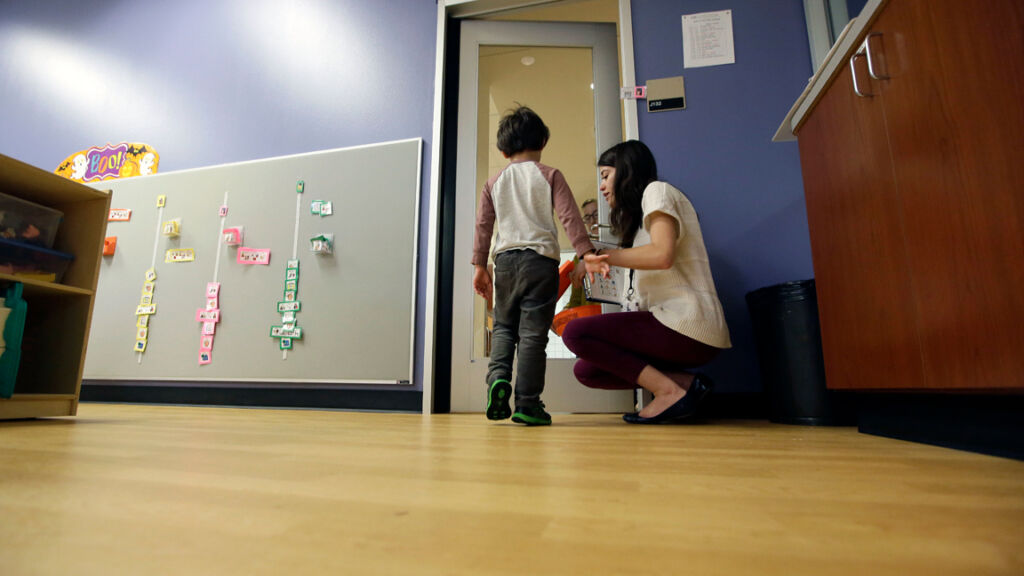
 Credit: (AP Photo/LM Otero)
Lydia Couch still recalls her terror on the day State Police called to report that her nonverbal autistic son escaped a school van and wandered onto Interstate 78, halting highway traffic.
“My heart came out of my chest,” she said.
With officials offering no answers, and her son unable to speak, her only recourse was to demand the school vehicle’s camera footage, she says. Only then did she discover that aides had failed to secure her son’s harness and seat belt as required.
Now nearly three years later, Couch, an Elizabeth resident, is asking a challenging question: With cameras all around us – in office buildings, on street corners, in shopping centers – why do we not install them in special education classrooms to protect vulnerable kids, as some other states require? And why has New Jersey’s state Legislature twice rejected a bill to do so?
“You already have cameras in certain areas like hallways—core areas where students go,” she told NJ Spotlight News. “The reason I feel that they don’t want them inside classrooms is because you’ll see a lot that’s going on, and they don’t want these things to get out.”
Teachers unions
Not everyone agrees, even among parents of special ed children.
They worry about privacy, and the risk that sensitive moments could be leaked on social media or used to bias future teachers or placement committees. Or that districts could use the images to justify using harsh discipline, or calling the police or moving children to more restrictive settings.
Teachers unions fear the cameras could be used for routine performance evaluations rather than safety inquiries.
And others object to the cost, arguing that the money is better spent on higher pay and better training for special education staffers.
Still, advocates are gaining ground. Texas was the first to pass legislation requiring cameras in self-contained special education classrooms in 2015, and four other states—Georgia, West Virginia, Louisiana and Alabama — passed similar laws by 2023.
Last year, Louisiana expanded its policy to mandate cameras in all dedicated special education classrooms; prior to that, they were installed only if a parent or staff member requested. And this year, several other states —including Florida, Iowa, Maryland, South Carolina and Tennessee—introduced legislation to place cameras in designated special ed classrooms.
Two main factors are likely driving the renewed interest, according to Jackie Rodriguez, CEO of the National Center for Learning Disabilities: the AI boom’s putting school technology back on the political agenda and a massive backlog of civil rights cases before the federal government — leaving families of children with disabilities with nowhere to turn but state lawmakers.
Dying in committee
Yet so far, similar legislation in New Jersey has gone nowhere. A bill introduced by Sen. Shirley Turner in 2018 would have mandated cameras in self-contained special ed rooms. It died in committee without a hearing, as did her 2020 attempt. Turner says she plans to introduce the bill again when the Legislature returns in the fall.
“Now it seems everybody has a camera—I mean, even in your home, now people have cameras,” said Turner (D-Mercer). “It’s a good idea to have cameras in the classroom, particularly for those students who cannot speak for themselves.”
 Credit: (NJ Office of Legislative Services)
Proponents argue that the absence of cameras allows teachers and school districts to cover up abuse and dodge liability. For nonverbal children, they insist, video footage is often the only dependable safeguard.
They highlight cases like that of Natara Matias, a Newark mother whose autistic, nonverbal son repeatedly came home with unexplained injuries, and a Paterson district staffer who was fired after being accused of disciplining nonverbal students by forcing them to eat hot sauce. In the Paterson case, advocates say, the district delayed notifying parents for weeks during an internal investigation and avoided issuing a clear public account of what happened.
Without cameras, Couch adds, districts hold all the power: “Because they know that the child can’t go home and say anything.”
Atlantic City mother Cierra Cook agrees.
She says her 7-year-old nonverbal, autistic daughter walked out of school unnoticed in June—crossing the street to a store before staff realized she was gone, despite having a one-to-one aide and three adults for about nine students in the classroom. It was her second escape; previously, school camera footage caught her in an unlocked staff shower.
As she waits for answers on the incident, Cook supports cameras throughout all school buildings to “hold staff members accountable.”
Parental rights
Yet the disability community itself is divided.
“That’s the problem,” says Peg Kinsell, director of public policy at SPAN Parent Advocacy Network in New Jersey, which is maintaining a neutral stance. “One kid and family might think it’s a good idea, but three other kids in the classroom don’t like it at all.”
Still, the momentum toward installing cameras is building. Denise Marshall, CEO of the Council of Parent Attorneys and Advocates, urges states to place cameras in all school settings—not just special ed classrooms.
Lower technology costs make it more feasible now, she notes, and courts have consistently held that there is no reasonable expectation of privacy in a public school classroom. “A child doesn’t have to be nonverbal to be unable to articulate what’s going on in the classroom, or to be fearful of retaliation if they tell,” she said.
She also dismisses fears that video will be used against students, noting that footage usually exposes staff misconduct. She points to a Maryland case in which staff broke a student’s leg during a restraint they claimed was necessary; video proved the staff actually escalated the encounter by taking the boy’s lunch and “pouncing on” him, she says. In her experience, that is how the footage is truly used.
More conservative states likely embraced classroom camera laws earlier due to a strong focus on parental rights and weaker influence from teachers unions, she notes. Yet the union pushback has softened over time, she says, as fears of footage being abused against teachers have proven unfounded over the past decade.
“We’ve only heard instances in which they’ve helped a student situation or a family,’ she said, “not instances in which they’ve been abused or used to encroach on privacy or leverage false attacks on teachers.”
‘A camera to tell the story’
In New Jersey, however, the effort stalled for different reasons: Rather than organized opposition, the proposed legislation was derailed by a political reshuffling and a lack of sustained advocacy, Turner says.
After an initial request from a constituent whose child was abused, neither the parent nor disability groups followed up to build legislative traction, she says. Then its primary Assembly champion, Valerie Huttle, lost her seat in 2021, and no other lawmaker stepped up to sponsor.
Turner hasn’t given up. She compares this to her long road to mandate police body cams in New Jersey — an effort that initially faced fierce resistance from police unions and deep reservations from civil liberties advocates like the ACLU.

Cameras protect everyone involved by providing an objective record for vulnerable students and insulating teachers against false accusations, she says. “People are going to be less likely to use force in excessive ways because there’s a camera to tell the story.”
Her special ed camera bill came with strict safeguards: it prohibited live monitoring, banned video in bathrooms and barred administrators from using footage for teacher evaluations. Schools would be required to retain the footage for at least three months, and access would be granted only if an incident or complaint was reported.
$1.2 million settlement
Even with sensitive areas like restrooms remaining strictly off-limits, more surveillance is a big improvement over a total lack of oversight, says parent advocate Hassanah Smith-Thomas of Elizabeth. She frames the double standard simply: Why should parents of toddlers in daycare enjoy the peace of mind of real-time video monitoring, as many private centers offer, while most special education classrooms remain in the dark?
A longtime independent special education advocate and parent who works with organizations such as the SPAN Parent Advocacy Network, Renay Zamloot, agrees: With proper safeguards, she says, cameras are “absolutely necessary” to protect students when staff might otherwise cover up abuse. She hasn’t seen classroom cameras in her 30 years working with New Jersey public schools, though she notes they are sometimes used in private programs.
“What we’re afraid of is that it becomes the solution to a problem, and we don’t actually solve the root cause.” — Jackie Rodriguez, National Center for Learning Disabilities.
The footage can be a deciding factor in court. In 2022, hallway camera video in Newark was instrumental in a case against a teacher’s aide who assaulted a 7-year-old autistic student –leading to a $1.2 million civil settlement.
Yet while cameras could theoretically protect teachers against false accusations of misconduct, some unions are spooked: What if the footage is used to evaluate educators, too?
In other states, unions fought for strict limits on how the recordings can be used—like the safeguards in Turner’s bill that bar video from job evaluations. Some critics also contend that districts should invest in better pay and training for special education staff instead of these surveillance systems.
 Credit: (NJ Spotlight News)
“What we’re afraid of is that it becomes the solution to a problem, and we don’t actually solve the root cause,” says Rodriguez, CEO of the National Center for Learning Disabilities.
Asked if New Jersey’s largest teachers union has concerns, spokesman Steven Baker cited only vague “privacy and safety issues.” He says the union took no position on Turner’s bill because it wasn’t expected to pass.
The New Jersey Principals and Supervisors Association did not respond to a request for comment.
While unions have opposed using cameras for teacher evaluations, advocates like Zamloot view this as an added benefit. Video could help dismantle the “low expectations” in many self-contained classrooms, she says, holding districts accountable for providing high-quality instruction to students with intellectual disabilities.
Acknowledging the privacy concerns, she still insists the primary obligation must always be to protect vulnerable children. “If you’re not doing anything abusive to students,” she said, “why do you have a problem with being video recorded?”