
 Credit: (Tim Larsen/Office of the New Jersey Governor)
Despite concerns about war and market volatility, the pension fund for hundreds of thousands of New Jersey public workers has gained another big boost from investments.
Net returns for the 2026 fiscal year were up 14% as of the end of May, according to preliminary estimates reviewed Wednesday during a New Jersey State Investment Council public meeting.
A final report on investment performance is expected later this year. If a strong rate of return continued through the end of June, the final month of the fiscal year, the pension fund will easily beat its 7% assumed rate.
Financial market conditions in June did not veer significantly from prior performance despite President Trump’s ongoing war in Iran, officials said Wednesday.
“We’re still waiting for a number of returns to be reported on the private market side,” said Shoaib Khan, director of the state Division of Investment. Khan added, though, “we’re quite pleased with” the 14% returns.
Lottery share
The investment returns report added to a series of positive developments for the pension fund, whose investments have generated a multiyear winning streak.
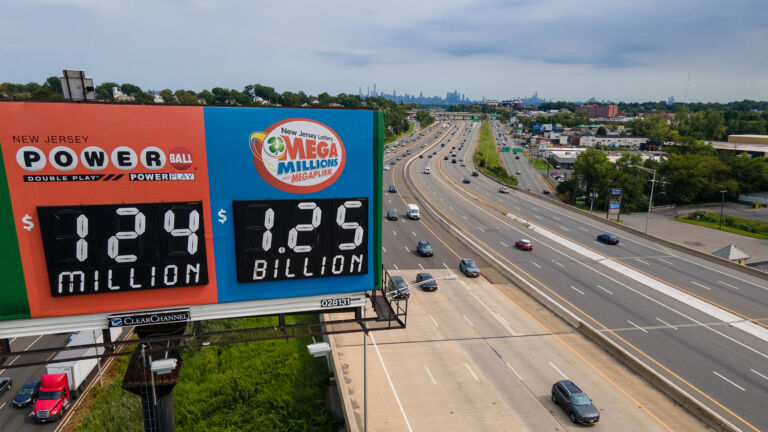
The New Jersey Lottery posted a nearly 5% increase in sales during the 2026 fiscal year, officials reported earlier this month.
A portion of state Lottery proceeds are dedicated to funding public worker retirements, and the pension system received more than $1 billion from the Lottery as a result, officials said.

Meanwhile, Gov. Mikie Sherrill and lawmakers approved an annual budget plan late last month that sets aside enough funding to cover the full employer pension contribution calculated by state actuaries for the 2027 fiscal year.
That means more than $7 billion will be deposited into the pension fund by June 30, counting Lottery contributions.
“I just want to recognize Gov. Sherrill and legislative leadership for another year of a full pension commitment … which is not easy to do, but is the fiscally responsible thing to do,” said Adam Liebtag, vice chair of the investment council.
New Jersey’s nearly $86 billion pension fund covers the retirements of more than 837,000 current and retired government workers in New Jersey, including teachers and judges. It does not cover police officers and firefighters, whose pension investments are managed by a different government entity.
The pension fund assets are managed by the Division of Investment, as well as outside professionals hired by the state. When fund managers generate strong returns, that can help ease pressure on taxpayers who also boost the retirements of public workers on a regular basis through state government’s annual budget.
Value dip
Trump’s launching of a military conflict in late February initially set off market volatility that threatened to upset state pension fund investment returns that were running above 10% at the time.
At the end of March, as oil prices surged worldwide, the pension fund’s fiscal year returns sagged to 6%, and the estimated market value dipped to $80.3 billion, according to preliminary estimates released at the time.
If the strong returns now estimated for the first 11 months of the 2026 fiscal year held up through the end of June, that would mark the fourth straight year of net returns besting the fund’s assumed rate of return.
The net returns totaled nearly 11% during both the 2025 and 2024 fiscal years, and 9% during the 2023 fiscal year, according to Division of Investment data.
Over the last five years, overall pension fund investment returns have totaled 7.7%.
New Jersey began dedicating a portion of Lottery revenues to the pension fund in 2017.
Prior to that reform, state government had been regularly underfunding annual employer pension contributions, and in some years, made little to no payments at all. This contributed to a massive unfunded liability that remains a key concern today, even though state government has fully funded its share for six straight years, counting what’s budgeted for 2027..
The latest projections from the Department of the Treasury indicate it will take another three decades of multibillion-dollar allocations before the pension system is considered by actuaries to be fully funded.
Despite the system’s unfunded liability, no retiree has been in danger of not receiving a pension check. The state, though, starting in 2011 has frozen annual cost-of-living adjustments, or COLAs, despite significant outcry from retirees.
This story is made possible in part by the Corporation for Public Broadcasting, a private corporation funded by the American people.
