
 Credit: (NJ Spotlight News)
In the final lame duck legislative session of his two terms in office, Gov. Phil Murphy wants lawmakers to pass an ambitious plan to rewrite state policies governing health benefits offered to many government workers in New Jersey.
Murphy’s plan — unveiled during a speech delivered at the state League of Municipalities conference in Atlantic City last week — would revise health plans for thousands of county and local government workers whose employers enroll in the local government section of the State Health Benefits Program.
The plan also calls for reforming the governance structure of the local section of the benefits program itself, as well as requiring the government employers that join the program to remain in it for at least five years.
And it would also come with a more than $250 million, one-time state appropriation to provide the program with near-term financial stability, according to details provided by the governor’s office.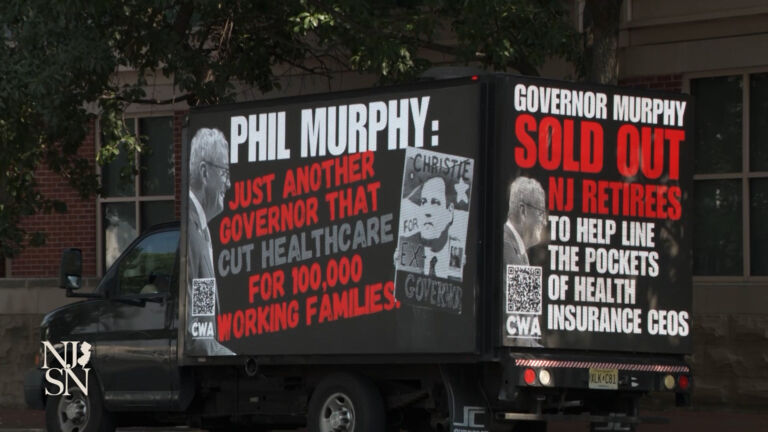
Murphy, a Democrat due to leave office in January, said the changes are needed to shore up a benefits program that has been rocked in recent years by dramatically rising premium costs and diminished participation, conditions that administration officials said actuaries would describe as a potential “death spiral,” according to a report issued earlier this year.
“We cannot allow that to happen,” Murphy told the local government leaders and others who gathered in Atlantic City for the annual convention.
“Let’s remember, this program provides health care coverage to our state’s valiant, and often under-appreciated, public servants,” he said.
However, Murphy is asking both houses of the Legislature to enact a set of sweeping changes to this benefits program over the remaining weeks of the current legislative session, which ends in January.
His proposals are also likely to draw resistance from public-employee labor unions whose members are not afraid to come to Trenton to stage vocal protests whenever there are proposals advancing that they oppose.
Meanwhile, Murphy is putting forward his plan several months after legislation was introduced in the state Assembly that also calls for a host of policy changes that would be made in response to the concerns about the benefits program, including the latest round of premium hikes, which topped 35%.
The reforms are also being considered at a time when local government officials say they are facing their own financial crunch amid lingering inflation and residential frustration with local property-tax bills that now top $10,000, on average, throughout the state.
For many county and local governments, as well as school districts, the cost to provide employees with health and pension benefits has been a key cost-driver in recent years.
Last year, the size of the average New Jersey property-tax bill increased by nearly $300 year over year, according to data collected by the state Department of Community Affairs.
The Assembly legislation has dozens of cosponsors and was passed unanimously by members of the Assembly’s State and Local Government Committee in July. It is now pending the in the Assembly Appropriations Committee.
Assembly Speaker Craig Coughlin (D-Middlesex) issued a statement last week after Murphy put forward his proposal that suggested there’s an opening to at least discuss the governor’s ideas before the end of lame duck.
But to get to Murphy’s desk before he leaves office, any legislation needs to win majority approval in the 80-member Assembly, as well the 40-member Senate, both controlled by Democrats.
“We welcome discussions about how to lower costs for taxpayers and municipalities while providing quality, affordable health insurance to public workers and look forward to finding common ground,” Coughlin said in the statement.

In his own statement, Senate President Nicholas Scutari (D-Union) also pointed to the Assembly legislation and suggested there is room for compromise.
“The foundational principles that are needed to enable the plans to operate effectively and efficiently are the stabilization of local governments going in and out of the system, reducing the number of health plan options, and breaking the stalemate between management and labor,” Scutari said.
“There is an opportunity for a compromise that preserves vital health care for workers while protecting municipal and county taxpayers,” he said.
To be sure, this is not the first time Murphy has sought to enact measures in recent years to address the rising cost of public worker benefits in New Jersey.
Murphy worked with labor leaders to identify health plan efficiencies in 2018 that he said would save taxpayers hundreds of millions over several years.
And earlier this year, the governor also reached an agreement with unions representing state workers that are projected to generate $75 million in savings through the remainder of the current fiscal year.
