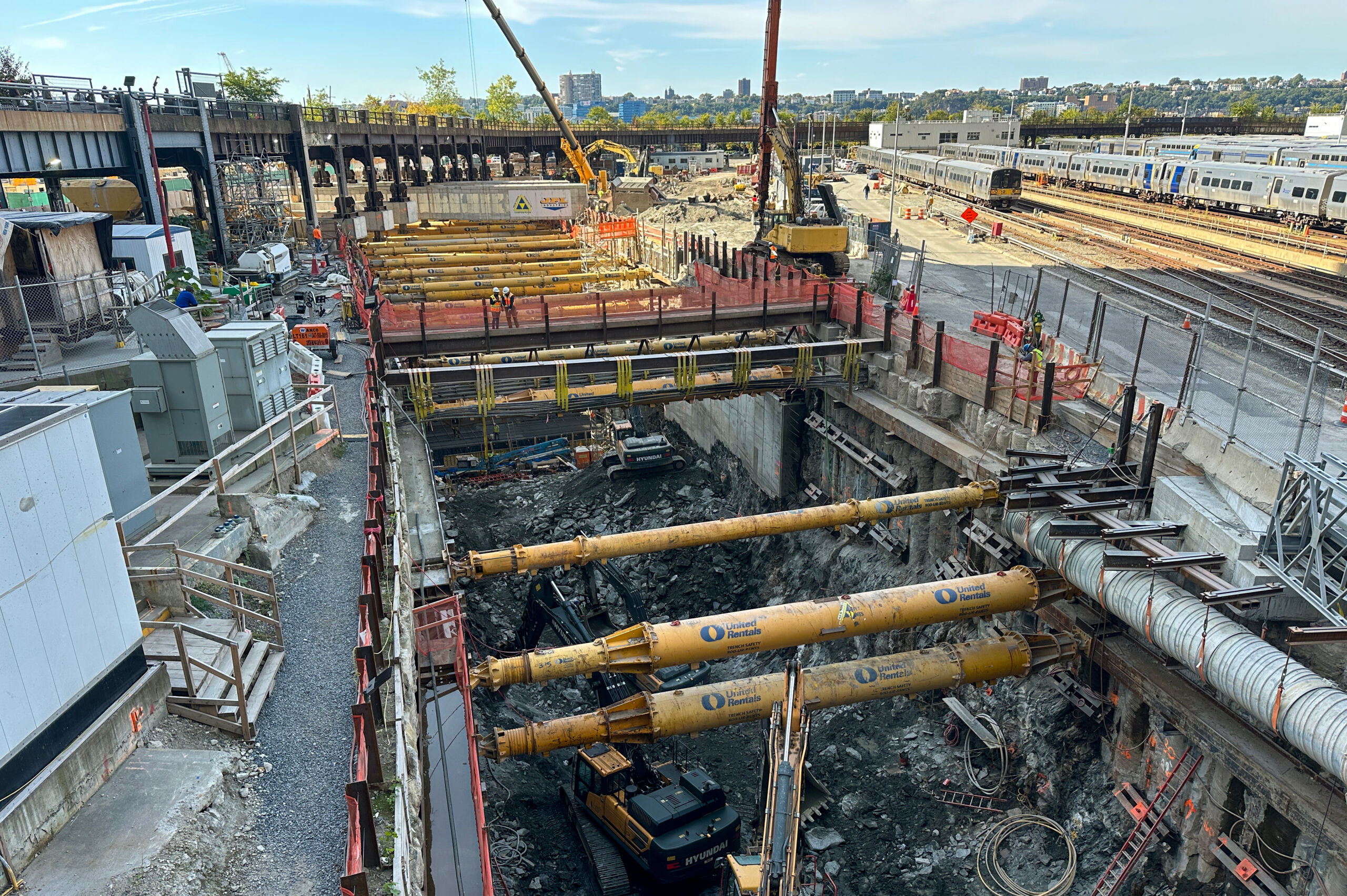
 Credit: AP Photo/Ted Shaffrey
WASHINGTON — President Donald Trump’s attempt to cancel funding for a massive railroad and tunnel project many years into construction is the latest in a string of maneuvers he’s issued to punish New Jersey and other Democratic-leaning regions of the nation during the government shutdown.
Trump said late Wednesday his administration was “terminating” the Gateway Program, a $16-billion public works project to expand railroad capacity by adding two tunnels beneath the Hudson River between New Jersey and Manhattan.
As of late Thursday, the funding status of Gateway, a years-long public works effort, the biggest railroad project in the Western Hemisphere and an immense economic engine for the Northeastern United States, was hazy as New Jersey’s top law enforcement official threatened to file a lawsuit to protect the project.
It was not immediately clear if Trump has the authority to outright cancel the project, which has received bipartisan backing from lawmakers across the Northeast.
“It’s thousands of people, and it’s billions of dollars,” Trump said, directing his remarks at Sen. Chuck Schumer, a New York Democrat who has long advocated for robust funding for Gateway, a multi-part project meant to loosen the 10-mile stretch between Newark and New York Penn Station for passenger and freight rail.
“It’s billions and billions of dollars that Schumer has worked 20 years to get,” Trump said. “Tell him it’s terminated.”
A White House spokeswoman, Victoria LaCivita, did not respond to questions from NJ Spotlight News about the legal authority Trump invoked to terminate the project.
The U.S. Department of Transportation did not respond to a request for comment seeking specific details about what funding had been cancelled.
“It’s a vital corridor under the Hudson River really connecting the entire Northeast and beyond,” Robert Puentes, vice president at the Brookings Institution, a Washington, D.C.-based think tank, said in an interview with NJ Spotlight News. “It’s in desperate need of repair.”
Tyler Jones, a spokesperson for Gov. Phil Murphy, declined to comment about potential recourse, referring questions to the office of New Jersey Attorney General Matt Platkin.
“The Gateway Program is critical to the New Jersey economy and the lives of our residents,” Platkin said to NJ Spotlight News in an emailed statement. “Following President Trump’s stated intent to ‘terminate’ Gateway, we are exploring all of our options, including litigation.”
 Credit: (Gateway Program)
Before and during the shutdown, Trump and officials in his administration, most prominently Russ Vought, the head of the White House budget office, known in Washington policy circles as a “grim reaper” for his bare-knuckled approach to spending cuts, have tried to deny or placed on hold funding for federal projects that Congress had already approved.
That the cuts have landed largely on regions where Democrats hold congressional seats seems to be a deliberate White House tactic.
“We’re only going to cut Democrat programs if the shutdown continues,” Trump said last week. Trump also teased potential funding cuts could be announced Friday. “We’ll give them a little taste of their own medicine.”
Democrats swiftly criticized the move as the latest example of the Trump administration wielding the shutdown as a weapon against Democratic voters and politicians. In a joint statement, the state’s U.S. senators Cory Booker and Andy Kim called it a “direct attack on New Jersey.”

In a Thursday interview with NJ Spotlight News, Kim said Trump’s move was unconstitutional because Congress, not presidents, write the national budget.
“He needs to follow through on the laws passed by Congress,” Kim said, adding that it was unclear what Trump meant by the word ‘terminate.’
“What he does need to spell out for us is what it means to ‘terminate’” money for Gateway, Kim said. “This is absolutely a reckless action by the president.”
Trump administration targets during the shutdown include $18 billion for Gateway and a separate New York City subway project the administration placed on hold in early October.
The Department of Energy also canceled 321 projects worth a total of about $8 billion for 16 Democratic leaning states, including New Jersey, according to a summary from Democrats on the House Appropriations Committee, which writes federal spending laws.
Included in that group are four projects for New Jersey — three for Rutgers University and one at Princeton University. Each was in the single-digit million dollar range.
This year alone, Trump has repeatedly and illegally cancelled federal funding that Congress had already approved, including for healthcare research, according to the Government Accountability Office, the nonpartisan auditor of congressional activity.
As part of his central legislative achievement of his second term, Trump also signed a law to cancel a host of climate and low-carbon energy programs and federal incentives, including a tax program to encourage homeowners to install solar panels on their roofs.
Two tunnels, built by the Pennsylvania Railroad in 1910, run between Newark and New York Penn Station.
Before Hurricane Sandy battered the region in 2012, the tracks were in need of repair, said Puentes, former president and CEO of the Eno Center on Transportation.
“The urgency to get the tunnels fixed is paramount,” Puentes said.
The Gateway Program, which shares costs between the federal government and state budgets, contains 11 “core projects” of bridges and tunnels to revitalize the stretch of tracks between Newark and New York, which services Amtrak and NJ Transit commuter rail.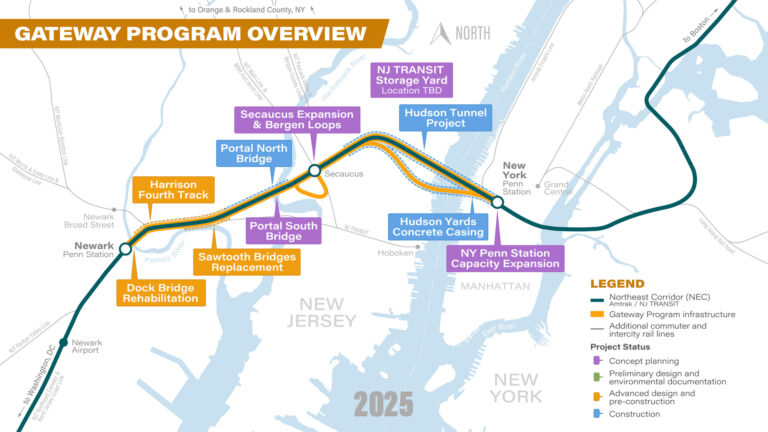
If nothing is done, delays will mount, Puentes and other experts said, backing up trains along the busy Northeast Corridor of rail stops that stretches from Boston to Washington, D.C., hitting every major city in between.
“That would cause delays on both the New Jersey and the New York side,” he said. “It would result in a real strangling choke on this vital artery.”
The idea that Gateway critics hold that the project is only of local importance is false, Puentes added. That concept, he said, “Doesn’t reflect the understanding of just how vital the Northeast Corridor is for the good of the country.”
The greater Northeast is home to one of every seven Americans, or 51 million humans, a number expected to rise to 58 million by 2040, according to the Federal Railroad Administration. It also generates about 20% of the national economic output and 30% of the country’s jobs.
Trump and Transportation Secretary Sean Duffy, a former Republican member of Congress from Wisconsin who never served on transportation committees during his time as a congressman, have gone after Gateway before.
During his first term, Trump pulled money for Gateway during his first term, and Duffy voted for an amendment in Congress to strip $900 million from the project. That amendment did not become law.
Duffy also voted in 2015 to eliminate all funding Amtrak receives from Congress and in 2017 tried to cut $1.1 billion in funding for Amtrak.
Speaking to reporters Oct. 6 at Newark Liberty International Airport, Duffy insisted the administration was not trying to cancel big infrastructure projects.
“We’re not trying to shut down these projects,” he said.
— John Reitmeyer contributed reporting.