
 Credit: (Rambo Talabong/Inside Climate News)
This story was originally published by Inside Climate News, a nonprofit, nonpartisan news organization that covers climate, energy and the environment. Sign up for their newsletter here. Inside Climate News and NJ Spotlight News are part of a collaborative of news organizations working together to provide comprehensive climate change coverage for New Jersey.
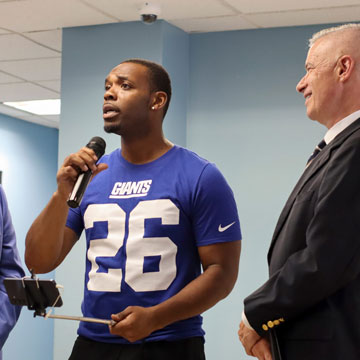
KEARNY, N.J. — From the second row of a fluorescent-lit room, Kavone Little, 38, aims his monopod-mounted phone to the front as he smiles ear to ear. He presses the record button.
Broad-shouldered, quick with riffs and smiling with easy charm, Little is an online streamer. He documents his life in New Jersey and posts the videos online: playing kickball, dancing in the street, hanging out with friends. He ends his captions with hashtags such as #contentking, #god1st and #hardwork.
His video for the day on July 17: his graduation.
He spent seven weeks this summer in a training program for formerly incarcerated people, learning how to install solar panels to help them reenter the workforce.
“I feel accomplished. Feeling blessed. Feeling stronger than ever,” said Kavone, who served 16 months before his release in 2024.
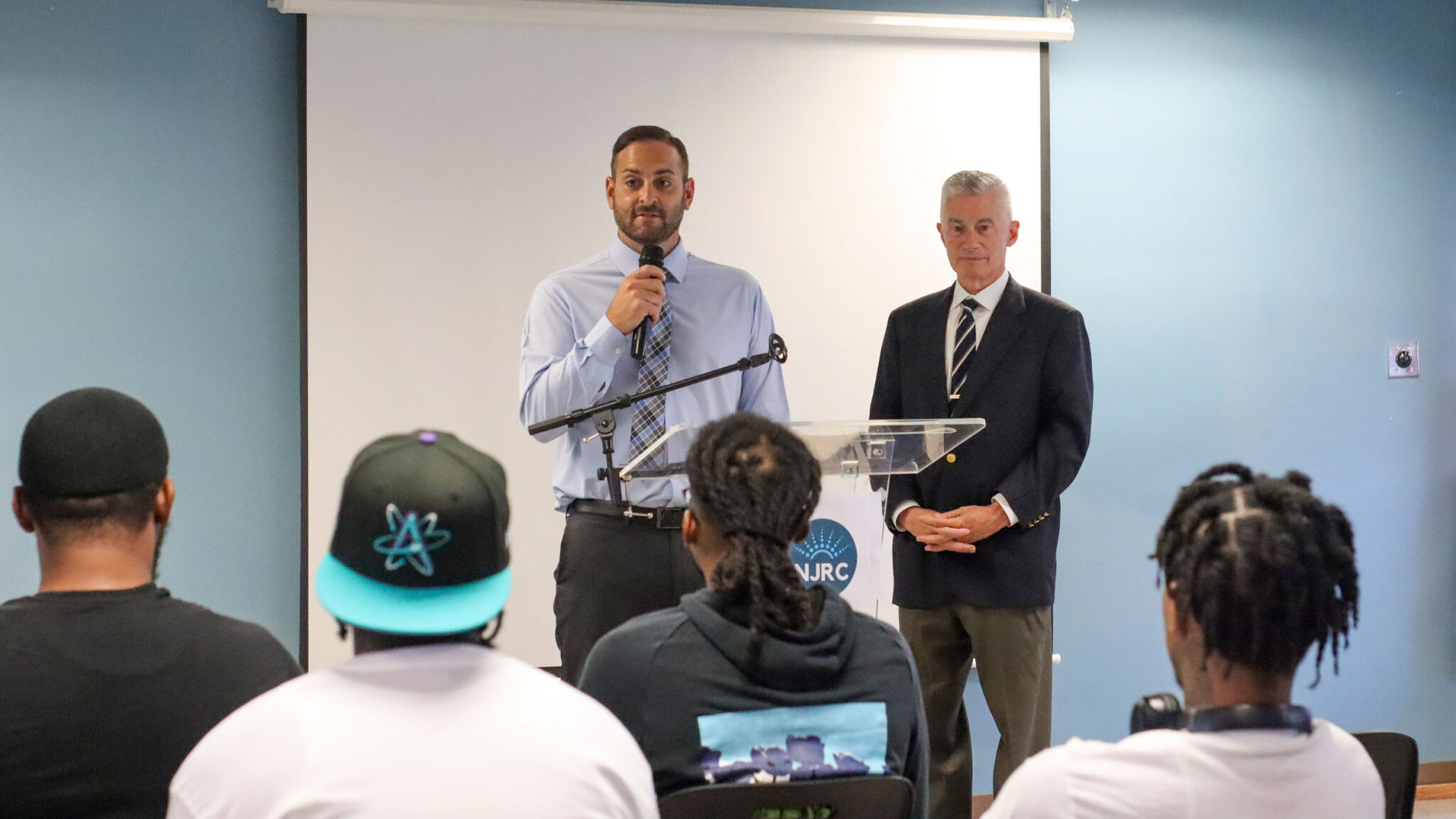
Kavone is one of 11 men who completed the program hosted by the nonprofit New Jersey Reentry Corporation (NJRC). A team from Hudson County Community College and solar developer Solar One led the course, which included solar installation, construction basics and work readiness and safety — each module providing them a certification.
A springboard to reintegration
In total, NJRC has trained over 500 people for various skills, including welding, construction, cooking, solar panel installations and even sales. Trainees are enrolled for free on a first-come, first-served basis. All they need to do is show up.
“With every program we try to base it on a couple things. A, is this an in-demand occupation that we could see being sustainable for the foreseeable future? And B, do we have the interest? We saw that there were a lot of individuals that were interested in solar training,” said Michael Hayek, the facility director of NJRC’s Kearny headquarters.
The program is a springboard to get “reintegrated right” and to bring back “structure” to the lives of former inmates, said Albert Williams, a coordinator with HCCC.
 Credit: (Rambo Talabong/Inside Climate News)
“It’s not just important for me,” said Kavone. “This is important for most men who are trying to have a second chance in life. It gives us the ability to have these skills to go into the world and feel confident about what we know and what we believe in and where we want to go for the rest of our lives.”
Kavone hoped to earn money from solar panel installations to start his dream of opening his own business: an ice cream shop in his hometown of Paterson in the northern edge of New Jersey. It’s a bet he placed on renewable energy.
“If you’re looking, they’re trying to change everything into solar. They want everything to be run by solar,” Kavone said.
Kavone’s observation is not unfounded.
Despite being the fifth-smallest state in land area, New Jersey ranks eleventh among all states in solar power capacity, according Solar Energy Industries Association data. For the past nine years, the state has seen an average of about 17,000 residential annual rooftop solar panel installations, according to data from the New Jersey Board of Public Utilities. Solar panel installers like Kavone are contracted to complete those installations.
Trump’s energy agenda
But President Donald Trump sees a different future for energy in America, where the federal government holds oil and gas in full embrace as it walks away from renewable energy commitments made by the Biden administration.
Trump removed the industry-shaping tax credits meant to encourage the construction of more renewable energy projects across the country, a credit that helped developers fund about a third of each of their projects. Then, in early August, a couple of weeks after Kavone graduated, Trump canceled the Biden-era Solar For All incentive program, which sought to award $7 billion to states to subsidize solar panel installations in low-income communities — the same communities Kavone hoped to serve with his new certification.
“No doubt, this withdrawal of funds and the clean-energy ban coming from the Trump administration is going to be a major setback. It’s going to increase energy prices. It’s going to increase air pollution. It’s going to kill New Jersey jobs,” said Ed Potosnak, executive director of the New Jersey League of Conservation Voters.
 Credit: (Rambo Talabong/Inside Climate News)
The federal government allotted $156 million to New Jersey through the BPU. The Garden State also stood to benefit from one multistate and one national grant worth about $500 million combined. The BPU planned to use the money for residential and community solar projects as well as for training people to work in the renewable energy industry.
“These projects are now in jeopardy, and NJBPU is currently reviewing its options,” the NJBPU said in a statement.
The BPU estimated that, in New Jersey, about 22,000 low-income households could have saved $400 annually on energy bills with solar panels that would have cut about 240,000 tons of carbon emissions.
These policy earthquakes emanating from Washington have left solar companies in “an air of gloom,” said Lyle Rawlings, president of Advanced Solar Products, which built large-scale projects from Virginia to Maine and as far west as Ohio.
“Companies like mine and the others that we’ve been meeting regularly are reeling from all of this and wondering how we can maintain our current staffing, let alone hire these new people who are being trained,” said Rawlings.
With the tax incentives for residential solar ending by January 2026 and commercial and larger-scale solar projects ending by July 2026, Rawlings said he’s seeing a rush to build to qualify for these incentives, which require companies to show they’ve at least started construction by the deadlines.
After which, Rawlings said, is a cliff.
With the incentives gone, fewer people will want to install panels on top of their homes and companies now have fewer projects that they could fund without federal dollars.
Can NJ do anything to shore up solar development?
But the impact of these solar incentive clawbacks will vary from state to state, said Joe Henri, a senior vice president at Dimension, a leading community solar developer. Henri said New Jersey is “in better shape than many places” because of the state’s incentive programs.
“Meanwhile, states like California that pegged their community solar plans to federal dollars are falling behind. More governors should follow New Jersey’s lead and create strong state programs that lower bills and create good local jobs,” Henri said.
New Jersey prides itself on maintaining a diverse set of incentive programs for solar. Under its community solar program — now a permanent fixture after a successful three-year pilot — New Jersey has committed to adding 3,000 megawatts of new community solar capacity by 2029. One megawatt can power roughly 150 homes in the Northeast for a year, depending on energy use.
There is also the Administratively Determined Incentive or ADI, which gives solar projects a steady, guaranteed payment for the power they make and the Competitive Solicitation Incentive or CSI, where bigger projects compete for state support, with the most cost-effective proposals winning the incentives.
To fill the void left by the federal government, the state would need to expand these, said Potosnak, of the League of Conservation Voters. But he also recognized that it would be a hard sell to advocate for transferring dollars into these programs, given that the Trump administration has also cut funding for housing, health care and food assistance.
“So if you backfill one thing, then something else is on the chopping block,” said Potosnak.
Just in the latest budget deliberations, New Jersey diverted $190 million from its climate investment funds in response to a budget shortfall and competing demands for state spending. It is the largest climate fund diversion under the administration of Gov. Phil Murphy.
Will the state step up more for renewables? It will depend on the governor it elects in November. Competing for the seat are U.S. Rep. Mikie Sherrill, a Democrat, and Republican Jack Ciattarelli, a former assemblyman and gubernatorial candidate. Sherrill wants to continue the incentive programs, while Ciattarelli has repeatedly condemned them as “radical.”
But before his term ends, Murphy will make a final push to enshrine into law the state’s goal of achieving fossil-fuel-free energy production by 2035, which would encourage more investment in renewables.
Three weeks after completing the solar installation training program, Kavone had yet to install a single panel.
“From what I understand, it’s tough right now,” said Kavone.
He has applied for 12 solar companies. None of them have gotten back to him. Kavone is worried that companies might be hesitant to hire him because he was formerly incarcerated.
People with incarceration histories face far higher unemployment than the general population. A 2018 report from the Prison Policy Institute showed that, on average, about a quarter of formerly incarcerated people are unemployed, a rate higher than the total U.S. unemployment rate during any period in history, including the Great Depression.
Kavone’s ice cream shop will have to wait. But he still hopes.
“I am a hundred percent still optimistic and still searching,” Kavone said. “The sun will power my future.”