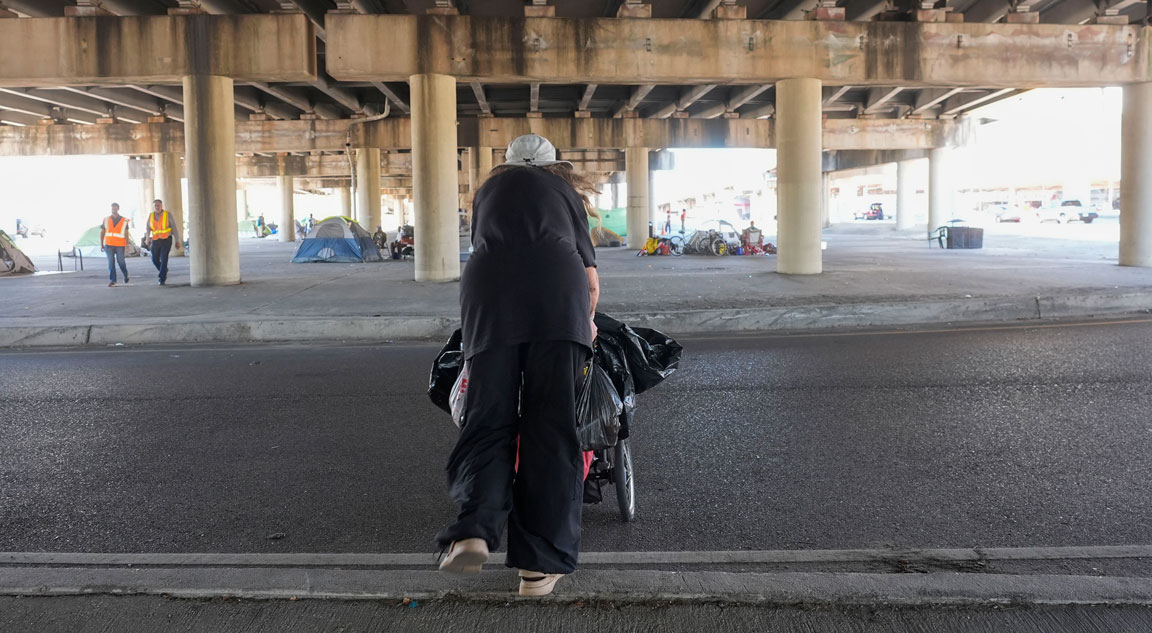
 Credit: (AP Photo/Gerald Herbert)
Housing programs that serve some of the most vulnerable people in New Jersey and across the country are losing support from state and federal governments as the number of homeless people continues to increase.
Last month, President Donald Trump signed an executive order that called to end support for housing-first policies, saying that they “deprioritize accountability” and fail to promote treatment, recovery and self-sufficiency.
The executive order also aimed to make it easier to remove homeless people from streets, to place homeless people in “long-term institutional settings” using involuntary commitment and to end federal funding for “harm reduction” programs working to address substance use disorder, among other issues. Housing advocates in New Jersey and across the country widely condemned the president’s order.
Under attack
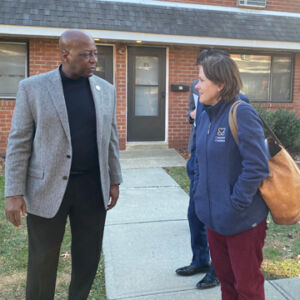 Credit: (Bobby Brier/NJ Spotlight News)
“Housing-first programs are under attack [nationally] because there’s a misunderstanding of what housing-first is,” said Kathleen Noonan, the president and CEO of the Camden Coalition. “Housing-first is a treatment program and it’s being portrayed as housing versus treatment.
“Certainly, what the Trump administration is saying is we support treatment first and, frankly, there are some advocates who are in that debate of housing versus treatment,” said Noonan. “I just want to say that a true housing-first program doesn’t pit those things against each other.”
The Camden Coalition saw its funding for a well-established housing-first program cut completely from the state budget approved by Democratic lawmakers and signed into law by Gov. Phil Murphy last month. After $500,000 in the last few years, the nonprofit was allotted $250,000 for the program in last year’s state budget. Now, that $250,000 has been slashed altogether.
What’s involved in housing-first?
The housing-first approach is a widely used model that seeks to end homelessness for people facing long-term housing challenges. It prioritizes finding permanent housing and then providing additional supports — often referred to as wraparound services — to help people improve their quality of life. The approach is guided by the belief that people need basic necessities, like food and a place to live, before attending to anything “less critical,” such as getting a job, budgeting properly or attending to substance use issues, according to the National Alliance to End Homelessness, a Washington, D.C.-based nonprofit.
‘Rents are high, and when rents go up so does homelessness.’ — Jesse Rabinowitz, National Homelessness Law Center
The Camden Coalition’s housing-first program has proven to be successful. Of the 95 people who have participated in the program since 2015, 83% remained in housing, transitioned to a long-term care facility, moved in with family members or died while in the program, according to the coalition. Sixteen percent became homeless again. Additionally, participants in the program had, on average, a 71% drop in emergency department visits and a 32% drop in inpatient admissions to hospitals, according to the coalition.
Conservative think tanks gain influence
Jesse Rabinowitz of the National Homelessness Law Center in Washington, D.C. pointed to the influence that conservative think tanks, like the Texas-based Cicero Institute, have had on shaping homelessness policy across states in recent years and through the Trump administration thus far.
The Cicero Institute was founded by billionaire tech entrepreneur Joe Lonsdale, who has ties to Vice President JD Vance and Elon Musk, a major Trump supporter and former head of the team known as the Department of Government Efficiency that slashed the federal workforce and dismantled programs. The institute says states should ban “unauthorized” street camping and should direct funds away from “expensive and ineffective” housing-first programs.
“The billionaires at The Cicero Institute, like Donald Trump, are so out of touch that they think homelessness is a personal choice and they don’t realize what most people in this country know, which is that it’s hard to make ends meet,” Rabinowitz said in a recent interview with NJ Spotlight News.
“Rents are high, and when rents go up so does homelessness,” said Rabinowitz. “They [The Cicero Institute] have misdiagnosed the cause of homelessness and therefore their so-called solutions just won’t work.”
‘Proudly’ supporting move to defund
Representatives of The Cicero Institute did not immediately respond to a request for comment from NJ Spotlight News.
In a press release, the institute said it “proudly supports” Trump’s recent executive order, which seeks to defund “failed housing first programs,” among other issues.
‘Housing-first is not why homelessness is growing in our communities. It’s because of housing cost and the unaffordability of housing, and the gap between people’s income and their housing cost.’ — Taiisa Kelly, CEO, Monarch Housing
“For years, federal policy has enabled lawlessness — protecting unlawful encampments, subsidizing addiction, and ignoring serious mental illness,” the institute said in a statement. “This executive order is a direct challenge to the activist-led industrial complex that profits from permanent homelessness and blocks reform. It backs law enforcement, prioritizes treatment over tents, and sends a clear message: cities don’t have to tolerate chaos.
“Cicero Action encourages governors, attorneys general, and state lawmakers across the country to use this moment. Build on this order. Strengthen civil commitment laws. Shut down illegal encampments. And stop sending taxpayer money to nonprofits that enable human suffering,” the statement says.
Project 2025’s fingerprints
The Heritage Foundation’s Project 2025, a federal policy agenda and conservative blueprint Trump has employed during his second term, also calls for an end to housing-first policies. The agenda says the federal Department of Housing and Urban Development should prioritize mental health and substance use issues before “jumping to permanent interventions in homelessness.” Dr. Benjamin S. Carson, the secretary of that department during Trump’s first term, wrote the chapter in Project 2025 that calls for an end to housing-first policies.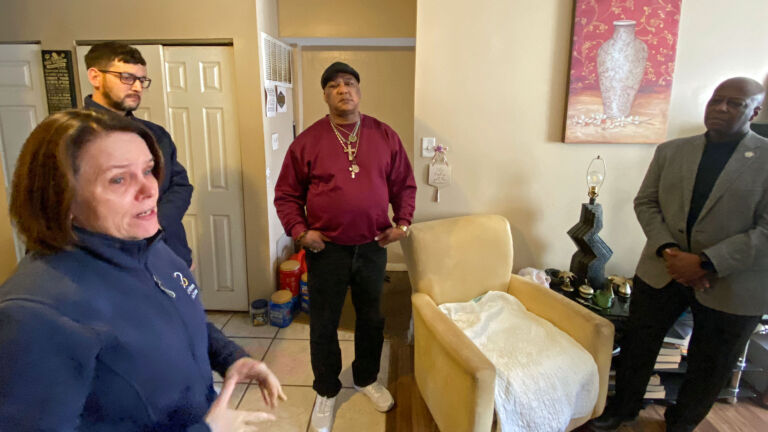
Marcy Thompson of the National Alliance to End Homelessness said in a recent interview with NJ Spotlight News that opposition to housing-first policies started to “ramp up” during Trump’s first term in office.
Over the years, opponents of housing-first have promoted a notion that the approach is enabling because they truly do not understand, or choose not to understand, what housing-first really means, said Thompson, the vice president of programs and policy at the nonprofit.
“That has gained steam, over the last eight years in particular, because it’s an easy thing to point to when we’re seeing the numbers of homeless go up,” said Thompson.
Homelessness in NJ
In New Jersey, the number of people who are homeless is the highest it has been in over a decade, according to the state’s latest annual point-in-time count report. Over 13,700 people were homeless on a single night in late January, which is an 8% increase compared to last year, according to Monarch Housing Associates. The Cranford-based nonprofit conducts the state’s annual homeless count.
In New Jersey, many local governments already have variations of laws that prohibit sleeping in public places.
Taiisa Kelly, the CEO of Monarch Housing, said the language in Trump’s recent executive order is “really pushing” communities toward thinking about “criminalizing” homelessness.
“They’re kind of pitting housing-first as a reason why homelessness is growing. Housing-first is not why homelessness is growing in our communities. It’s because of housing cost and the unaffordability of housing, and the gap between people’s income and their housing cost,” said Kelly.
Supreme Court’s intervention
The U.S. Supreme Court’s 6-3 decision in the City of Grants Pass v. Johnson case last year cleared the way for local governments to enforce bans on homeless people sleeping outside in public places. Since then, around 240 cities across the country have passed anti-camping or anti-sleeping ordinances, according to Rabinowitz. The Cicero Institute wrote an amicus brief in support of Grants Pass in March of last year, before the case was decided by the Supreme Court.
In New Jersey, many local governments already have variations of laws that prohibit sleeping in public places. Recently, Toms River adopted an ordinance that bans people from seeking shelter in the township’s municipal parking garage, while threatening fines and jail time, according to the Asbury Park Press.
Kelly of Monarch Housing noted a correlation between the federal government’s recent actions and efforts by local officials in New Jersey to address homelessness in their towns and cities.
“It is very clear that the direction from the [Trump] administration and the types of things they are supporting are clearly getting to our communities in our state,” said Kelly. “It’s unfortunate because it’s not the answer to this issue.”